
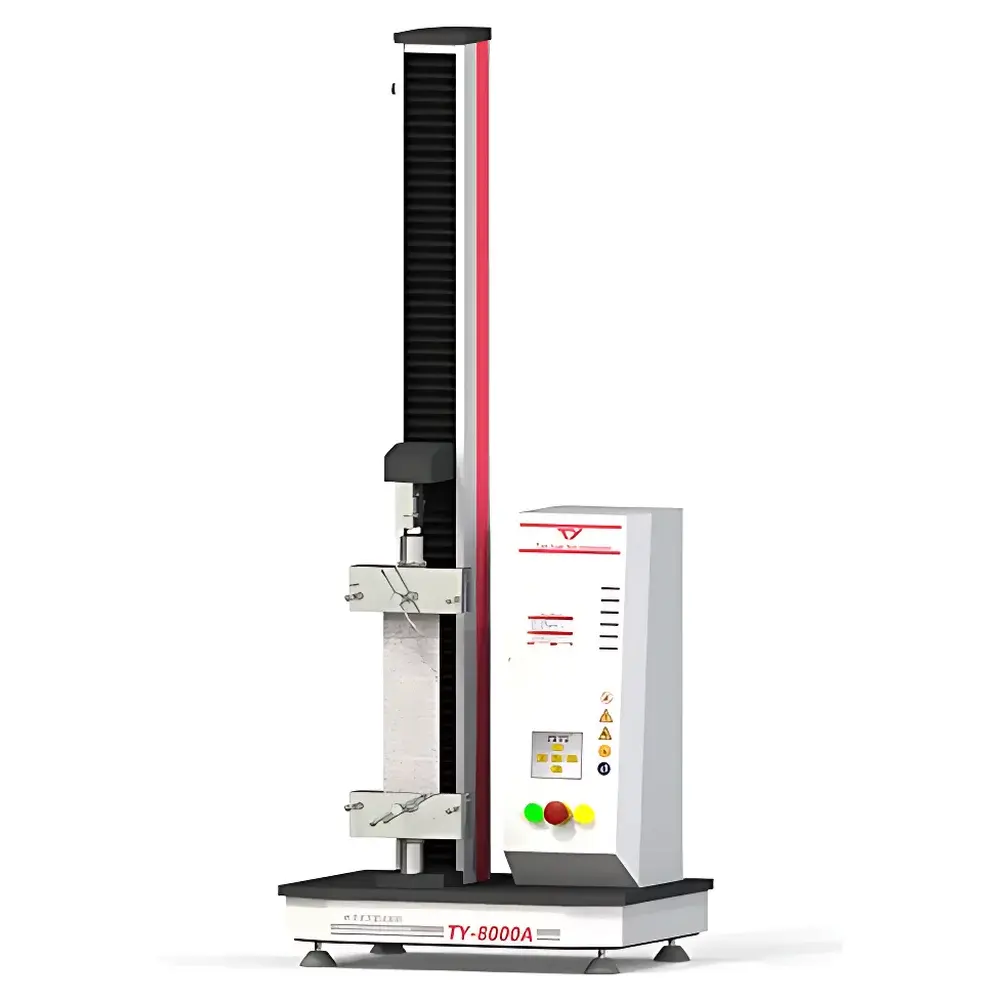
TianYuan TY8000-A1KN Universal Testing Machine
| Brand | TianYuan |
|---|---|
| Origin | Jiangsu, China |
| Manufacturer Type | Direct Manufacturer |
| Country of Origin | China |
| Model | TY8000-A1KN |
| Instrument Type | Electromechanical Universal Testing Machine |
| Load Capacity | 1 kN |
| Accuracy Class | 0.5 |
| Force Resolution | 1/500,000 FS |
| Force Measurement Range | 0.4–100% FS |
| Deformation Measurement Range | 0.2–100% FS |
| Force Control Rate Range | 0.01–5% FS/s |
| Force Control Accuracy | ±1% of set value |
| Deformation Control Rate Range | 0.02–5% FS/s |
| Deformation Control Accuracy | ±1% of set value |
| Constant Load/Deformation/Displacement Control Range | 0.5–100% FS |
| Maximum Travel (excluding grips) | 1000 mm |
| Effective Width | 420 mm |
| Test Speed Range | 0.001–1000 mm/min |
| Speed Accuracy | ≤±0.3% |
| Displacement Resolution | 0.001 mm |
| Dimensions (W×D×H) | 800×500×1600 mm |
| Weight | 260 kg |
| Power Supply | 220 V ±10%, 500 W |
| Compliance | GB/T 2611, GB/T 16491-2008, GB/T 12160, GB/T 16825, ASTM, ISO, DIN, JIS, BS |
Overview
The TianYuan TY8000-A1KN Universal Testing Machine is an electromechanical static testing system engineered for high-precision mechanical property evaluation of metallic, polymeric, composite, and elastomeric materials under tension, compression, bending, and shear loading conditions. It operates on a closed-loop servo-controlled architecture, integrating a high-rigidity frame, precision planetary gear reducer, preloaded ball screw actuation system, and a high-fidelity DSP+MCU dual-core digital control platform. Unlike conventional worm-gear-driven systems—characterized by low transmission efficiency, large backlash, poor positional repeatability, and routine lubrication requirements—the TY8000-A1KN employs a maintenance-free planetary gearbox delivering superior torsional stiffness, sub-arcminute angular repeatability, and extended service life. The system supports real-time dynamic curve visualization at up to 1000 Hz sampling frequency (optional configuration), enabling accurate capture of transient mechanical responses such as yield onset, strain localization, and fracture initiation.
Key Features
- High-accuracy 0.5-class force measurement with 1/500,000 full-scale resolution and verified traceability to national metrological standards
- Dual-channel closed-loop control architecture supporting simultaneous or independent regulation of force, displacement, and strain at rates from 0.01% to 5% FS/s
- Planetary gear reduction system coupled with preloaded ball screw drive ensures minimal axial play (<5 µm), high positioning fidelity, and long-term mechanical stability
- Integrated displacement encoder with 0.001 mm resolution and speed accuracy better than ±0.3% across the full 0.001–1000 mm/min range
- Modular software interface compliant with GLP data integrity principles, supporting audit trail logging, user access levels, and electronic signature capability (21 CFR Part 11 ready)
- Robust structural design with 260 kg mass and reinforced load frame optimized for vibration damping and thermal drift mitigation during extended test cycles
Sample Compatibility & Compliance
The TY8000-A1KN accommodates standard tensile specimens (e.g., ASTM E8/E21, ISO 6892-1), compression cylinders (ASTM C39/C109), flexural beams (ASTM D790/D5045), and custom geometries via interchangeable grip systems—including wedge-action, pneumatic, hydraulic, and specialized fixtures for thin films or brittle ceramics. All calibration and verification procedures adhere to GB/T 16491-2008 (equivalent to ISO 7500-1:2018) and GB/T 16825.1-2008 (ISO 7500-1). System validation includes linearity, hysteresis, zero drift, and repeatability assessments per GB/T 2611 and ASTM E4. Data outputs conform to ISO/IEC 17025 reporting requirements when used in accredited laboratories.
Software & Data Management
The proprietary testing software provides ISO-compliant test method templates for tensile, compression, peel, shear, and cyclic loading protocols. Real-time plotting includes stress–strain, load–displacement, and time-based parameter overlays. Post-test analysis tools support automatic yield point detection (0.2% offset, tangent, or secant methods), modulus calculation (initial, tangent, chord), elongation at break, and fracture energy integration. Export formats include native binary (.tdf), CSV, and Excel (.xlsx); reports may be generated with embedded digital signatures, instrument ID, operator credentials, environmental metadata (temperature/humidity logs if interfaced), and calibration certificate references. Audit trails record all parameter modifications, test start/stop events, and user logins with timestamps.
Applications
This system serves quality control laboratories in automotive component suppliers (e.g., fastener tensile strength, gasket compression set), medical device manufacturers (suture tensile integrity, catheter kink resistance), polymer compounders (PP, PET, TPU mechanical profiling), and academic research groups conducting constitutive modeling of viscoelastic solids. Its wide speed range supports quasi-static characterization (e.g., creep compliance per ASTM D2990) as well as high-rate response studies (up to 1000 mm/min for impact-simulated loading). With optional extensometer integration (per GB/T 12160 Class 1), it meets stringent requirements for modulus determination in ISO 527-2 and ASTM D638 Type I–V specimens.
FAQ
What international standards does the TY8000-A1KN comply with?
It conforms to GB/T 16491-2008 (ISO 7500-1), GB/T 2611, ASTM E4, ASTM E8, ISO 6892-1, ISO 527-2, and supports method development aligned with DIN EN 10002-1, JIS Z2241, and BS EN ISO 6892.
Is the system suitable for fatigue testing?
While primarily designed for static and quasi-static tests, the machine supports programmed cyclic loading (tension–compression, load-controlled) up to 5 Hz with optional high-speed controller firmware; dedicated servo-hydraulic systems are recommended for high-cycle (>10⁵ cycles) fatigue applications.
Can third-party extensometers be integrated?
Yes—standard analog (±10 V) and digital (LVDT, SSI, RS-422) interfaces are provided; compatibility with MTS, Instron, and Zwick extensometers has been validated.
What documentation is supplied for regulatory audits?
Factory calibration certificates (traceable to NIM), installation qualification (IQ), operational qualification (OQ), and software validation summary (including 21 CFR Part 11 assessment) are included with each unit.
Does the system support multi-language UI and report generation?
The software interface and report templates are configurable for English, Chinese, German, French, and Spanish; language selection is enforced at user login level.



