
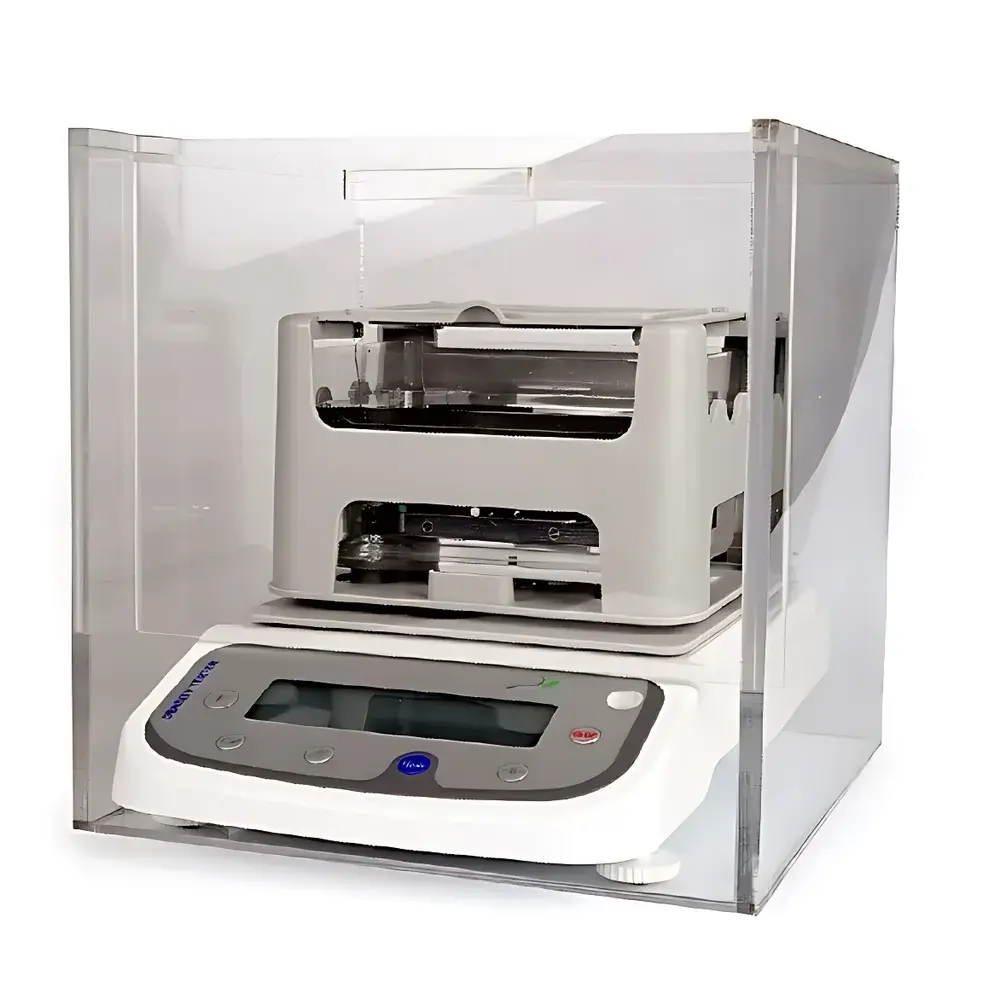
TianYuan TYDX-300 Digital Density Analyzer (Solid & Particle Densitometer)
| Brand | TianYuan |
|---|---|
| Origin | Jiangsu, China |
| Manufacturer Type | Direct Manufacturer |
| Regional Classification | Domestic (China) |
| Model | TYDX-300 |
| Instrument Type | Buoyancy-Based Density Analyzer |
| Form Factor | Benchtop Laboratory Instrument |
| Sample Type | Solids, Granules, Irregular & Floating Objects |
| Density Range | 0.005–300 g/cm³ |
| Density Resolution | 0.001 g/cm³ |
| Density Accuracy | ±0.001 g/cm³ |
| Repeatability | ±0.001 g/cm³ |
| Temperature Range | 0.0–40.0 °C |
| Minimum Sample Mass | 0.005 g |
| Water Bath Dimensions | 165 × 115 × 85 mm |
| Overall Dimensions (L×W×H) | 270 × 270 × 270 mm |
| Net Weight | 4.5 kg |
| Power Supply | AC 220 V / 50 Hz |
| Interface | RS-232 Serial Port |
| Compliance Standards | ASTM D792, ASTM D297, ISO 1183, ISO 2781, GB/T 1033, GB/T 2951, GB/T 3850, GB/T 533, JIS K6268, HG4-1468 |
Overview
The TianYuan TYDX-300 Digital Density Analyzer is a precision benchtop instrument engineered for rapid, high-reproducibility density determination of solid materials—including irregularly shaped parts, granular powders, porous foams, and low-density floating specimens—using the Archimedean buoyancy principle. It operates in accordance with internationally recognized standards for solid density measurement, including ASTM D792 (Standard Test Methods for Density and Specific Gravity of Plastics by Displacement), ASTM D297 (Rubber Products—Chemical Analysis), ISO 1183 (Plastics—Methods for Determining the Density of Non-Cellular Plastics), and ISO 2781 (Rubber—Determination of Density). The system employs dual-mass measurement: first acquiring the sample’s weight in air, then its apparent weight when fully submerged in a temperature-controlled liquid medium (typically distilled water or ethanol). From these two values—and with user-defined temperature and medium-specific gravity compensation—the instrument computes true density (g/cm³), specific gravity (dimensionless), and volume (cm³) without manual calculation.
Key Features
- High-resolution density measurement with ±0.001 g/cm³ accuracy and repeatability, validated across repeated cycles on certified reference materials.
- Integrated temperature-compensation function enabling real-time correction for thermal expansion of both sample and immersion medium within 0.0–40.0 °C operational range.
- Corrosion-resistant, one-piece molded transparent acrylic water bath (165 × 115 × 85 mm) for unobstructed visual monitoring of sample submersion and bubble detection.
- 0.5 mm diameter stainless steel suspension wire—rigid, non-deforming, and orthogonal to the weighing pan—to minimize parasitic buoyancy error from filament displacement.
- Dual-mode operation supporting both sinking and floating sample protocols via interchangeable accessories: standard immersion basket for dense solids and auxiliary float-support cradle for buoyant materials (e.g., EVA foam, polyolefin pellets).
- Ceramic load cell with gold-plated strain gauge architecture, delivering long-term stability, low drift (<0.002 g/24 h), and resistance to chemical exposure during routine cleaning or solvent-based measurements.
- RS-232 serial interface compliant with standard ASCII protocol, enabling direct integration into laboratory data acquisition systems, LIMS, or automated QA/QC workflows.
Sample Compatibility & Compliance
The TYDX-300 accommodates a broad spectrum of industrial and research-grade solid samples: metallic alloys (Al, Cu, Zn die-castings), sintered powder metallurgy compacts, ceramic green bodies and fired monoliths, refractory bricks, magnetic ferrites, rubber compounds, thermoplastic granules (PVC, PP, PE), elastomeric foams (EVA, PU), mineral aggregates, gemstone roughs, and cementitious composites. Its design satisfies traceability requirements under GLP and GMP environments through stable calibration routines, documented zero-tracking procedures, and audit-ready measurement logs (when paired with compliant software). All mechanical and electrical components meet IEC 61010-1 safety specifications for laboratory equipment. Calibration verification is supported using NIST-traceable stainless steel and fused quartz density standards.
Software & Data Management
While the TYDX-300 operates autonomously via front-panel controls, its RS-232 port supports bidirectional communication with third-party data logging applications or custom scripts (Python, LabVIEW, MATLAB). Output format includes ASCII-delimited fields: timestamp, air weight (g), immersed weight (g), calculated density (g/cm³), specific gravity, volume (cm³), temperature (°C), and operator ID (if pre-configured). Optional PC software—available upon request—enables batch reporting, statistical process control (SPC) charting (X̄–R, Cpk), export to CSV/Excel, and PDF certificate generation compliant with ISO/IEC 17025 documentation frameworks. Audit trail functionality records all parameter changes, calibration events, and measurement initiations with time-stamped user attribution.
Applications
This analyzer serves critical functions across R&D, production QC, and regulatory compliance labs. In polymer formulation labs, it quantifies filler loading efficiency and detects void content in composite pellets. In metal recycling facilities, it distinguishes alloy grades (e.g., 304 vs. 316 stainless) based on density differentials <0.02 g/cm³. Ceramic engineers use it to monitor green-body density evolution during drying and sintering cycles. Wire & cable manufacturers verify insulation compound homogeneity prior to extrusion. Jewelry appraisers perform non-destructive authenticity screening of precious stones and mounted settings. Additionally, it supports ASTM-compliant quality release testing for ASTM F2129 (corrosion testing of surgical implants) where substrate density correlates with microstructural integrity.
FAQ
What standards does the TYDX-300 comply with?
ASTM D792, ASTM D297, ISO 1183, ISO 2781, GB/T 1033, GB/T 2951, JIS K6268, and HG4-1468.
Can it measure porous or absorbent materials?
Yes—when used with vacuum impregnation accessories (sold separately) and surface-sealing protocols per ASTM D6223.
Is temperature control built-in?
No internal thermostat; however, external water baths or Peltier-cooled immersion media can be integrated via user-defined temperature input.
How is calibration performed?
Two-point calibration using certified weights (e.g., 10 g and 100 g stainless steel) and a density standard (e.g., borosilicate glass, ρ = 2.23 g/cm³) at reference temperature.
Does it support GLP/GMP documentation?
Yes—when connected to compliant software, it provides electronic signatures, change logs, and 21 CFR Part 11–ready audit trails.



