
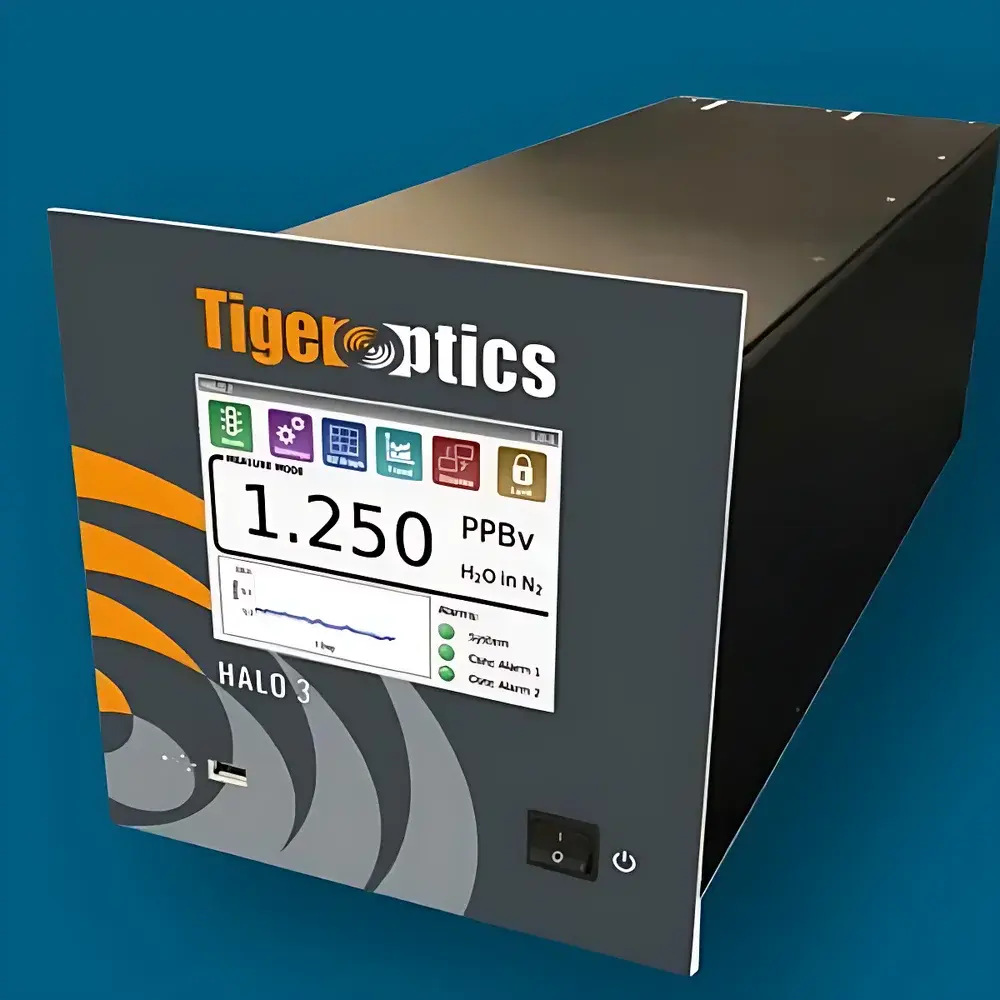
Tiger Optics CRDS Cavity Ring-Down Spectroscopy Gas Analyzer
| Brand | Tiger Optics |
|---|---|
| Model | CRDS Series |
| Technology | Cavity Ring-Down Spectroscopy (CRDS) |
| Detection Principle | Time-resolved optical cavity decay measurement |
| Target Analytes | H₂O, CO₂, CH₄, C₂H₂, H₂, and other trace gases |
| Sensitivity | Sub-part-per-trillion (sub-ppt) level |
| Measurement Speed | Real-time, <1 s response time |
| Optical Cavity | Ultra-high-reflectivity mirrors (R > 99.999%) |
| Laser Source | Tunable near-IR diode lasers |
| Compliance | Designed for ISO/IEC 17025-compliant labs, compatible with FDA 21 CFR Part 11 data integrity requirements |
| Maintenance | Zero consumables, no zero/span gases, no carrier gas required |
| Architecture | Solid-state, no moving parts |
| Interface | Ethernet, RS-232, analog outputs (4–20 mA) |
| Environmental Rating | Industrial-grade enclosure (IP54) |
Overview
The Tiger Optics CRDS Cavity Ring-Down Spectroscopy Gas Analyzer is a high-precision, laboratory- and process-grade instrument engineered for quantitative, real-time detection of trace and ultra-trace gas species in complex matrices. It employs cavity ring-down spectroscopy (CRDS), a laser-based absorption technique that measures the exponential decay rate of light intensity within an optical resonant cavity formed by two ultra-high-reflectivity mirrors (R > 99.999%). Unlike conventional absorption spectroscopy, CRDS does not rely on absolute intensity calibration; instead, it quantifies gas concentration via the cavity’s effective decay time (τ), which is inversely proportional to total optical loss—including molecular absorption at specific wavelengths. This fundamental principle delivers exceptional sensitivity (sub-ppt detection limits), long-term stability, and immunity to laser power fluctuations—making CRDS inherently self-calibrating and highly reproducible across extended operational periods.
Key Features
- True zero-consumables operation: No zero gas, span gas, carrier gas, or optical filters required—eliminating ongoing calibration drift and supply chain dependencies.
- Passive optical architecture: No moving parts, no choppers, no modulators—ensuring mechanical robustness and minimal downtime in 24/7 industrial environments.
- Sub-second response time: Enables closed-loop process control in semiconductor fab ambient monitoring, specialty gas purity verification, and cleanroom airborne molecular contaminant (AMC) surveillance.
- Multi-species capability: Simultaneous or sequential analysis of H₂O, CO₂, CH₄, C₂H₂, H₂, NH₃, HF, and other IR-active gases through wavelength-tunable laser sources.
- Factory-aligned optical cavity: Pre-aligned, thermally stabilized cavity assembly minimizes field service requirements and supports plug-and-play deployment.
- Industrial I/O suite: Standard 4–20 mA analog outputs, digital Ethernet (TCP/IP), and RS-232 interface for integration into SCADA, DCS, and LIMS platforms.
Sample Compatibility & Compliance
The analyzer accepts gaseous samples at ambient or controlled pressure (typically 100–1000 mbar) and temperature (15–35 °C). Sample introduction is via stainless-steel or electropolished tubing with Swagelok or VCR fittings; heated sample lines are optional for condensable analytes. The system complies with key regulatory frameworks governing analytical instrumentation in regulated industries: it supports audit-trail-enabled data logging per FDA 21 CFR Part 11 requirements when paired with compliant software; its measurement uncertainty budget aligns with ISO/IEC 17025 method validation expectations; and its design adheres to GLP/GMP environmental monitoring guidance for semiconductor and pharmaceutical cleanrooms (e.g., ISO 14644-8 Annex B). No internal wet chemistry or reactive reagents are used—ensuring non-destructive, non-invasive analysis suitable for Grade A/B cleanroom applications.
Software & Data Management
The instrument is operated via Tiger Optics’ proprietary CRDS Control Suite—a Windows-based application supporting real-time spectral visualization, multi-channel concentration trending, alarm configuration (high/low, rate-of-change), and automated report generation (PDF/CSV). All raw decay time data, timestamped spectra, and system diagnostics are stored locally with configurable retention policies. The software implements role-based user access control (administrator/operator/viewer), electronic signatures for critical actions, and tamper-evident audit logs—fully satisfying ALCOA+ (Attributable, Legible, Contemporaneous, Original, Accurate, Complete, Consistent, Enduring, Available) data integrity criteria. Optional OPC UA and Modbus TCP drivers enable seamless interoperability with enterprise MES and analytics platforms.
Applications
- Semiconductor manufacturing: Real-time monitoring of H₂O and O₂ impurities in bulk electronic-grade gases (e.g., N₂, Ar, He) and tool-side purge streams.
- Specialty gas certification: Purity verification of cylinder-filling gases per SEMI F63 and ISO 8573-8 standards.
- Cleanroom AMC monitoring: Detection of base-neutral-acid (BNA) contaminants including NH₃, HF, and organic acids at pptv levels.
- Environmental research: Isotopic ratio measurements (e.g., δ¹³C in CH₄) using dual-laser CRDS configurations.
- Hydrogen economy infrastructure: Leak detection and purity assurance for green H₂ distribution systems (IEC 62282-3 compliance support).
- Pharmaceutical manufacturing: Monitoring of residual solvents and reactive impurities in lyophilization chambers and inerting lines.
FAQ
How does CRDS differ from traditional TDLAS or FTIR gas analyzers?
CRDS provides significantly higher effective pathlength (>20 km equivalent) without physical alignment complexity, enabling superior sensitivity and reduced interference from broadband background absorption.
Is routine calibration required?
No—CRDS is intrinsically referenced to the cavity decay time constant, eliminating the need for periodic zero/span calibration. Annual performance verification against NIST-traceable standards is recommended for ISO 17025 compliance.
Can the analyzer be integrated into an existing factory automation system?
Yes—native Ethernet/IP and Modbus TCP support enables direct connection to PLCs, DCS, and cloud-based IIoT platforms without middleware.
What maintenance is required over a 5-year operational life?
Only periodic inlet filter replacement and annual mirror reflectivity verification—no optical realignment, laser replacement, or detector recalibration is necessary under normal operating conditions.
Does the system meet cleanroom compatibility requirements?
Yes—the analyzer meets ISO 14644-1 Class 5 particulate emission limits when installed with appropriate venting and grounding; optional HEPA-filtered purge air kit available for Class 1 environments.




