
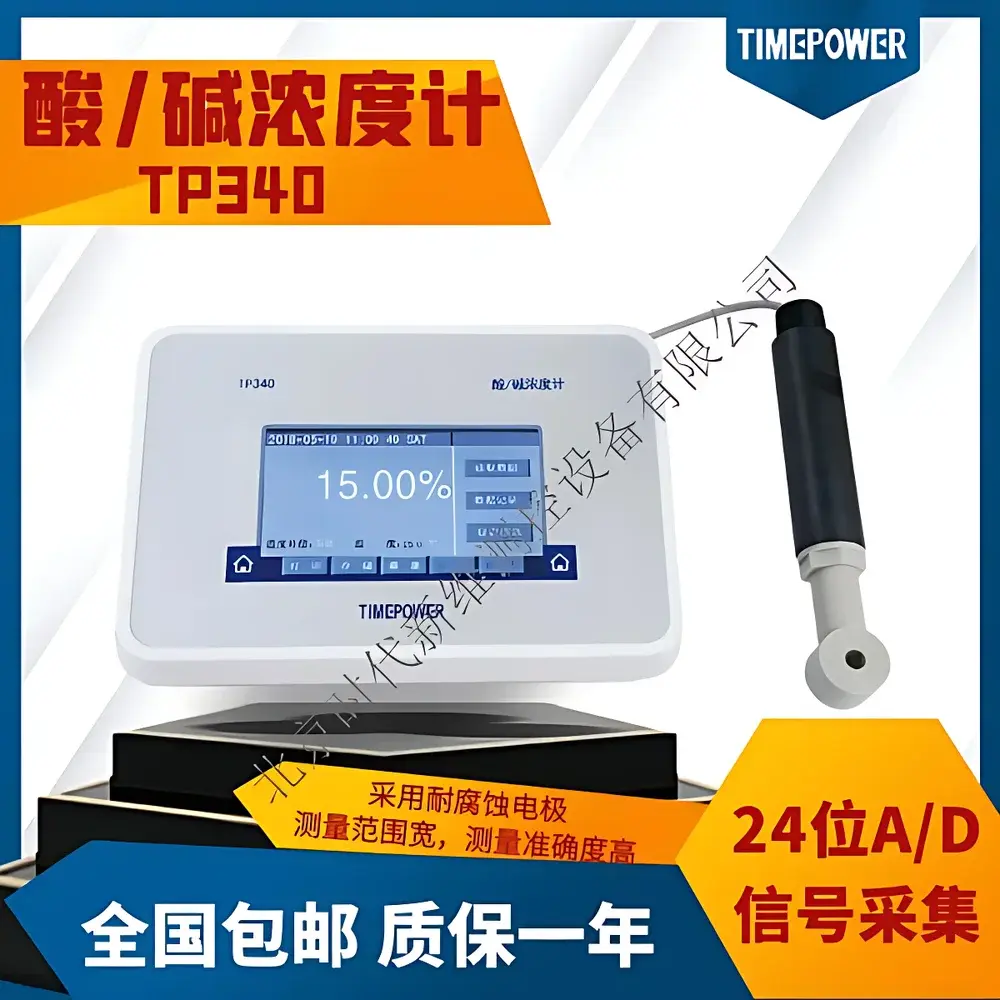
TimePower TP-140/340 Non-Contact Inductive Conductivity-Based Acid-Base Concentration Meter
| Brand | TimePower |
|---|---|
| Origin | Beijing, China |
| Manufacturer Type | Direct Manufacturer |
| Model | TP-140/340 |
| Measurement Principle | Inductive (Toroidal) Conductivity Transduction |
| Display | 128×64 Dot-Matrix LCD (Chinese Interface) |
| Measurands & Ranges | HCl (0–10.00%), NaOH (0–10.00%), H₂SO₄ (0–20.00%), NaCl (0–20.00%), HNO₃ (0–15.00%), Na₂CO₃ (0–10.00%) — Customizable |
| Accuracy | ±2% FS |
| Resolution | 0.01% |
| Repeatability | ≤1% |
| Drift | ±1% FS / 4 h |
| Sample Temp. | 5–50 °C |
| Ambient Temp. | 5–45 °C |
| Humidity | ≤85% RH (non-condensing) |
| Power | AC 85–265 V, 45–65 Hz |
| Power Consumption | ≤5 W |
| Dimensions | 200 × 200 × 85 mm |
| Weight | 2.1 kg |
Overview
The TimePower TP-140/340 is a laboratory-grade, non-contact inductive acid-base concentration meter engineered for continuous or batch monitoring of strong electrolyte solutions in industrial process and quality control environments. Unlike traditional electrode-based potentiometric or galvanic sensors, this instrument employs a toroidal (two-coil, send/receive) inductive conductivity transduction principle: an excitation current in the transmitter coil induces eddy currents in the conductive solution, which are proportionally detected by the isolated receiver coil. Because the sensor probe is fully encapsulated and physically separated from the process medium—no direct electrode contact—the system eliminates polarization, fouling, corrosion, and drift associated with wetted electrodes. This architecture delivers stable, maintenance-free operation in aggressive chemical environments, including concentrated mineral acids and caustic alkalis. The instrument calculates concentration values in real time by applying pre-calibrated, solution-specific conductivity-to-concentration algorithms stored in firmware. It is not a general-purpose pH or ion-selective device; rather, it is purpose-built for quantitative analysis of known strong electrolytes where conductivity correlates linearly or predictably with molar or mass concentration.
Key Features
- Non-contact toroidal conductivity sensing: Fully isolated probe design ensures zero chemical interaction, enabling long-term stability in corrosive media such as HCl, H₂SO₄, NaOH, and HNO₃.
- Dual-range programmable calibration: Supports up to six pre-configured analytes (HCl, NaOH, H₂SO₄, NaCl, HNO₃, Na₂CO₃) with user-definable upper limits and custom calibration curves.
- High-resolution digital display: 128×64 dot-matrix LCD with Chinese-language interface for intuitive local operation and parameter navigation.
- Robust industrial enclosure: IP65-rated front panel, compact footprint (200 × 200 × 85 mm), and low power consumption (<5 W) suitable for benchtop or panel-mount deployment.
- Thermal compensation: Integrated temperature sensor (5–50 °C sample range) enables automatic conductivity correction using standard polynomial algorithms per IEC 60788.
- Stable metrological performance: ±2% full-scale accuracy, 0.01% resolution, ≤1% repeatability, and <±1% FS drift over 4 hours under controlled conditions.
Sample Compatibility & Compliance
The TP-140/340 is validated for use with homogeneous aqueous solutions of strong electrolytes where ionic strength dominates conductivity behavior. It is routinely deployed in power plant demineralization systems (e.g., monitoring HCl/NaOH regenerant strength for ion exchange resins), chemical manufacturing (acid/alkali feedstock verification), metallurgical leaching circuits, and pharmaceutical intermediate synthesis steps requiring precise stoichiometric dosing. While not certified to ISO/IEC 17025 for accredited testing, its measurement traceability aligns with ASTM D1125 (Standard Test Methods for Electrical Conductivity and Resistivity of Water) and supports GLP documentation workflows when paired with external data loggers. The instrument meets CE electromagnetic compatibility (EMC) requirements per EN 61326-1 and safety standards per EN 61010-1 for laboratory electrical equipment.
Software & Data Management
The TP-140/340 operates as a standalone embedded system with no proprietary PC software or cloud connectivity. All configuration—including range selection, unit definition, temperature coefficient adjustment, and calibration point entry—is performed locally via membrane keypad and on-screen prompts. Calibration is two-point (zero and span) using NIST-traceable standard solutions. Though the device lacks USB, RS-232, or 4–20 mA analog output as standard, optional hardware modules (available upon request) support 4–20 mA current loop transmission for integration into DCS or SCADA systems. Audit-ready calibration records must be manually logged per facility SOPs; the instrument does not implement FDA 21 CFR Part 11 electronic signature or audit trail functionality.
Applications
- Power generation: Real-time verification of regeneration acid (HCl/H₂SO₄) and caustic (NaOH) concentrations prior to resin bed treatment.
- Chemical process control: In-line validation of reactor feedstock strength during neutralization, hydrolysis, or precipitation steps.
- Pharmaceutical water systems: Monitoring of sanitizing agent (e.g., NaOH) concentration in clean-in-place (CIP) cycles per USP .
- Electroplating and metal finishing: Control of acid pickling bath strength (HCl, H₂SO₄) to ensure consistent surface activation.
- Food ingredient preparation: Verification of food-grade acidulant (e.g., citric, phosphoric) or buffering salt (e.g., Na₂CO₃) concentrations in batch formulation.
FAQ
Does the TP-140/340 measure pH or individual ion activity?
No. It measures bulk solution conductivity and infers concentration for pre-defined strong electrolytes using fixed calibration models. It cannot determine pH, redox potential, or speciate weak acids/bases.
Can the sensor be immersed directly in hot or viscous solutions?
The probe is rated for continuous immersion at temperatures up to 50 °C. Viscosity >50 cP may attenuate eddy current coupling; validation with representative process fluids is recommended.
Is calibration required before each use?
Initial two-point calibration is mandatory after installation or range change. Daily verification with a single standard is advised for regulated environments; full recalibration is required if drift exceeds ±1% FS.
What maintenance does the inductive sensor require?
None beyond periodic visual inspection for coating or mechanical damage. Since there are no exposed electrodes or membranes, cleaning with deionized water or mild detergent suffices.
Can the instrument be used for seawater or brine concentration monitoring?
Yes—NaCl is a supported analyte with a 0–20.00% range. For high-salinity applications (>15%), verify linearity empirically due to conductivity saturation effects.





