
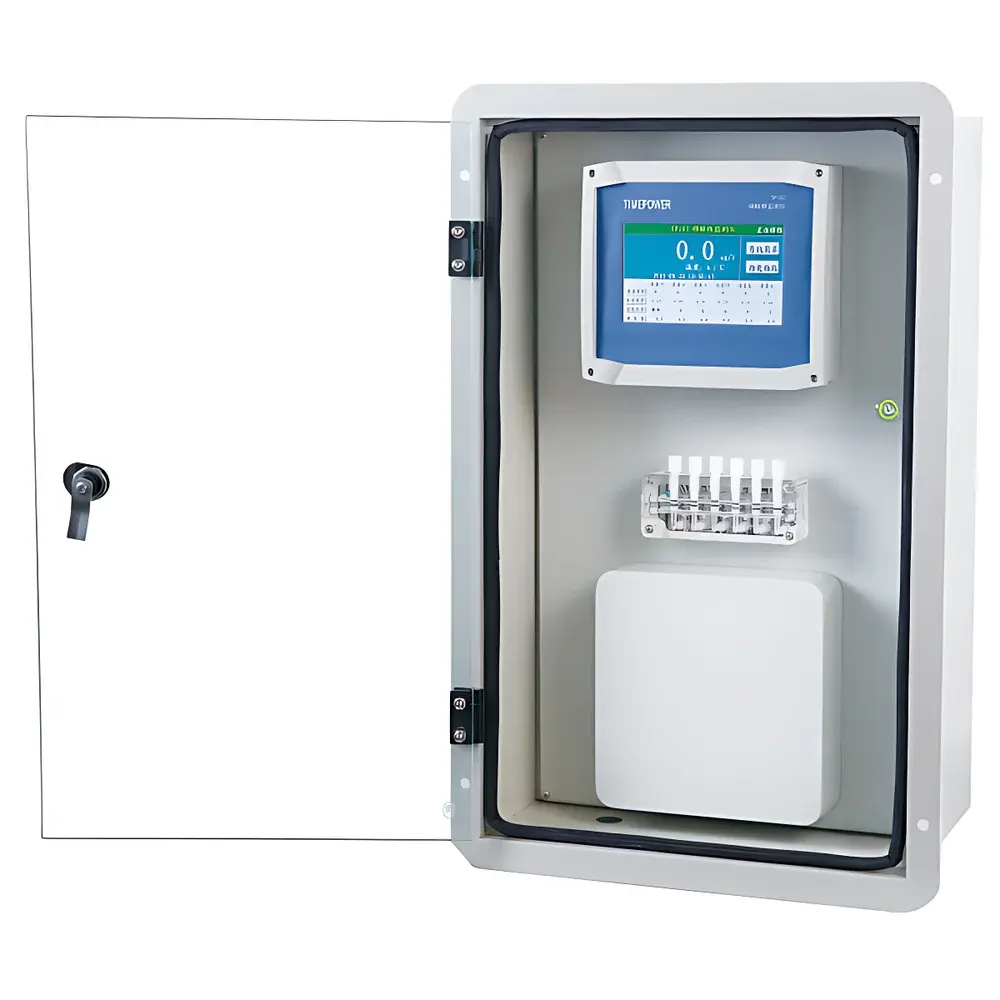

Timepower TP107 Online Phosphate Analyzer
| Brand | Timepower |
|---|---|
| Origin | Beijing, China |
| Manufacturer Type | Manufacturer |
| Country of Origin | Domestic (China) |
| Model | TP107 |
| Instrument Type | Online Analyzer |
| Pricing | Upon Request |
Overview
The Timepower TP107 Online Phosphate Analyzer is a dedicated photometric instrument engineered for continuous, real-time quantification of orthophosphate (PO₄³⁻) in aqueous process streams. It operates on the phosphovanadomolybdate colorimetric method—where phosphate ions react with ammonium metavanadate and ammonium molybdate under acidic conditions to form a stable yellow-colored heteropoly acid complex (phosphovanadomolybdic acid). Absorbance of this complex is measured at a fixed wavelength (typically ~400–450 nm) using a monochromatic cold light source. Quantification follows the Lambert-Beer law, establishing a linear relationship between absorbance and phosphate concentration within the calibrated range. Designed for industrial water quality management, the TP107 meets the analytical requirements of GB/T 6913–2008 (“Methods for analysis of boiler water and cooling water — Determination of phosphate”), making it suitable for applications where regulatory compliance, operational continuity, and long-term measurement stability are critical.
Key Features
- Multi-channel configuration: Supports 1–6 independent measurement channels in a single enclosure, enabling cost-effective monitoring of multiple sampling points without redundant hardware.
- High-reliability fluidics: Utilizes imported high-precision solenoid valves with extended service life, ensuring repeatable reagent dosing, accurate sample aspiration, and minimal carryover between cycles.
- Automated calibration protocol: Executes user-defined two-point standard calibration at scheduled intervals (e.g., daily or per shift), maintaining traceable accuracy and reducing manual intervention.
- Persistent data storage: Retains up to 30 days of timestamped measurement records (including raw absorbance, calculated concentration, calibration logs, and alarm events) with local non-volatile memory.
- Stable optical architecture: Features a solid-state monochromatic cold light source with low thermal drift and >10,000-hour operational lifetime, minimizing photometric baseline variation.
- Flexible analog output: Provides isolated 4–20 mA, 0–20 mA, or 0–10 mA current outputs per channel—configurable via touchscreen interface for integration with DCS, PLC, or automated chemical dosing systems.
- Human-centric interface: 7-inch color TFT LCD touchscreen with Chinese-language UI; supports simultaneous display of real-time trends and historical curves across all active channels using distinct color coding.
- Modular mechanical design: Panel-mount (cutout installation) chassis with standardized dimensions (460 × 280 × 720 mm), facilitating retrofit into existing control rooms or analyzer shelters.
Sample Compatibility & Compliance
The TP107 is validated for use with clarified, low-turbidity aqueous samples meeting the following specifications: flow rate 10–40 L/h; temperature 5–50 °C; suspended solids <5 µm in diameter; absence of colloidal or viscous organic matter that may foul reaction coils or optical windows. It complies with GB/T 6913–2008 for phosphate determination in boiler feedwater and recirculating cooling water systems. While not certified to ISO/IEC 17025 or ASTM D859, its measurement methodology aligns with established spectrophotometric principles referenced in ISO 6878 and EPA Method 365.3. The system supports GLP-aligned operation through audit-trail-capable event logging (calibration, alarm, maintenance), though native 21 CFR Part 11 compliance requires external data acquisition software.
Software & Data Management
Instrument control, calibration management, and data visualization are handled locally via an embedded Linux-based firmware platform. All operational parameters—including measurement range (0.00–20.00 mg/L or 0.00–50.00 mg/L PO₄), cycle timing, alarm thresholds, and output scaling—are configurable through the touchscreen GUI. Historical data can be exported via USB port in CSV format for offline review or LIMS integration. The system supports time-synchronized logging with internal RTC (real-time clock) and allows manual annotation of maintenance actions. No cloud connectivity or remote access capability is included by default; network-enabled variants require optional Ethernet module and third-party SCADA middleware.
Applications
The TP107 serves as a core monitoring solution in industries where phosphate control directly impacts equipment integrity and regulatory discharge limits. Primary deployment contexts include: steam generation circuits in thermal power plants (to prevent scale formation in boilers and turbines); closed-loop cooling water systems in petrochemical and fertilizer facilities (for corrosion inhibitor dosing feedback); effluent monitoring at municipal wastewater treatment plants (compliance with phosphorus discharge permits); and purified water loops in pharmaceutical manufacturing (supporting USP water quality expectations). Its robustness against moderate ambient humidity (≤90% RH) and operating temperature range (5–45 °C) also supports outdoor shelter or skid-mounted installations.
FAQ
What is the minimum detectable phosphate concentration?
The lower limit of quantitation (LLOQ) is determined by the selected measurement range and noise characteristics of the photometric system. For the 0.00–20.00 mg/L range, typical LLOQ is ≤0.1 mg/L PO₄, subject to reagent purity and sample filtration.
How often must reagents be replaced?
At nominal operating conditions (one channel, 3-minute cycle), reagent consumption averages ~3 L/month. Frequency scales linearly with number of active channels and cycle rate.
Can the TP107 measure total phosphorus?
No. The TP107 measures only orthophosphate (reactive phosphorus) via direct colorimetry. Total phosphorus determination requires prior digestion (e.g., persulfate oxidation), which is outside the scope of this analyzer’s design.
Is field calibration possible without lab standards?
Yes—two-point calibration uses user-supplied certified phosphate standards (e.g., 1 mg/mL stock, diluted on-site). The instrument does not require factory-certified reference materials, but traceability to NIST or equivalent primary standards is recommended for regulated environments.
What maintenance tasks are required monthly?
Routine tasks include visual inspection of tubing and fittings, cleaning of optical windows with lint-free tissue and isopropanol, verification of filter integrity, and confirmation of waste line drainage. Valve actuation tests and blank absorbance checks are advised weekly.







