
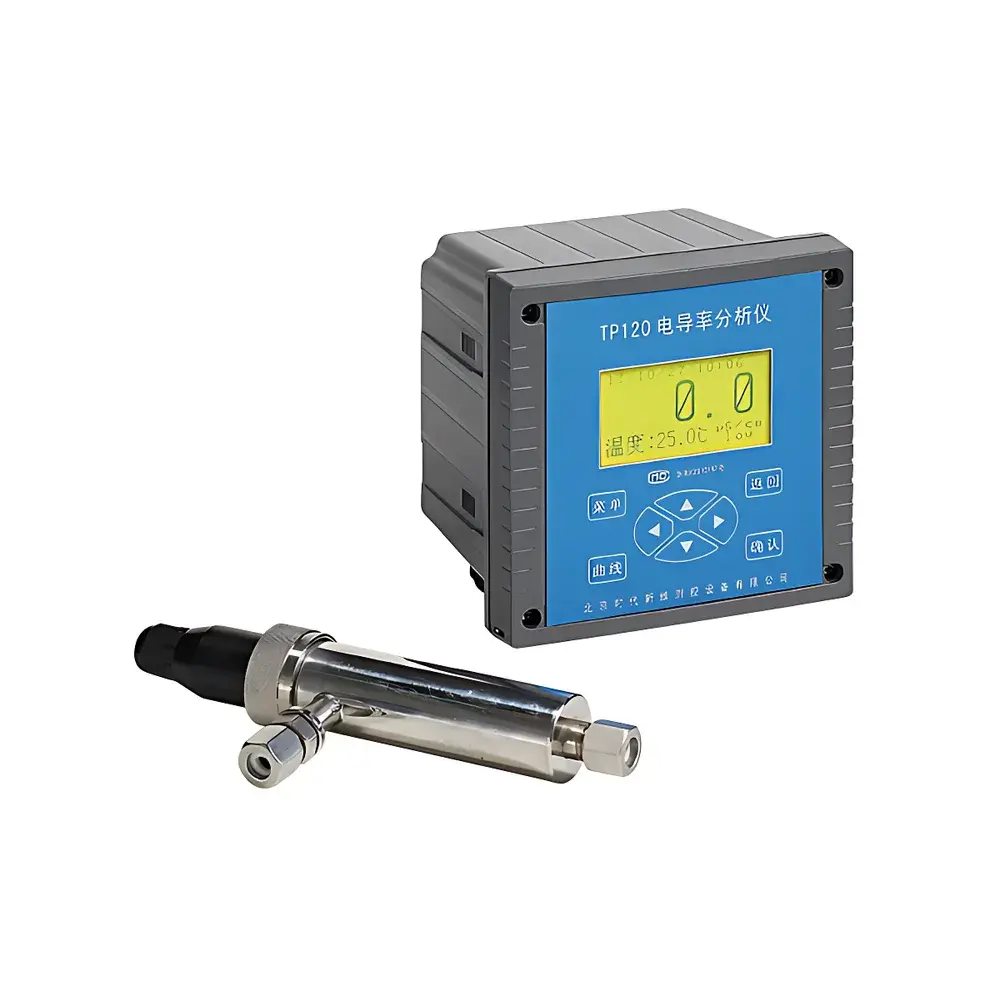
TimePower TP120 Online Conductivity Analyzer for Power Plant Applications
| Brand | TimePower |
|---|---|
| Origin | Beijing, China |
| Manufacturer Type | Manufacturer |
| Country of Origin | Domestic (China) |
| Model | TP120 |
| Detection Parameters | Multi-parameter |
| Portability | Portable |
| Conductivity Range | 0–1000 µS/cm (with selectable cell constants: K=0.01, 0.1, 1.0, 10.0 cm⁻¹) |
| TDS Range | 0–500 ppm (calculated) |
| Resistivity Range | 0.001–1000 MΩ·cm |
| Salinity Range | 0–35 ppt (NaCl equivalent) |
| Temperature Range | 5–60 °C |
| Accuracy | ±2.5% FS |
| Minimum Resolution | 0.001 µS/cm |
| Repeatability | ≤1% FS |
| Temperature Sensor | Pt1000 |
| Temp. Compensation Range | 0–60 °C |
| IP Rating | IP65 |
| Output Signals | 4–20 mA (isolated, load <300 Ω), 0–10 mA, 0–20 mA |
| Relay Outputs | 2 SPST, AC 220 V / 3 A or DC 30 V / 3 A |
| Power Supply | AC 85–265 V, 45–65 Hz |
| Power Consumption | ≤15 W |
| Dimensions | 145 × 120 × 150 mm |
| Panel Cutout | 138 × 138 mm |
| Weight | 0.64 kg |
| Display | 128×64 dot-matrix LCD, Chinese interface |
| Data Storage | Cyclic memory with >10-year data retention upon power loss |
| Operating Humidity | ≤90% RH (non-condensing) |
| Storage Temperature | −25 to +55 °C |
| Sample Pressure Limit | <0.6 MPa |
Overview
The TimePower TP120 Online Conductivity Analyzer is an industrial-grade electrochemical instrument engineered for continuous, real-time monitoring of electrical conductivity in aqueous process streams across power generation, chemical processing, water treatment, and pharmaceutical manufacturing environments. It operates on the fundamental principle of two-electrode (or four-electrode) conductometric measurement: a known alternating current (1–3 kHz sinusoidal excitation) is applied across a pair of electrodes with a fixed geometric cell constant (K), and the resulting current is measured to determine solution conductance. This value—corrected for temperature using a built-in Pt1000 sensor and standardized to 25 °C—is converted into conductivity (µS/cm), resistivity (MΩ·cm), TDS (ppm), or salinity (ppt) via configurable algorithms compliant with ASTM D1125 and ISO 7888 standards. Designed specifically for utility boiler feedwater, condensate, and demineralized water loops, the TP120 delivers stable, drift-free performance under fluctuating thermal and hydraulic conditions typical of fossil-fueled and nuclear power plants.
Key Features
- Multi-range conductivity measurement supported by interchangeable electrode cell constants (K = 0.01, 0.1, 1.0, and 10.0 cm⁻¹), enabling accurate quantification from ultra-pure water (30,000 µS/cm).
- High-precision analog front-end with 24-bit A/D conversion and embedded microcontroller-based signal processing, ensuring repeatability ≤1% FS and long-term stability without manual recalibration.
- Optically isolated 4–20 mA current output (selectable 0–10 mA or 0–20 mA), compliant with IEC 61000-4 electromagnetic compatibility (EMC) requirements, suitable for integration into DCS/PLC systems up to 300 m cable distance.
- Two programmable relay outputs (SPST, rated AC 220 V / 3 A or DC 30 V / 3 A), configurable for high/low alarm thresholds, pump control, or sample diversion—fully customizable via on-device menu navigation.
- Robust IP65-rated NEMA-type enclosure with polycarbonate front panel and stainless-steel mounting hardware, certified for outdoor installation in humid, dusty, or chemically aggressive ambient conditions.
- Non-volatile cyclic memory retains >10 years of timestamped conductivity, temperature, and alarm event logs—even during extended power interruption—supporting root-cause analysis and regulatory audit trails.
Sample Compatibility & Compliance
The TP120 accommodates a broad spectrum of aqueous matrices, including deionized water, steam condensate, cooling tower makeup, flue gas desulfurization (FGD) scrubber liquor, and pharmaceutical purified water (PW). Its modular electrode interface supports standard DIN 19266-compliant fittings and optional flow-through cells for pressurized line monitoring (<0.6 MPa). The analyzer conforms to key industry safety and quality frameworks: CE marking per EMC Directive 2014/30/EU; RoHS 2011/65/EU compliance; and design alignment with USP , EP 2.2.38, and ASTM D5391 for conductivity verification in GMP-regulated water systems. While not inherently 21 CFR Part 11 compliant, its deterministic logging architecture enables validation-ready deployment when paired with time-stamped, user-access-controlled SCADA or LIMS interfaces.
Software & Data Management
Operation is managed exclusively via the integrated 128×64 monochrome LCD with intuitive Chinese-language menu navigation—no external PC required for setup or routine operation. All configuration parameters—including temperature compensation curve (linear or non-linear), alarm hysteresis, output scaling, and electrode calibration coefficients—are stored in EEPROM with password-protected access levels. Data export is achieved through serial RS-485 (Modbus RTU protocol) for integration into centralized asset monitoring platforms. Although no proprietary PC software is bundled, the device supports third-party SCADA drivers and OPC UA gateways for enterprise-level data aggregation, trending, and automated report generation aligned with ISO 9001 and ISO 14001 documentation requirements.
Applications
- Power Generation: Continuous monitoring of turbine condensate purity, feedwater conductivity deviation detection, and demineralizer effluent verification per ASME PTC 19.11 guidelines.
- Chemical & Petrochemical: Real-time tracking of acid/base concentration in neutralization reactors, rinse water quality in electroplating lines, and leak detection in heat exchanger cooling circuits.
- Pharmaceutical Water Systems: Validation-supporting conductivity surveillance in PW and WFI distribution loops, meeting pharmacopeial limits for Stage 1–3 conductivity testing.
- Municipal & Industrial Wastewater: Effluent compliance monitoring against local discharge permits (e.g., EPA NPDES), especially for chloride or sulfate-laden influents.
- Food & Beverage: Sanitary rinse cycle verification, CIP solution concentration control, and post-sterilization water quality assurance.
FAQ
What electrode constant should I select for ultrapure water applications?
For conductivity values below 1 µS/cm (e.g., boiler feedwater or WFI), use the K = 0.01 cm⁻¹ electrode with sealed flow cell to minimize atmospheric CO₂ interference and ensure measurement integrity.
Does the TP120 support automatic temperature compensation?
Yes—integrated Pt1000 sensing provides real-time compensation across 0–60 °C, with user-selectable linear or nonlinear (ASTM D1125) algorithms.
Can the device be mounted directly in a pipe?
It is designed as a secondary transmitter; direct in-line measurement requires pairing with a compatible flow-through conductivity cell (e.g., stainless steel or PEEK-bodied) and appropriate pressure-rated housing.
Is calibration traceable to national standards?
Field calibration uses NIST-traceable KCl standard solutions (e.g., 1413 µS/cm at 25 °C); full calibration records—including date, operator ID, and reference standard lot number—can be archived manually or via Modbus polling.
How is data security handled during power failure?
All operational settings and logged measurements are retained in non-volatile memory with >10-year data retention capability without battery backup, satisfying GLP data integrity requirements.






