
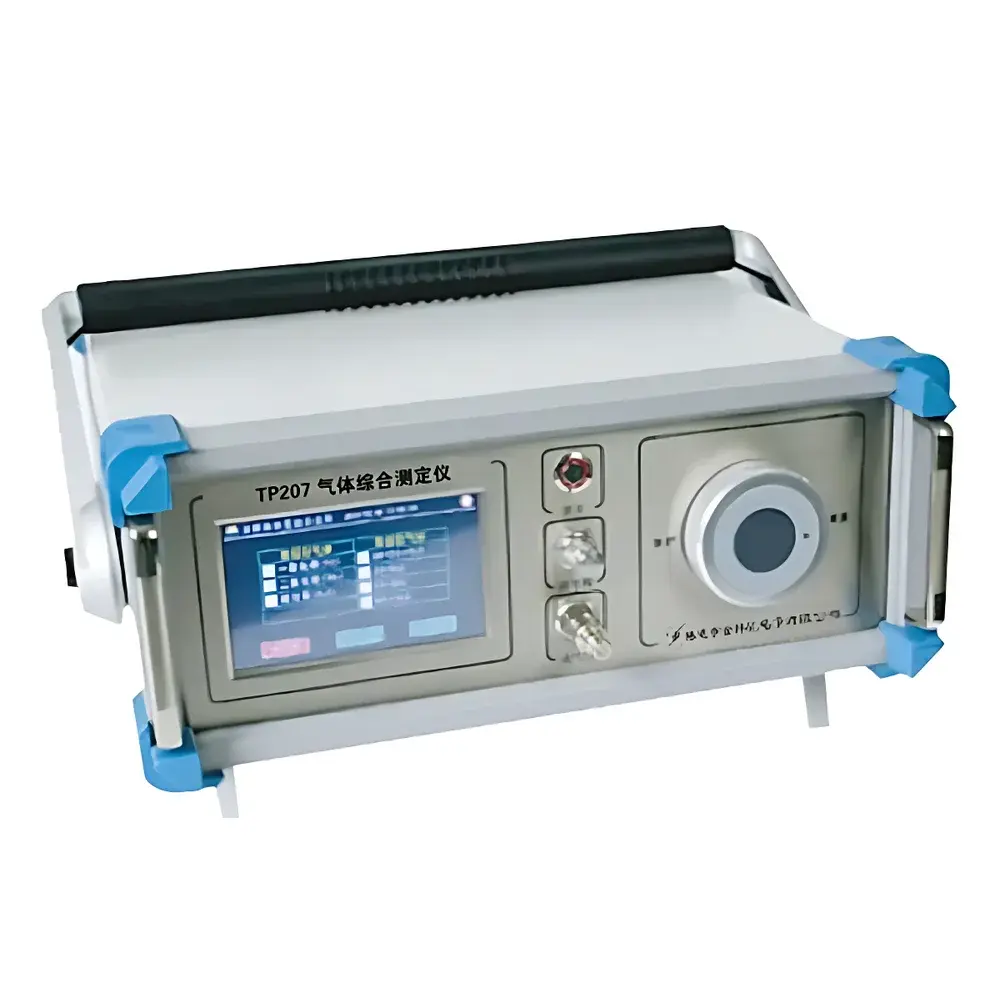
TimePower TP207 Multicomponent SF₆ Gas Analyzer
| Brand | TimePower |
|---|---|
| Model | TP207 |
| Type | Online Multicomponent SF₆ Gas Analyzer |
| Origin | Beijing, China |
| Manufacturer | TimePower (Domestic Producer) |
| Measurement Principles | Electrochemical (SO₂, H₂S, CO), Semiconductor/NDIR (HF, optional), Capacitive Dew Point & Thermal Conductivity (SF₆ Purity) |
| Flow Rate | ~900 mL/min |
| Repeatability | ±2% FS for SO₂, H₂S, CO |
| Detection Ranges | SO₂: 0–100 µL/L |
| H₂S | 0–100 µL/L |
| CO | 0–1000 µL/L |
| HF (optional) | 0–10 µL/L |
| SF₆ Purity | 0–100% vol |
| Dew Point | –80 to +20°C |
| Operating Pressure | <1 MPa |
| Display | 800×480 TFT capacitive touchscreen |
| Data Output | USB 2.0 interface |
| Storage Capacity | 1000 records |
| Power Supply | Rechargeable Li-ion battery + AC/DC adapter |
| Dimensions | 400 × 370 × 180 mm |
| Weight | ~8 kg |
| Operating Environment | –20 to +50°C, <80% RH |
Overview
The TimePower TP207 Multicomponent SF₆ Gas Analyzer is an integrated online analytical platform engineered for high-precision, real-time assessment of sulfur hexafluoride (SF₆) gas quality in high-voltage electrical equipment—particularly circuit breakers, GIS (gas-insulated switchgear), and transformers. Unlike conventional single-parameter analyzers, the TP207 consolidates three critical diagnostic functions into one robust unit: SF₆ dew point (moisture content), SF₆ purity (by thermal conductivity), and SF₆ decomposition product analysis (SO₂, H₂S, CO, and optionally HF). Its measurement architecture leverages complementary transduction principles: electrochemical sensors for trace acidic gases, a capacitive polymer-based dew point sensor with automatic pressure/temperature compensation to standardize readings to 20°C at 101.325 kPa (per IEC 60480 and DL/T 919–2016), and a dual-beam thermal conductivity cell optimized for %vol SF₆ quantification in N₂/SF₆ binary mixtures. Designed for field-deployable reliability, the system operates under variable inlet pressures (<1 MPa) and supports flow-controlled sampling (900 mL/min nominal), enabling consistent diffusion-limited response kinetics across all modules.
Key Features
- Triple-function integration: Simultaneous dew point, SF₆ purity, and decomposition product analysis eliminates instrument stacking, calibration cross-talk, and logistical overhead.
- Auto-compensated dew point reporting: Converts raw sensor output to standardized moisture values referenced to 20°C and atmospheric pressure—fully compliant with IEEE C37.122.1 and GB/T 28537.
- German-sourced self-locking quick-connect fittings: Ensures leak-tight sample integrity during repeated field connections; validated to ISO 15848-1 for fugitive emission control.
- Intelligent endpoint detection: Algorithmic termination of moisture and decomposition gas measurements based on signal stabilization thresholds, reducing operator dependency.
- Onboard temperature compensation: Applies real-time correction to electrochemical sensor outputs using integrated Pt100 reference, improving long-term stability per ISO 17025 QA requirements.
- Modular firmware architecture: Enables selective activation of SO₂/H₂S/CO/HF channels via software license—supporting phased deployment and regulatory alignment.
Sample Compatibility & Compliance
The TP207 is validated for direct analysis of SF₆ gas extracted from live or de-energized HV equipment, including aged gas containing oxidation byproducts and hydrolysis residues. It complies with key international standards governing insulating gas diagnostics: IEC 60480 (reuse criteria), IEC 62271-1 (GIS type testing), and DL/T 919–2016 (Chinese power industry specification for SF₆ gas testing). All sensors meet RoHS Directive 2011/65/EU material restrictions. The system’s data acquisition and storage protocols support GLP-compliant audit trails when used with TimePower’s certified LabLink Pro software—enabling full traceability per FDA 21 CFR Part 11 Annex 11 requirements for electronic records.
Software & Data Management
LabLink Pro (v4.2+) serves as the certified host application for the TP207, providing configuration management, automated report generation, and secure export to CSV/Excel formats. The software implements role-based access control, digital signature capture for test authorization, and time-stamped audit logs for all parameter changes and measurement events. Raw sensor voltages, compensated values, and environmental metadata (ambient T/RH, sample pressure, flow rate) are stored with 16-bit resolution. USB 2.0 mass-storage mode allows direct file transfer without driver installation. Optional cloud synchronization enables centralized fleet monitoring across substations via TLS 1.2–encrypted MQTT endpoints.
Applications
- Routine condition monitoring of SF₆-filled GIS and dead-tank circuit breakers in transmission networks.
- Commissioning verification per IEC 62271-203 prior to energization.
- Fault root-cause analysis following internal arcing or partial discharge events—correlating SO₂/H₂S ratios with decomposition pathways.
- Recycling facility QC: Quantifying moisture and air ingress before reprocessing per IEC 60480 Annex B.
- Research studies on SF₆ alternative gas blends (e.g., g³, AirPlus™), where purity drift and trace contaminant formation must be tracked over accelerated aging cycles.
FAQ
What flow rate should be used for different measurement modes?
For dew point only: set flow to 0.5 L/min. For decomposition product analysis (SO₂/H₂S/CO): reduce to 0.3 L/min to ensure optimal electrochemical sensor residence time and minimize cross-sensitivity.
How often does the TP207 require calibration?
Annual calibration with certified multi-gas standards (e.g., SO₂/N₂, H₂S/N₂, CO/N₂, and SF₆/air mixtures) is recommended per ISO/IEC 17025 Clause 7.7 and manufacturer specifications.
Is HF detection included by default?
HF measurement is an optional module requiring separate sensor installation and firmware licensing; it is not active in base configurations.
Can the TP207 operate unattended in remote substations?
Yes—the integrated Li-ion battery supports >6 hours of continuous operation, and the USB interface permits scheduled data dumps to external NAS or SCADA edge devices.
Does the system support pressure compensation for non-ambient sampling conditions?
Yes—both dew point and purity algorithms apply dynamic pressure correction using onboard absolute pressure sensing (0–2 MPa range), ensuring accuracy across varying GIS operating pressures.
Related Products







