
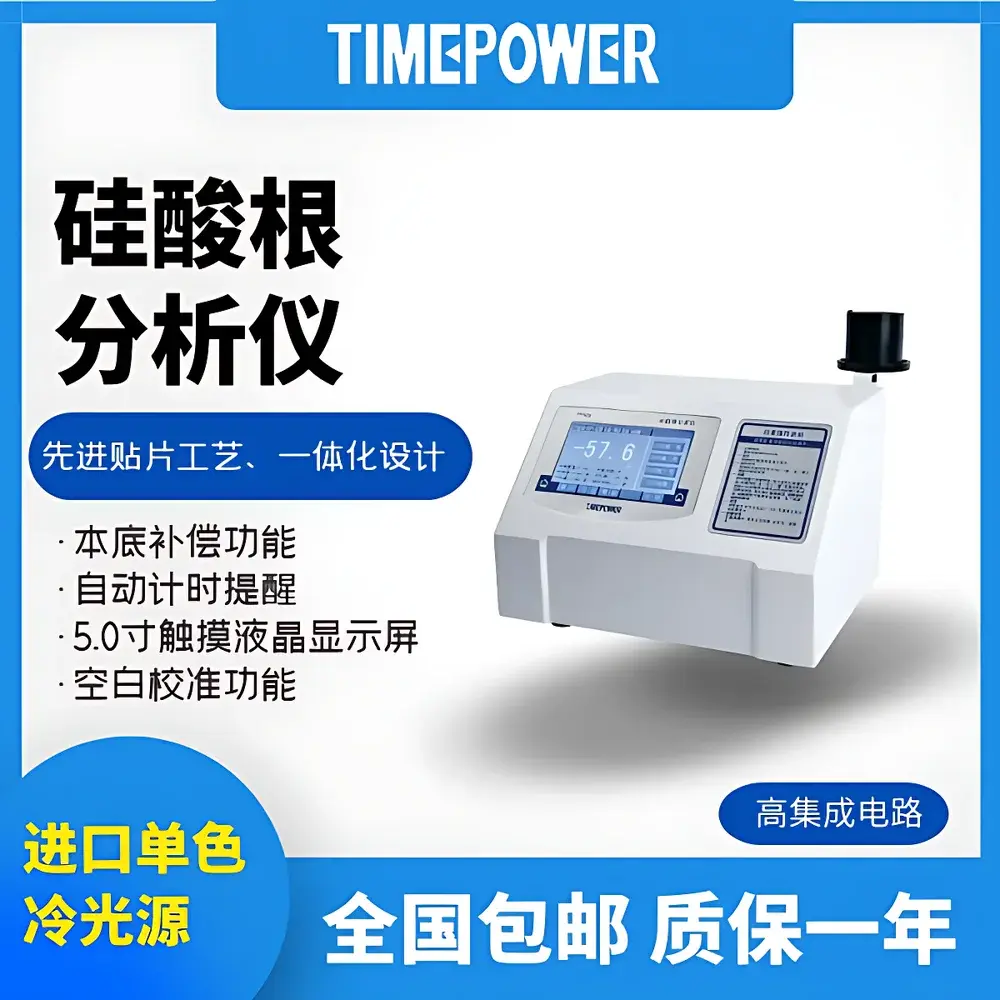
Timepower TP306 Silicate Analyzer
| Brand | Timepower |
|---|---|
| Origin | Beijing, China |
| Manufacturer Type | Manufacturer |
| Product Category | Domestic |
| Model | TP306 |
| Instrument Type | Benchtop Laboratory Analyzer |
| Measurement Principle | Photometric Colorimetry (Molybdenum Blue Method) |
| Display | 5.0-inch TFT color touchscreen, Chinese interface |
| Power Supply | AC 85–265 V, 45–65 Hz |
| Power Consumption | ≤30 W |
| Dimensions | 260 × 200 × 180 mm |
| Weight | 3.2 kg |
| Operating Temperature | 5–45 °C |
| Relative Humidity | ≤90% RH (non-condensing) |
| Measurement Range | 0–200 µg/L and 0–2000 µg/L (selectable) |
| Accuracy | ±2% FS |
| Resolution | 0.1 µg/L |
| Repeatability | ≤1% |
| Stability | ±1% FS / 4 h |
| Compliance | GB/T 12149–2019 (Chinese National Standard for Silica Determination in Water by Molybdenum Blue Spectrophotometry) |
| Data Storage | Up to 256 entries with circular overwrite |
| Calibration | Blank calibration, optional multi-point curve calibration |
| Key Features | Built-in timer alert, baseline compensation, cold LED light source, SMD circuitry, single-chip microcontroller architecture |
Overview
The Timepower TP306 Silicate Analyzer is a benchtop photometric instrument engineered for precise quantification of dissolved silica (SiO₂) and soluble silicates in ultrapure water streams. It operates on the internationally recognized molybdenum blue spectrophotometric method—standardized in ASTM D859, ISO 10577, and GB/T 12149–2019—where orthosilicic acid reacts with ammonium molybdate under controlled acidic conditions (pH 1.1–1.3) to form a yellow heteropolyacid complex. This intermediate is subsequently reduced by 1-amino-2-naphthol-4-sulfonic acid (1-2-4 acid) to yield an intensely colored silicon-molybdenum blue complex. Absorbance is measured at ~815 nm using a stable, low-drift cold LED light source and high-transmittance optical path. The analyzer applies the Lambert–Beer law to convert absorbance into quantitative silica concentration, delivering trace-level sensitivity critical for steam cycle chemistry control in thermal power plants and high-purity process water monitoring in semiconductor fabrication and pharmaceutical manufacturing.
Key Features
- High-stability cold LED light source with narrow spectral bandwidth and >10,000-hour service life, minimizing thermal drift and photometric noise
- Integrated baseline compensation algorithm to correct for matrix interferences and improve accuracy in sub-5 µg/L measurements
- Automated timing protocol with audible/visual alerts for reagent addition, reaction incubation, and measurement—ensuring strict adherence to standard reaction kinetics
- Onboard blank calibration routine to eliminate zero-point drift caused by electronic offset, cuvette variability, or ambient light leakage
- Robust SMD-based PCB architecture with conformal coating, designed for continuous operation in laboratory environments with variable temperature and humidity
- Low-power 32-bit microcontroller platform enabling extended uptime and deterministic response latency during multi-step assay sequences
- 5.0-inch capacitive touchscreen with intuitive Chinese GUI, supporting real-time parameter adjustment, history review, and calibration log export
Sample Compatibility & Compliance
The TP306 is validated for use with deionized water, condensate, boiler feedwater, and ultrapure process water (UPW) meeting ASTM D5127 or SEMI F63 specifications. It complies with national and industry-standard methodologies including GB/T 12149–2019 and is compatible with quality assurance frameworks requiring documented traceability. While not inherently 21 CFR Part 11 compliant, its data storage architecture supports audit-ready records when deployed within GLP/GMP-aligned laboratories using external validation protocols. Sample introduction is manual via calibrated sample cups; no integrated autosampler or fluidic manifold is included. All wetted components contact only high-density polyethylene (HDPE) and borosilicate glass—materials certified for low leachable silica content per USP .
Software & Data Management
The embedded firmware provides local data handling without cloud dependency. Up to 256 measurement records—including date/time stamp, range setting, absorbance value, calculated concentration, and operator ID—are stored in non-volatile memory with circular overwrite logic. Calibration logs retain blank values, slope/intercept coefficients, and verification timestamps. Data export is limited to manual screen capture or USB-assisted transfer (optional accessory). For integration into centralized LIMS or SCADA systems, analog 4–20 mA output (optional module) or RS-232 serial interface (standard) enables external logging. Firmware updates are performed via USB flash drive following vendor-provided checksum-verified binaries.
Applications
- Monitoring silica breakthrough in mixed-bed ion exchange units and EDI modules in power plant makeup water treatment
- Guarding against silica deposition in turbine blades and heat exchangers through continuous analysis of condensate return lines
- Verifying UPW purity in semiconductor front-end fabs where SiO₂ contamination >0.5 µg/L risks gate oxide integrity
- Supporting USP and EP 2.2.43 compliance testing for silica in purified water and water for injection (WFI)
- Quality control of boiler drum water in high-pressure natural circulation boilers (e.g., >10 MPa operating pressure)
- Research applications involving silicate speciation kinetics in hydrothermal synthesis or geochemical modeling studies
FAQ
What reagents are required for daily operation?
Ammonium molybdate solution (analytical grade), 1-2-4 acid reducing agent, sulfuric acid (for pH adjustment), and certified silica standard solutions (0–200 µg/L and 0–2000 µg/L). All reagents must be prepared in ASTM Type I water.
Is the instrument suitable for field deployment?
No—the TP306 is a benchtop laboratory analyzer optimized for controlled ambient conditions (5–45 °C, ≤90% RH). It lacks shock resistance, battery operation, or IP-rated enclosure for outdoor or mobile use.
How often must calibration be performed?
Blank calibration is recommended before each analytical session; full multi-point calibration using NIST-traceable standards is advised every two weeks or after reagent batch change.
Does the analyzer support automatic dilution?
No—sample dilution must be performed manually prior to analysis if concentrations exceed the selected range.
Can the device measure total silicate or only reactive silica?
It measures reactive (dissolved, ortho-) silica only, as defined by the molybdenum blue method. Polymerized or colloidal silica requires acid hydrolysis pretreatment, which is not automated in this model.







