
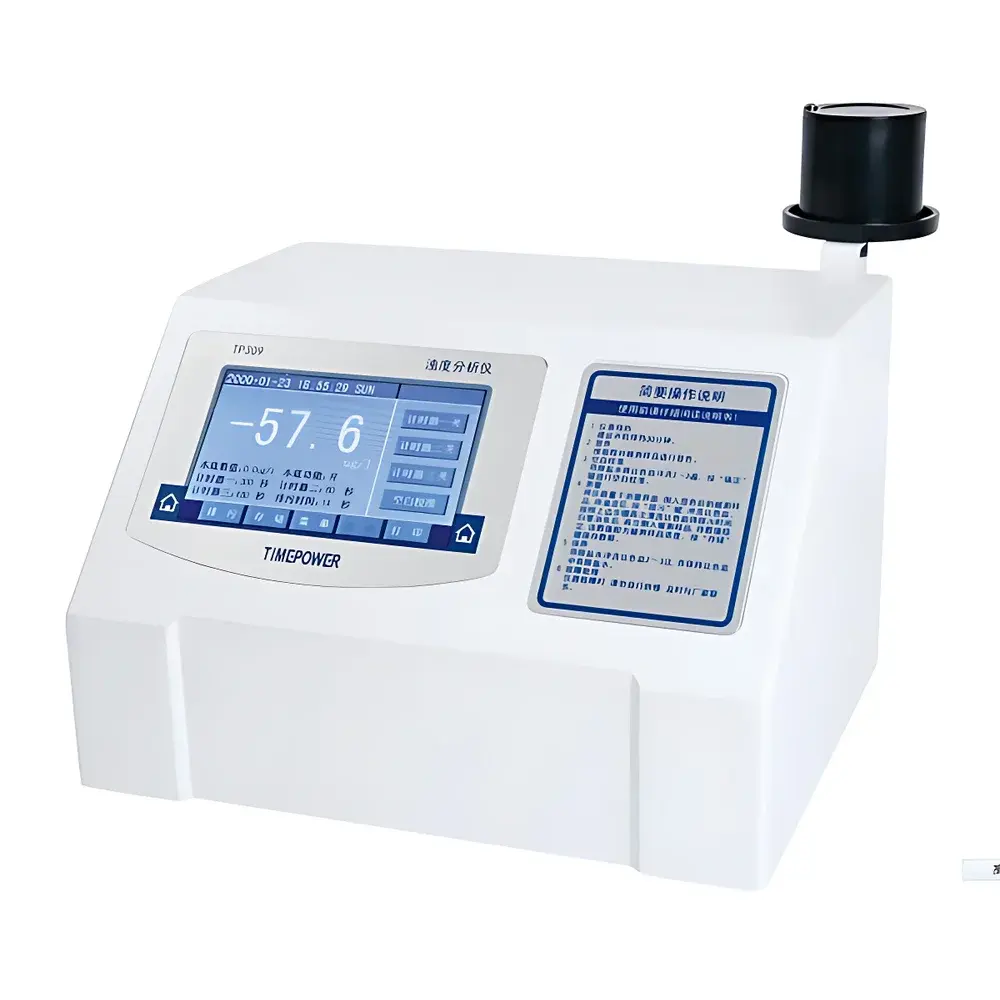
TimePower TP309 Desktop Turbidimeter with Multi-Range Measurement
| Brand | TimePower |
|---|---|
| Model | TP309 |
| Origin | Beijing, China |
| Manufacturer | TimePower Instrument Co., Ltd. |
| Instrument Type | Laboratory Water Quality Analyzer |
| Measured Parameter | Turbidity |
| Measurement Range | 0.0–100 NTU / 100–1000 NTU |
| Range Switching | Auto or Manual |
| Accuracy | ±2% F.S. (0.0–100 NTU), ±5% F.S. (100–1000 NTU) |
| Resolution | 0.01 NTU (low range), 0.1 NTU / 1 NTU (high ranges) |
| Repeatability | ≤1% |
| Stability | ±1% F.S. / 4 h |
| Light Source | Imported monochromatic cold LED |
| Display | 5.0-inch capacitive color touchscreen (Chinese UI) |
| Data Storage | Up to 256 records (circular buffer) |
| Calibration | Formazin-based zero and multi-point calibration per Chinese national standard (GB/T 13200–1991) |
| Power Supply | AC 85–265 V, 45–65 Hz, ≤30 W |
| Dimensions | 260 × 200 × 180 mm |
| Weight | 3.2 kg |
| Operating Temperature | 5–45 °C |
| Relative Humidity | ≤90% RH (non-condensing) |
Overview
The TimePower TP309 Desktop Turbidimeter is a precision laboratory-grade instrument engineered for accurate, traceable turbidity measurement in water quality control applications. It operates on the principle of nephelometry—measuring the intensity of light scattered at 90° by suspended particulate matter in aqueous samples. Compliant with the Chinese national standard GB/T 13200–1991 (equivalent in methodology to ISO 7027:2016 and EPA Method 180.1), the TP309 employs a stable, temperature-insensitive monochromatic cold LED light source to minimize spectral drift and ensure long-term photometric consistency. Its dual-range architecture (0.0–100 NTU and 100–1000 NTU) supports both low-turbidity monitoring—critical for ultrapure water systems—and high-turbidity process control in coagulation/flocculation units or wastewater influent screening. The instrument’s optical path design minimizes stray light interference, while its integrated thermal management ensures signal stability across ambient fluctuations within the specified 5–45 °C operating envelope.
Key Features
- 5.0-inch capacitive color touchscreen interface with intuitive Chinese-language navigation—designed for routine lab operation without external PCs or software dependencies.
- High-integration PCB architecture using surface-mount technology (SMT) and embedded microcontroller firmware, delivering robust electrical noise immunity and extended mean time between failures (MTBF).
- Formazin-standard traceable calibration protocol supporting zero-point correction and multi-point linearity verification—aligned with GLP documentation requirements for audit-ready calibration logs.
- Automatic or manual range switching with seamless transition between low- and high-range modes; resolution adapts dynamically (0.01 NTU in 0–100 NTU range; 0.1/1 NTU in 100–1000 NTU range).
- Circular memory buffer storing up to 256 measurement records with timestamp, sample ID, and operator tag—enabling basic traceability without external data export.
- Low-power LED illumination system (rated lifetime >50,000 hours) with negligible thermal load on the sample chamber, eliminating convection-induced measurement artifacts.
Sample Compatibility & Compliance
The TP309 is validated for use with clear to moderately turbid aqueous matrices including deionized water, potable water, filtered surface water, and secondary-treated effluent. Sample compatibility extends to solutions containing non-absorbing, non-fluorescent particulates—e.g., clay, silt, alum flocs, and activated carbon fines. It is not intended for highly colored, fluorescent, or strongly absorbing samples without prior filtration or dilution. The instrument conforms to the optical geometry and wavelength specifications defined in ISO 7027:2016 (nephelometric method, 860 nm ±30 nm), and its calibration traceability aligns with national metrological standards referenced in GB/T 13200–1991. While not FDA 21 CFR Part 11–certified out-of-the-box, its audit trail functionality (calibration timestamps, operator inputs, and stored readings) supports GMP/GLP-aligned record-keeping when deployed in regulated QC environments under documented SOPs.
Software & Data Management
The TP309 operates as a standalone analytical platform with no proprietary PC software required. All configuration, calibration, and data review occur directly via the onboard touchscreen interface. Calibration parameters—including zero offset, gain factor, and reference point values—are retained in non-volatile memory with write-protection logic to prevent accidental overwrites. Each stored reading includes date/time stamp, user-defined sample ID, and range mode indicator. For laboratories requiring electronic data interchange, raw NTU values can be manually transcribed or exported via optional RS-232 or USB-to-serial adapters (not included). The instrument supports periodic recalibration intervals per internal QA protocols: daily zero calibration to correct for electronic/dark current drift, and biweekly multi-point calibration to verify linearity and optical integrity—consistent with ISO/IEC 17025 clause 7.7 on equipment verification.
Applications
- Monitoring ultra-low turbidity (<0.1 NTU) in semiconductor-grade ultrapure water loops and pharmaceutical water-for-injection (WFI) distribution systems.
- Optimizing coagulant dosing in drinking water treatment plants by tracking rapid changes in raw water turbidity and post-sedimentation clarity.
- Validating filter performance in municipal and industrial water reclamation facilities—especially membrane pre-filtration and granular media filters.
- Supporting environmental compliance reporting under China’s “Surface Water Environmental Quality Standards” (GB 3838–2002) and discharge permit requirements.
- Conducting bench-scale jar testing to evaluate flocculation kinetics and settling efficiency in wastewater treatment R&D labs.
FAQ
What turbidity standard is used for calibration?
The TP309 uses formazin suspension as the primary turbidity standard, prepared according to GB/T 13200–1991. Certified formazin standards (e.g., 10 NTU, 100 NTU, 400 NTU) are recommended for multi-point calibration.
Can the instrument measure samples above 1000 NTU?
No—the maximum measurable range is 1000 NTU. Samples exceeding this limit must be diluted with formazin-free, particle-free rinse water (e.g., ASTM D1193 Type I water) and results multiplied by the dilution factor.
Is temperature compensation automatic?
The TP309 does not feature real-time temperature compensation; however, its LED light source and detector exhibit minimal thermal drift. Users are advised to equilibrate samples to room temperature (20–25 °C) prior to measurement per ISO 7027 guidelines.
How often should zero calibration be performed?
A blank (zero) calibration using particle-free rinse water is required before each measurement session—or at minimum, once per day—to correct for electronic baseline drift and cuvette surface contamination.
Does the instrument support export to LIMS or CSV files?
Not natively. Data export requires manual entry or integration via optional serial communication modules. Third-party middleware may be configured for automated ingestion into LIMS platforms using ASCII-based polling protocols.
Related Products







