
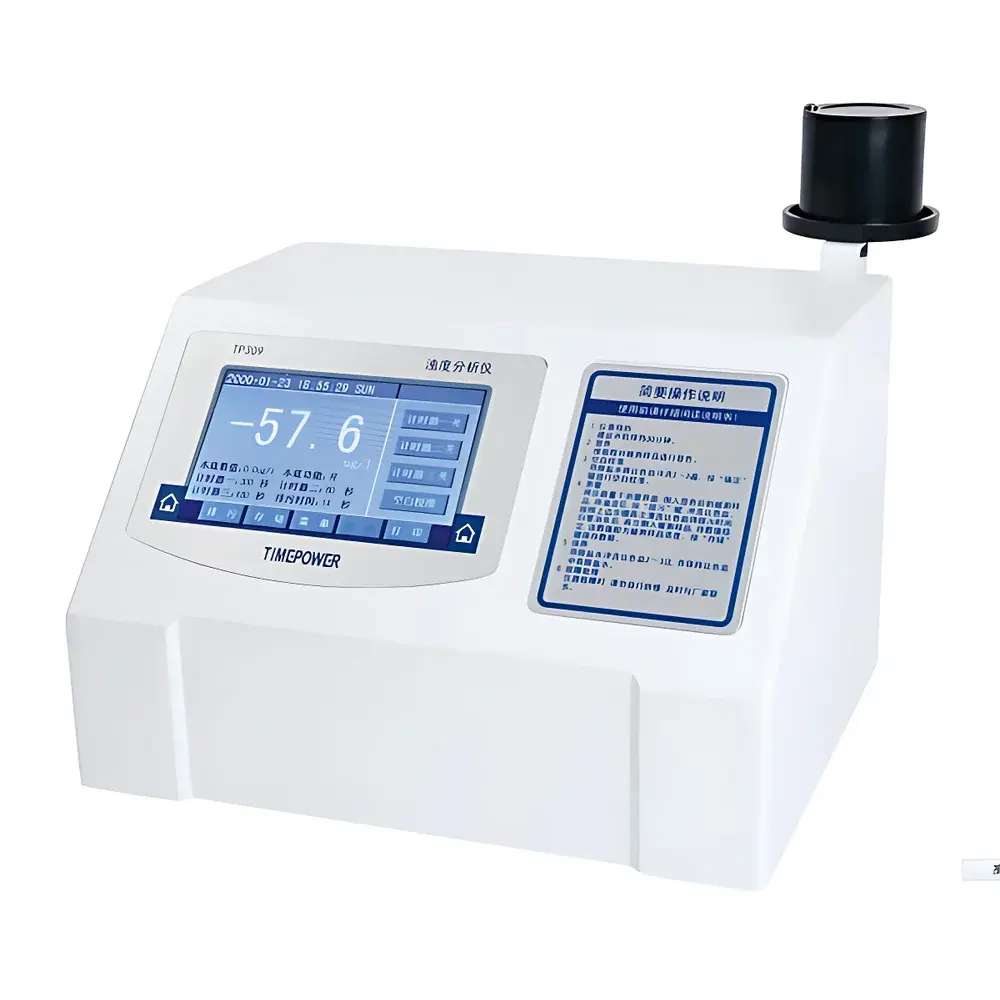
TimePower TP309 Turbidity Analyzer
| Brand | TimePower |
|---|---|
| Origin | Beijing, China |
| Manufacturer Type | Manufacturer |
| Product Origin | Domestic (China) |
| Model | TP309 |
| Instrument Type | Laboratory Turbidity Analyzer |
| Measured Parameter | Turbidity |
| Display | 5.0-inch color touchscreen LCD (Chinese interface) |
| Measurement Range | (0.0–100.0) NTU or (100.0–1000) NTU (auto-ranging) |
| Accuracy | ±2% F.S. (0–100 NTU), ±5% F.S. (100–1000 NTU) |
| Resolution | 0.01 NTU / 0.1 NTU / 1 NTU (range-dependent) |
| Repeatability | ≤1% |
| Stability | ±1% F.S. / 4 h |
| Operating Temperature | 5–45 °C |
| Relative Humidity | ≤90% RH (non-condensing) |
| Dimensions | 260 × 200 × 180 mm |
| Power Supply | AC 85–265 V, 45–65 Hz |
| Power Consumption | ≤30 W |
| Weight | 3.2 kg |
| Data Storage | Up to 256 records (circular buffer) |
| Calibration | Zero-point calibration with blank standard |
Overview
The TimePower TP309 Turbidity Analyzer is a laboratory-grade optical instrument engineered for precise, reliable measurement of turbidity in water and aqueous solutions according to the nephelometric principle. It operates on the fundamental physical relationship between suspended particulate matter and light scattering: when a collimated beam of monochromatic light passes through a sample, particles scatter photons at angles—primarily 90°—and the intensity of this scattered light is quantitatively correlated to the concentration and size distribution of suspended solids. The TP309 implements ISO 7027-compliant nephelometry using a high-stability imported cold LED light source (typically centered near 860 nm), minimizing interference from sample coloration and enabling robust performance across low- to mid-range turbidity applications—from ultrapure water monitoring in semiconductor manufacturing to process control in municipal drinking water treatment plants.
Key Features
- Optical architecture compliant with ISO 7027 and EPA Method 180.1, ensuring traceable metrological equivalence to reference instruments.
- Integrated single-board design with surface-mount technology (SMT) PCBs, delivering enhanced thermal stability and long-term signal integrity under continuous operation.
- High-efficiency 860 nm cold LED light source: low power consumption (50,000-hour operational lifetime, minimal spectral drift, and immunity to warm-up time artifacts.
- Automatic zero-point compensation via blank calibration—performed daily per recommended operating procedure—to correct for electronic offset, photodetector dark current drift, and cuvette-related scatter artifacts.
- Intelligent auto-ranging detection system that dynamically selects optimal gain and integration time across two calibrated ranges: 0.0–100.0 NTU (high-resolution mode) and 100.0–1000 NTU (extended-range mode).
- Onboard data logging with circular memory buffer (256 entries), supporting timestamped turbidity values, calibration event logs, and operator-initiated annotations—exportable via USB interface for audit-ready recordkeeping.
Sample Compatibility & Compliance
The TP309 is validated for use with clear to moderately turbid aqueous matrices including deionized water, reverse osmosis permeate, potable water, filtered surface water, and clarified secondary effluent. Sample containers must be standardized quartz or optical-grade polystyrene cuvettes (10 mm path length); non-standard vessels introduce geometric and refractive index errors. The analyzer meets key regulatory expectations for routine water quality testing: it supports GLP-compliant workflows through documented calibration intervals (daily zero check, biweekly multi-point calibration), adheres to ASTM D6508 and ISO 7027 optical geometry specifications, and enables traceable verification against NIST-traceable formazin or AMCO AEPA standards. While not certified to FDA 21 CFR Part 11 out-of-the-box, its data export functionality and audit trail metadata support integration into validated LIMS environments under site-specific validation protocols.
Software & Data Management
The TP309 features an embedded Linux-based firmware platform with a localized Chinese GUI displayed on a 5.0-inch capacitive touchscreen. All user interactions—including method selection, calibration execution, data review, and system diagnostics—are performed directly on-device without external PC dependency. Stored measurements include date/time stamps, range identifier, raw ADC counts, and calibration status flags. Data export is supported via USB mass storage mode: CSV-formatted files are generated automatically upon connection, containing column headers compatible with Excel, LabChart, or statistical process control (SPC) software. No proprietary drivers or cloud dependencies are required; file structure follows IEC 62443-aligned naming conventions for industrial cybersecurity readiness.
Applications
- Monitoring feedwater and product water quality in pharmaceutical water systems (PW, WFI) per USP and EU Annex 1 requirements.
- Optimizing coagulant dosing in drinking water treatment by tracking rapid sand filter influent turbidity trends pre- and post-flocculation.
- Validating membrane integrity in ultrafiltration and nanofiltration pilot studies via breakthrough detection at sub-0.1 NTU levels.
- Supporting environmental compliance reporting for NPDES discharge permits requiring turbidity limits in stormwater outfalls.
- Quality control of reagent-grade water used in analytical chemistry labs, particularly where particle-induced interference affects UV-Vis spectrophotometry or ICP-MS analysis.
FAQ
What calibration standards are required for routine operation?
Formazin-based primary standards (e.g., 0.1, 10, 100, and 400 NTU) traceable to NIST SRM 2134 are recommended. AMCO AEPA standards may be used as secondary references if certified by an ISO/IEC 17025-accredited provider.
Is the TP309 suitable for field deployment?
No—it is designed exclusively for controlled laboratory environments. Its specified operating temperature range (5–45 °C) and lack of IP-rated enclosure preclude outdoor or mobile use.
How often must the optical path be cleaned?
The detector window and light source aperture should be inspected and wiped with lint-free optical tissue before each batch of analyses; more frequent cleaning is necessary when measuring highly contaminated or oily samples.
Can the instrument store calibration curves?
Yes—up to three user-defined multi-point calibration curves may be saved and recalled, each with associated date, technician ID, and standard lot numbers for full traceability.
Does the TP309 support RS-232 or Ethernet communication?
No—communication is limited to USB 2.0 host-mode file transfer. For networked integration, third-party USB-to-serial adapters with CDC ACM class drivers may be evaluated under site-specific IT security policies.







