
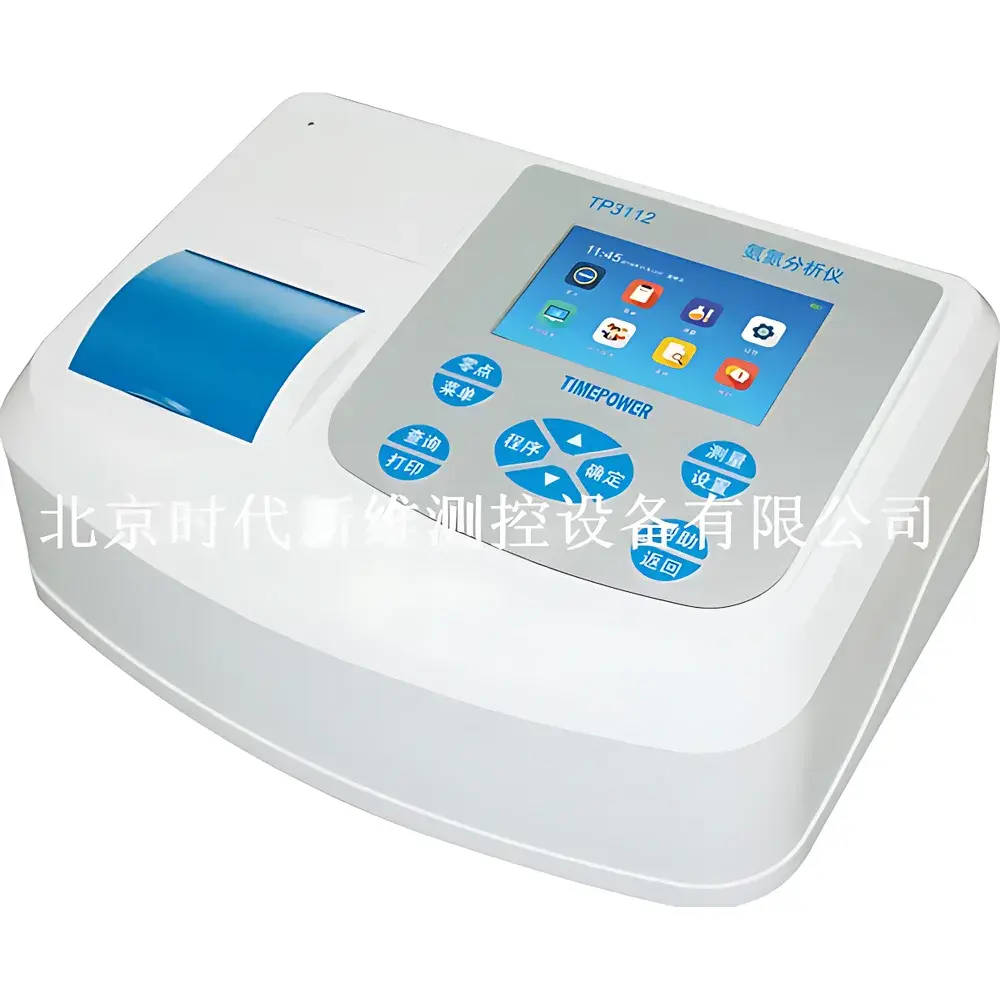
Timepower TP3111 Permanganate Index (CODMn) Analyzer
| Brand | Timepower |
|---|---|
| Origin | Beijing, China |
| Manufacturer Type | Direct Manufacturer |
| Product Category | Domestic |
| Model | TP3111 |
| Pricing | Upon Request |
| Measurement Principle | Potassium Permanganate Oxidation with ORP Endpoint Detection |
| Range | 0–10 mg/L (dilution applicable for higher concentrations) |
| Repeatability | ±3% |
| Accuracy | ≤±3 mg/L |
| LOD | 0.20 mg/L |
| Resolution | 0.01 mg/L |
| Single-Test Duration | 30 min |
| Digestion Temperature | 100 °C ±1.5 °C |
| Digestion Time | 30 min |
| Dimensions | 266 × 200 × 130 mm |
| Weight | 4 kg |
| Power Consumption | <10 W |
| Operating Environment | 5–40 °C, RH ≤85% |
| Power Supply | AC 220 V ±10%, 50 Hz ±0.5 Hz |
| Display | Backlit LCD |
| Light Source | Stable Cold LED Source |
| Data Output | Thermal Printer Support & USB Interface |
| Compliance | Designed per GB/T 11892–1989 (Chinese Standard for Permanganate Index), aligned with ISO 8467:1993 principles |
Overview
The Timepower TP3111 Permanganate Index (CODMn) Analyzer is a dedicated benchtop instrument engineered for the quantitative determination of the permanganate index—commonly referred to as CODMn—in surface water, groundwater, wastewater, and industrial effluents. Unlike dichromate-based COD methods (CODCr), the TP3111 implements the standardized potassium permanganate oxidation method, which is particularly suited for low-organic-load samples such as drinking water sources and lightly polluted natural waters. The system operates on a two-stage process: controlled thermal digestion at 100 °C ±1.5 °C for 30 minutes, followed by photometric quantification via ORP (oxidation-reduction potential) endpoint detection. This dual-mode verification ensures robust endpoint discrimination in variable matrix conditions. Optical measurement adheres to the Lambert–Beer law, using a stable cold LED light source and precision optical path design to minimize drift and thermal interference. Crucially, the digestion module is physically isolated from the photometric unit—a deliberate architectural choice that eliminates thermal cross-talk and preserves long-term optical stability.
Key Features
- Physically separated high-temperature digestion block and optical detection chamber to prevent thermal degradation of photodiodes and LED emitters
- Cold LED light source with narrow spectral bandwidth, delivering superior photometric stability over extended operation cycles
- ORP endpoint confirmation integrated with absorbance monitoring, reducing false endpoints caused by chloride interference or incomplete oxidation
- Backlit LCD interface with intuitive menu navigation, supporting real-time status feedback and step-by-step guided workflows
- Onboard thermal printer for immediate hardcopy output of calibration logs, sample IDs, timestamps, and result reports
- USB 2.0 interface compliant with CDC (Communication Device Class) protocols, enabling direct data export to Windows/Linux systems without proprietary drivers
- Low power consumption (<10 W) and compact footprint (266 × 200 × 130 mm), suitable for field labs, mobile monitoring units, and space-constrained QA/QC environments
Sample Compatibility & Compliance
The TP3111 is validated for use with raw and filtered aqueous matrices meeting the scope of GB/T 11892–1989, the national standard governing permanganate index determination in China. It aligns methodologically with ISO 8467:1993 (Water quality — Determination of permanganate index), particularly in digestion temperature control, reagent stoichiometry, and endpoint interpretation. Sample types include potable water, reservoir inflows, riverine monitoring points, municipal secondary effluents, and pre-treatment industrial discharges. For samples exceeding 10 mg/L CODMn, manual dilution using deionized water (conductivity 300 mg/L Cl−) and strongly colored humic waters without pretreatment, consistent with ISO guidance on interferent mitigation.
Software & Data Management
While the TP3111 operates as a standalone instrument, its USB interface enables seamless integration into laboratory data management ecosystems. Exported CSV files contain timestamped records of sample ID, measured absorbance, ORP curve inflection point, calculated concentration (mg/L), operator code, and QC flag status (e.g., “within calibration window”, “dilution applied”). No proprietary software is required; exported files are natively readable in Excel, LabWare LIMS, and OpenLab CDS. Audit trail functionality is maintained via internal non-volatile memory storing the last 500 test records—including calibration date, standard lot number, and user-entered notes—supporting GLP-compliant documentation requirements. Firmware updates are delivered via signed HEX files through the USB port, with checksum validation prior to flash programming.
Applications
- Routine monitoring of source water quality at waterworks intake stations
- Compliance verification against Class I–III surface water quality standards (GB 3838–2002)
- Performance evaluation of tertiary treatment stages in municipal wastewater plants
- Baseline organic load assessment in ecological restoration projects
- Educational use in environmental engineering laboratories for method validation exercises
- Field-deployable verification tool during emergency spill response where rapid CODMn estimation is critical
FAQ
What distinguishes CODMn from CODCr, and when should each be used?
CODMn employs potassium permanganate under mild acidic or neutral conditions and oxidizes ~50–60% of organic matter—making it appropriate for clean to moderately polluted waters. CODCr uses potassium dichromate under strong acid reflux and achieves >95% oxidation, but is unsuitable for chloride-rich samples and requires hazardous reagents. Regulatory frameworks (e.g., EU WFD, China’s Environmental Quality Standards) specify CODMn for drinking water sources and sensitive aquatic ecosystems.
Can the TP3111 be used for seawater or high-chloride samples?
No. Chloride ion concentrations above 300 mg/L interfere with permanganate oxidation kinetics and ORP endpoint reliability. For saline matrices, ASTM D1253-18 recommends alternative methods such as UV spectrophotometric estimation or biological oxygen demand proxies.
Is third-party calibration verification supported?
Yes. The instrument accepts NIST-traceable potassium hydrogen phthalate (KHP) and oxalic acid reference standards. Calibration verification checks can be performed using certified reference materials (CRMs) from LGC, AccuStandard, or CNAS-accredited domestic providers.
How is data integrity ensured during power interruption?
All active measurements and calibration parameters are written to EEPROM before thermal digestion initiation. In case of unexpected power loss, the system resumes from the last stable state upon reboot—no data corruption or incomplete record generation occurs.







