
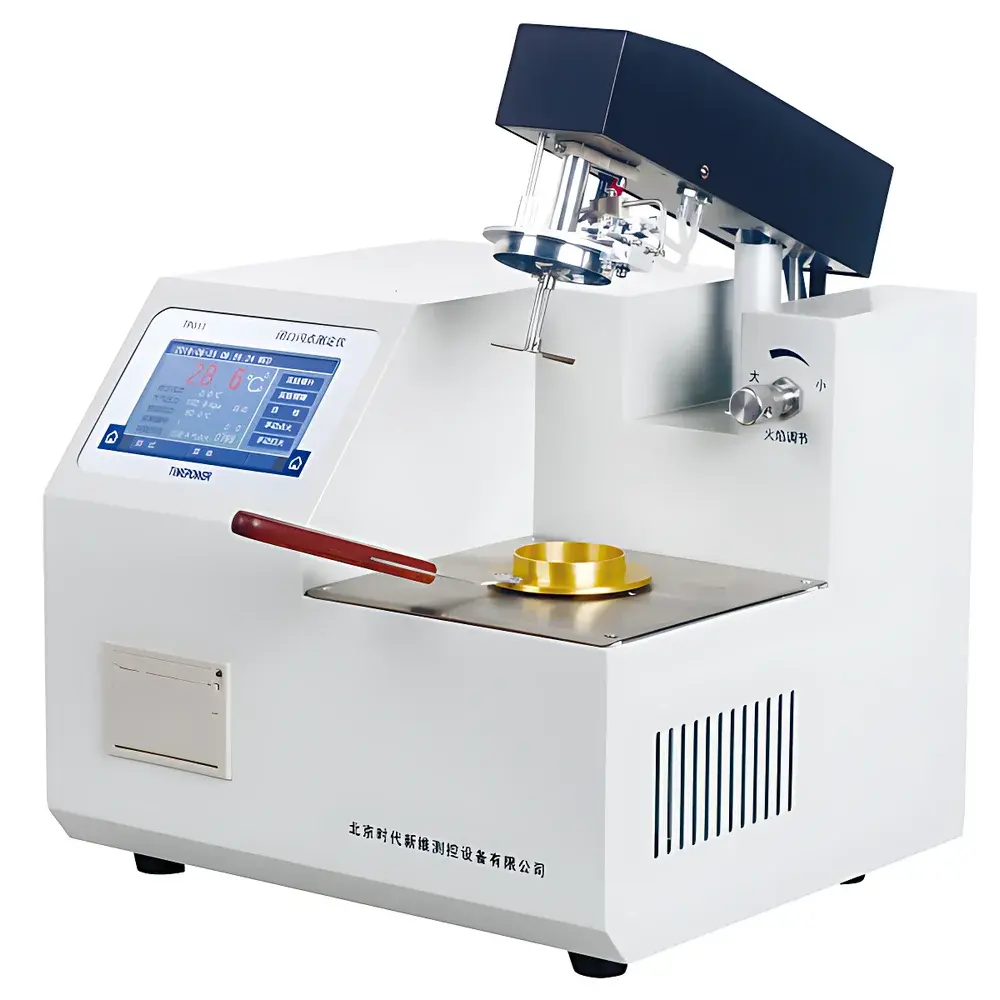
Timepower TP611 Automated Closed-Cup Flash Point Tester
| Brand | Timepower |
|---|---|
| Origin | Beijing, China |
| Manufacturer Type | Manufacturer |
| Product Origin | Domestic (China) |
| Model | TP611 |
| Detection Method | Closed-Cup Method |
| Measurement Range | 40–370 °C |
| Accuracy | ±1 °C for flash point <110 °C |
| Repeatability | ≤2 °C |
| Resolution | 0.1 °C |
| Ambient Temperature Range | 5–40 °C |
| Relative Humidity | ≤85% |
| Display | 260k-color TFT LCD (480×272) |
| Cooling Method | Integrated forced-air cooling |
| Printer | Thermal printer (36-character width, Chinese character support) |
| Power Supply | AC 220 V ±10%, 50 Hz ±10% |
| Power Consumption | ≤500 W |
| Dimensions | 350 × 310 × 300 mm |
| Weight | 13.5 kg |
Overview
The Timepower TP611 Automated Closed-Cup Flash Point Tester is a precision-engineered instrument designed to determine the closed-cup flash point of petroleum products in strict accordance with internationally recognized test standards—including ASTM D93 (Standard Test Method for Flash Point by Pensky-Martens Closed Cup Tester) and GB/T 261 (Chinese national standard equivalent to ISO 2719). The device operates on the principle of controlled heating and automated ignition detection: a precisely metered sample is placed in a sealed test cup, heated at a regulated rate, and exposed to an ignition source at defined intervals. The flash point is recorded as the lowest temperature at which vapors above the sample ignite momentarily upon exposure to a flame or electric spark under standardized atmospheric conditions. This measurement serves as a critical safety parameter for storage, transport, and handling classification of flammable liquids—particularly in power generation, petrochemical refining, lubricant formulation, and regulatory compliance laboratories.
Key Features
- Fully automated operation sequence: cup lifting, temperature ramping, stirring, ignition, flash detection, data recording, thermal shutdown, and arm retraction.
- Programmable heating rate and stirrer speed to accommodate multiple standard protocols (e.g., ASTM D93 Method A/B, GB/T 261 Annex A/B).
- Integrated barometric pressure compensation algorithm to correct flash point values to standard atmospheric pressure (101.3 kPa), ensuring traceability and inter-laboratory comparability.
- Over-temperature protection circuitry halts heating immediately if measured temperature exceeds user-defined or standard-specified limits.
- Self-diagnostic system continuously monitors sensor integrity, ignition subsystem status, cup positioning, and thermal actuator function—reporting fault codes via the display interface.
- 260,000-color TFT LCD (480 × 272 pixels) provides real-time graphical temperature profiles, status icons, and bilingual (English/Chinese) menu navigation.
- Dual-mode ignition system: configurable selection between gas-fueled pilot flame (using LPG or butane) and electronic arc ignition—enabling operation in environments where open flames are restricted or gas supply is unavailable.
Sample Compatibility & Compliance
The TP611 is validated for use with a broad range of petroleum-based liquids, including transformer oils, turbine oils, diesel fuels, base oils, hydraulic fluids, and solvent fractions. It excludes highly volatile substances with flash points below 40 °C (e.g., gasoline, acetone, or ether) due to physical design constraints of the closed-cup geometry and safety interlocks. All operational parameters comply with the mechanical and procedural requirements of ASTM D93 and GB/T 261, including cup geometry, lid sealing torque, stirrer dimensions, and ignition source positioning tolerances. The instrument supports audit-ready documentation through timestamped thermal records and printed reports—facilitating adherence to GLP (Good Laboratory Practice) and internal quality management systems. While not inherently 21 CFR Part 11 compliant, its data output format and thermal log structure are compatible with validated third-party LIMS or ELN integration pathways.
Software & Data Management
The TP611 embeds firmware with non-volatile memory capable of storing up to 200 test records locally, each containing sample ID, ambient pressure, initial/final temperatures, detected flash point, pass/fail flag, and operator timestamp. Thermal data is logged at 1-second intervals during active heating phases. Reports are generated in real time on the built-in thermal printer (36-character line width, supporting ASCII and GB2312-encoded Chinese characters) and include instrument ID, model number, calibration date, and standard reference. Export functionality is limited to manual transcription; however, RS-232 serial interface (standard) enables connection to external PCs for batch data capture using terminal emulation software. No proprietary software suite is required—raw ASCII data streams can be parsed directly into Excel or laboratory informatics platforms.
Applications
- Quality control of insulating oils in electrical utilities—verifying conformance to IEC 60296 and ASTM D877/D1816 specifications.
- Refinery QC labs performing routine flash point screening on distillate cuts prior to blending or shipment.
- Third-party testing laboratories accredited to ISO/IEC 17025, requiring documented traceability to national metrology institutes.
- R&D departments evaluating thermal stability and volatility profiles of synthetic lubricants and bio-based fuels.
- Customs and commodity inspection agencies verifying product classification under UN GHS and TDG hazard communication frameworks.
FAQ
What standards does the TP611 comply with?
The instrument implements ASTM D93 (Pensky-Martens closed-cup method) and GB/T 261, with hardware and firmware calibrated to meet the dimensional, thermal, and timing tolerances specified in both documents.
Can the TP611 be used for open-cup flash point testing?
No—it is mechanically and algorithmically configured exclusively for closed-cup methodology. Open-cup tests (e.g., ASTM D92) require different cup geometry, ventilation, and ignition protocols.
Is atmospheric pressure correction applied automatically?
Yes. The unit includes a built-in digital barometer; users may input local pressure manually or enable auto-compensation mode to adjust reported flash point values to 101.3 kPa.
What maintenance is required for long-term reliability?
Daily cleaning of the test cup and lid sealing surface with lint-free cloth and analytical-grade solvent; quarterly verification of stirrer motor torque and ignition electrode alignment; annual recalibration of the Pt100 temperature sensor against NIST-traceable reference.
Does the TP611 support network connectivity or remote monitoring?
No Ethernet or Wi-Fi interface is provided. Communication is limited to RS-232 serial output for local data logging; no cloud upload, remote control, or firmware OTA updates are supported.




