Timepower TP611 Automatic Closed-Cup Flash Point Tester
| Brand | Timepower |
|---|---|
| Origin | Beijing, China |
| Manufacturer Type | Manufacturer |
| Country of Origin | China |
| Model | TP611 |
| Detection Method | Closed-Cup Method |
| Measurement Range | 40–370 °C |
| Accuracy | ±1 °C for flash point <110 °C |
| Repeatability | ≤2 °C |
| Resolution | 0.1 °C |
| Display | 260k-color TFT LCD (480×272) |
| Cooling Method | Integrated forced-air cooling |
| Printer | Thermal printer (36-character Chinese/English output) |
| Power Supply | AC 220 V ±10%, 50 Hz ±10% |
| Power Consumption | ≤500 W |
| Dimensions | 350 × 310 × 300 mm |
| Weight | 13.5 kg |
| Atmospheric Pressure Compensation | Yes |
| Ignition Modes | Switchable gas flame scanning or electronic spark ignition |
| Safety Features | Over-temperature cutoff, self-diagnostic system, ventilation cabinet operation requirement |
| Environmental Operating Conditions | 5–40 °C, RH ≤85% |
| Compliance Standards | GB/T 261, ASTM D93 |
Overview
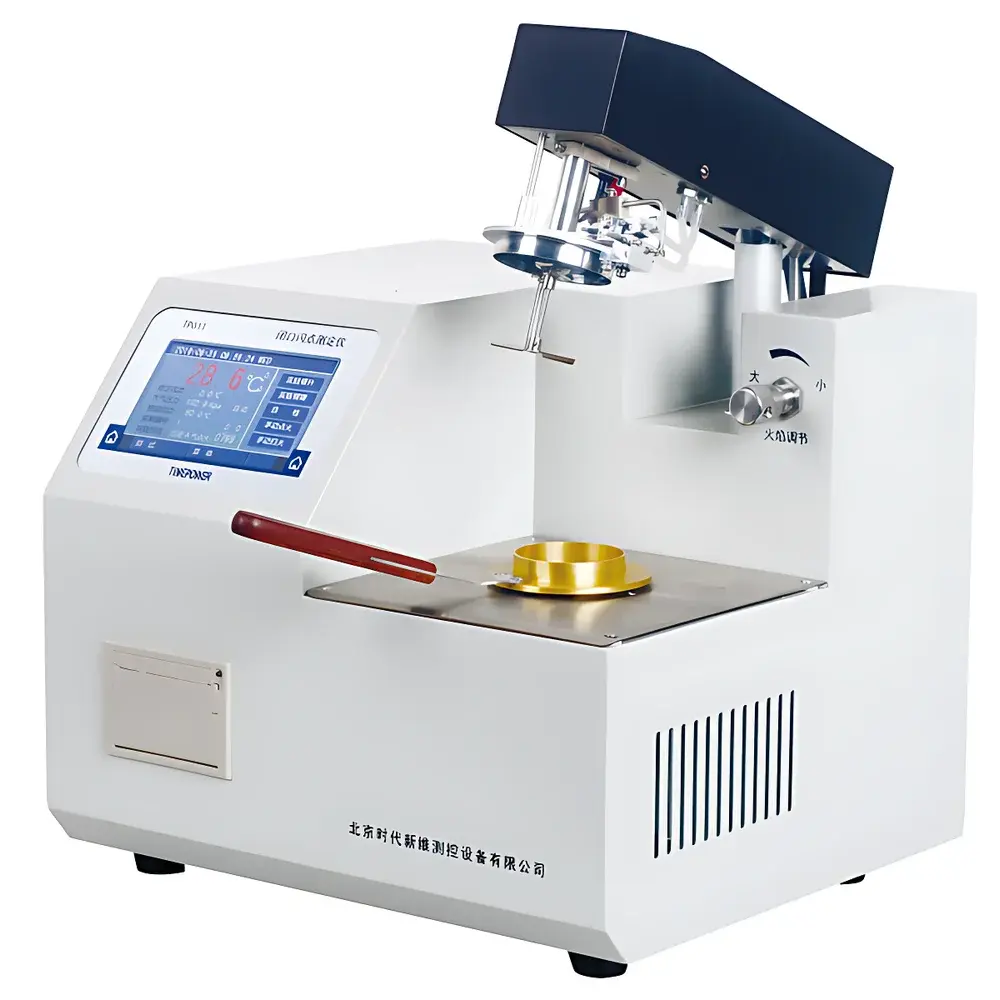
The Timepower TP611 Automatic Closed-Cup Flash Point Tester is a precision-engineered instrument designed for the standardized determination of the closed-cup flash point of petroleum products, lubricants, biodiesel blends, and related hydrocarbon-based liquids. It operates on the principle of controlled heating and automated ignition detection in accordance with internationally recognized test protocols—specifically GB/T 261 (Chinese National Standard) and ASTM D93 (Standard Test Method for Flash Point by Pensky-Martens Closed Cup Tester). The instrument heats a precisely metered sample within a sealed test cup at a regulated rate while continuously monitoring vapor concentration and temperature. When the evolving vapor–air mixture ignites upon exposure to an externally applied ignition source, the corresponding temperature is recorded as the flash point—the lowest temperature at which sufficient vapor is generated to form an ignitable mixture above the liquid surface under defined closed-cup conditions. This measurement serves as a critical safety parameter for transportation, storage, handling, and regulatory classification of flammable liquids across upstream, midstream, and downstream petroleum operations.
Key Features
- Fully automated workflow: integrated control of cup lifting, temperature ramping, stirring, ignition sequence, flash detection, data logging, thermal printing, and post-test air-cooling.
- Dual ignition mode selection: user-switchable between propane-based flame scanning and solid-state electronic spark ignition—enabling flexibility across laboratory gas infrastructure constraints and method-specific requirements.
- Real-time atmospheric pressure compensation: built-in barometric sensor adjusts flash point results per ASTM D93 Annex A1 and ISO 2719 Annex B, ensuring traceable compliance under variable ambient conditions.
- High-resolution thermal control: PID-regulated heating system maintains precise ramp rates (e.g., 1–2 °C/min for initial heating, 0.5–1 °C/min near expected flash point), conforming to standard-defined heating profiles.
- Robust safety architecture: automatic over-temperature cutoff, hardware-level fault diagnostics, mandatory ventilation cabinet operation, and leak-proof cup sealing verification prior to test initiation.
- Intuitive human-machine interface: 260,000-color TFT display (480×272 pixels) with multilingual menu navigation, real-time curve plotting, and on-screen diagnostic prompts.
- Thermal printer with native Chinese character support: generates audit-ready reports including sample ID, date/time stamp, atmospheric pressure, observed flash point, pass/fail status per specification limits, and operator signature field.
Sample Compatibility & Compliance
The TP611 is validated for use with a broad spectrum of petroleum-derived and synthetic fluids—including diesel fuel, jet fuel (Jet A/A-1), transformer oil, hydraulic oil, base oils, cutting fluids, and biodiesel (B5–B20). It excludes highly volatile solvents (e.g., gasoline, acetone) requiring open-cup methods (ASTM D56) or low-flash-point instrumentation (ASTM D3828). All operational procedures align with GLP documentation practices and support 21 CFR Part 11-compliant data integrity when paired with validated LIMS integration protocols. Instrument calibration is traceable to NIM (National Institute of Metrology, China)–certified reference standards, and routine verification follows ASTM D6417 guidance for flash point apparatus performance checks.
Software & Data Management
While the TP611 operates as a standalone embedded-system instrument, its thermal printer output provides permanent, tamper-evident records suitable for internal QA audits and third-party inspections. For laboratories requiring digital archiving, optional RS232/USB interfaces enable secure transfer of ASCII-formatted test logs—including raw temperature vs. time arrays, ignition event timestamps, and environmental metadata—to validated laboratory information management systems (LIMS) or electronic lab notebooks (ELN). All printed reports include unique instrument serial number, firmware version, and operator ID fields to satisfy ISO/IEC 17025 clause 7.8.2 on result reporting traceability.
Applications
- Quality control in refineries and blending terminals for finished fuel certification against ASTM D975, GB 19147, and EN 590 specifications.
- Transformer oil condition monitoring per IEC 60156 and DL/T 706 for insulation integrity assessment.
- Regulatory submission testing for SDS (Safety Data Sheet) Section 9—Flammability classification per GHS Category 1–4.
- R&D screening of alternative fuels and bio-lubricants during formulation development.
- Contract laboratory services supporting API RP 2000, NFPA 30, and DOT 49 CFR §173.120 hazard classification determinations.
FAQ
What standards does the TP611 comply with?
The instrument is designed and verified per GB/T 261–2021 and ASTM D93–22, with full alignment to ISO 2719 and IP 34 methodologies for closed-cup flash point determination.
Is external gas supply mandatory?
No—users may select electronic spark ignition for gas-free operation; propane supply is required only when flame-scanning mode is activated.
How is measurement repeatability ensured?
Through strict adherence to cup pre-conditioning protocols, automated stirrer speed control (250 ± 10 rpm), and algorithmic rejection of false positives via dual-sensor flame confirmation logic.
Can the TP611 be integrated into a networked QC environment?
Yes—via optional serial or USB connectivity, test data can be exported in CSV or TXT format for ingestion into validated LIMS platforms with configurable field mapping.
What maintenance is required for long-term accuracy?
Monthly cleaning of the test cup, ignition electrode, and vapor path with analytical-grade solvent; annual calibration verification using certified reference materials (CRM) traceable to national metrology institutes.