
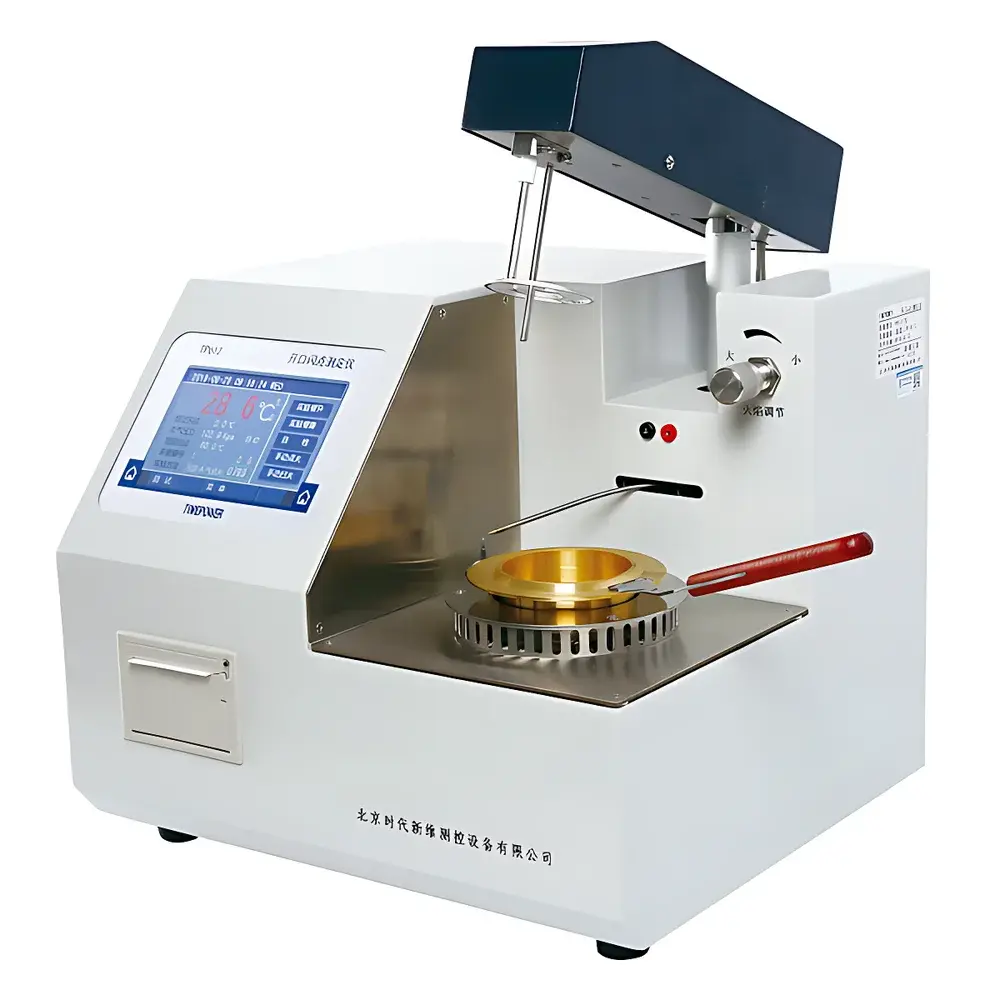
Timepower TP612 Automatic Cleveland Open-Cup Flash Point Tester
| Brand | Timepower |
|---|---|
| Model | TP612 |
| Origin | Beijing, China |
| Manufacturer | Timepower (Producer) |
| Detection Method | Cleveland Open-Cup (COC) |
| Standards Compliance | GB/T 3536, ASTM D92 |
| Measurement Range | 79–370 °C |
| Accuracy | ±2 °C |
| Repeatability | ≤4 °C |
| Resolution | 0.1 °C |
| Temperature Sensor | Pt100 (stainless-steel sheathed) |
| Display | 5.0-inch touch LCD (Chinese interface) |
| Cooling | Integrated forced-air cooling |
| Printer | Thermal printer (36-character Chinese/English output) |
| Power Supply | AC 220 V ±10 %, 50 Hz ±10 % |
| Power Consumption | ≤600 W |
| Dimensions | 350 × 310 × 300 mm |
| Weight | 14.5 kg |
| Atmospheric Pressure Compensation | Yes |
| Ignition Options | Adjustable gas flame scanning or electronic arc ignition |
| Safety Features | Over-temperature cutoff, self-diagnostic system, automatic test arm retraction, flame detection via ionization ring |
Overview
The Timepower TP612 Automatic Cleveland Open-Cup Flash Point Tester is an engineered solution for precise, repeatable determination of the open-cup flash point of petroleum products in accordance with internationally recognized standard test methods—specifically GB/T 3536 (China National Standard) and ASTM D92 (Standard Test Method for Flash and Fire Points by Cleveland Open Cup Tester). Operating on the Cleveland Open-Cup (COC) principle, the instrument heats a standardized sample in a prescribed brass test cup under controlled conditions while applying a calibrated test flame at specified intervals. The flash point is defined as the lowest temperature at which vapors above the heated sample ignite momentarily upon exposure to the test flame—indicating the onset of flammability under atmospheric conditions. This measurement is critical for classifying fuel safety, assessing thermal stability, and ensuring regulatory compliance across refining, distribution, storage, and end-use applications.
Key Features
- Fully automated operation sequence: cup lifting, heating ramp control, flame application, flash detection, data logging, thermal shutdown, and test arm retraction.
- Programmable heating rate compliant with GB/T 3536 and ASTM D92 requirements—enabling reproducible thermal profiles across diverse sample matrices.
- High-sensitivity ionization ring detector for reliable, non-contact flash event recognition—minimizing false positives and operator dependency.
- Integrated atmospheric pressure compensation algorithm—automatically adjusting flash point results to standard reference pressure (101.3 kPa), essential for laboratories operating at variable elevations.
- Dual ignition mode selection: user-switchable between propane-based gas flame scanning (with optional LPG cylinder kit) and solid-state electronic arc ignition—supporting both traditional method fidelity and gas-free operational safety.
- Pt100 platinum resistance thermometer housed in corrosion-resistant stainless-steel sheath—ensuring long-term calibration stability and traceable temperature measurement within ±2 °C accuracy.
- Embedded forced-air cooling system—reducing post-test cooldown time and enabling high-throughput analysis without external chillers.
- Comprehensive safety architecture: over-temperature cutoff, real-time fault diagnostics, flame-out detection, and automatic power disengagement upon flash confirmation.
Sample Compatibility & Compliance
The TP612 is validated for use with lubricating oils, residual fuels, distillate fuels (including diesel, heating oil, and marine bunker fuels), bituminous materials, and other non-volatile or semi-volatile petroleum derivatives where open-cup flash point assessment is mandated. It supports routine quality control per ISO 2719 (flash point—Cleveland open cup method), and aligns with regulatory frameworks including China’s GB 17411 (Marine Fuel Specifications), GB 19147 (Diesel Fuel for Vehicles), and ASTM specification families governing fuel handling safety. While not intrinsically rated for hazardous area installation, the instrument is designed for safe operation inside certified fume hoods with controlled airflow—meeting general laboratory safety best practices outlined in ANSI Z9.5 and ISO 15195.
Software & Data Management
The TP612 operates via embedded firmware with a localized Chinese-language 5.0-inch capacitive touchscreen interface—providing intuitive navigation through test setup, parameter configuration, real-time temperature curve visualization, and result review. All measurements are timestamped and stored internally with automatic thermal printout (36-character thermal printer supporting bilingual character sets). Data export is supported via USB interface for integration into LIMS or QA documentation systems. Though the device does not include network connectivity or 21 CFR Part 11-compliant electronic signatures out-of-the-box, its audit-ready output—including raw temperature logs, flash event timestamps, atmospheric pressure readings, and operator ID fields—facilitates GLP/GMP-aligned recordkeeping when paired with procedural SOPs and manual logbook supplementation.
Applications
- Quality assurance labs in refineries verifying conformance of diesel, jet fuel, and heavy fuel oil to flash point specifications prior to shipment.
- Power generation facilities monitoring insulating oil degradation and detecting low-flash contaminants in transformer and turbine oils.
- Third-party testing agencies performing accredited flash point determinations for customs clearance, insurance risk classification, and transportation hazard labeling (UN TDG, IMDG Code Class 3).
- R&D laboratories evaluating formulation stability of biofuels, synthetic lubricants, and additive packages under accelerated thermal stress.
- Government metrology institutes conducting interlaboratory comparisons and proficiency testing using reference standards traceable to NIM (National Institute of Metrology, China) or NIST SRMs.
FAQ
What standards does the TP612 comply with?
The instrument fully implements GB/T 3536 and ASTM D92 for Cleveland Open-Cup flash point determination, with built-in logic for ramp rate control, flame positioning, and pass/fail criteria per clause requirements.
Is the TP612 suitable for testing highly volatile solvents?
No—this is an open-cup instrument intended for samples with flash points ≥79 °C. Highly volatile liquids (e.g., gasoline, acetone) require closed-cup testers such as Pensky-Martens (ASTM D93) or Tag (ASTM D56) apparatuses.
Can test data be exported digitally?
Yes—results and temperature logs can be saved to USB storage in CSV format for downstream analysis or LIMS ingestion.
Does the TP612 require external gas supply?
Gas ignition is optional; the unit supports both propane-based flame scanning (with included regulator and hose) and flameless electronic arc ignition—eliminating gas dependency where required.
How often should calibration verification be performed?
Users should verify temperature accuracy before each daily shift using certified reference standards (e.g., NIST-traceable flash point standards at 110 °C, 200 °C, and 300 °C) per internal QA protocols or ISO/IEC 17025 Clause 6.6.





