
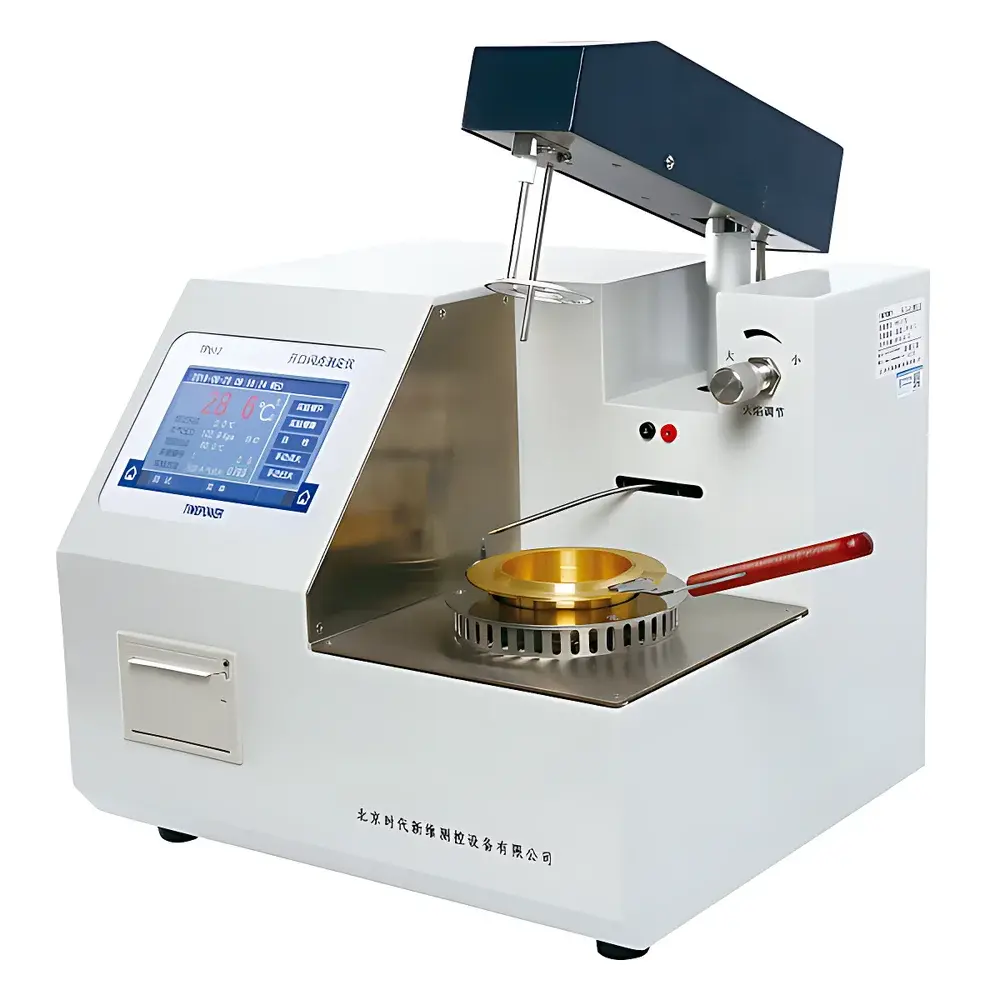
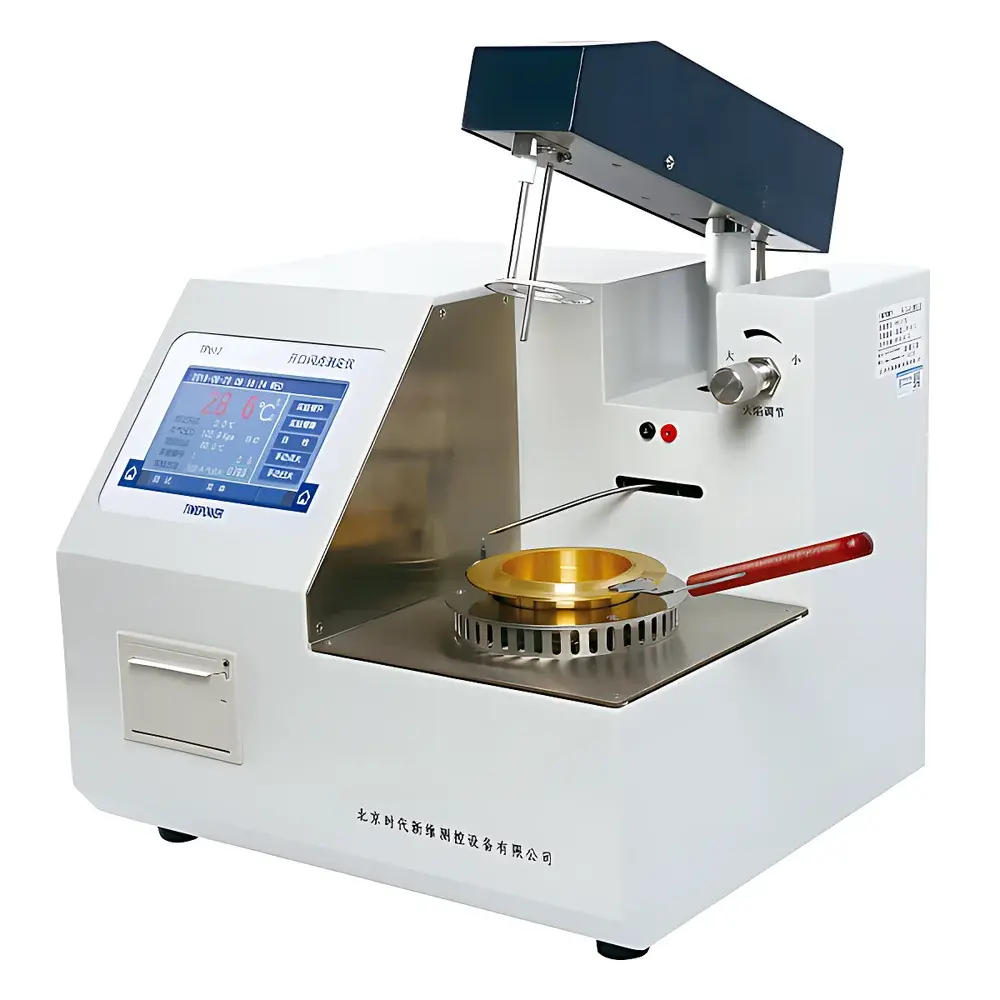
Timepower TP612 Automatic Cleveland Open-Cup Flash Point Tester
| Brand | Timepower |
|---|---|
| Origin | Beijing, China |
| Manufacturer | Timepower |
| Country of Origin | China |
| Model | TP612 |
| Detection Method | Cleveland Open-Cup (COC) |
| Standards Compliance | GB/T 3536, ASTM D92 |
| Measurement Range | 79–370 °C |
| Accuracy | ±2 °C |
| Repeatability | ≤4 °C |
| Resolution | 0.1 °C |
| Temperature Sensor | Pt100 (stainless steel sheath) |
| Ignition Modes | Adjustable gas flame scanning or electronic arc ignition |
| Atmospheric Pressure Compensation | Yes |
| Cooling Method | Integrated forced-air cooling |
| Display | 480×272 TFT color LCD (260K colors) |
| Printer | Thermal, 36-character Chinese/English output |
| Power Supply | AC 220 V ±10%, 50 Hz ±10% |
| Power Consumption | ≤600 W |
| Dimensions | 350 × 310 × 300 mm |
| Weight | 14.5 kg |
| Environmental Operating Conditions | 5–40 °C, RH ≤85% |
Overview
The Timepower TP612 Automatic Cleveland Open-Cup Flash Point Tester is a precision-engineered instrument designed for the accurate determination of the open-cup flash point of petroleum products in accordance with internationally recognized standard test methods—specifically GB/T 3536 (Chinese National Standard) and ASTM D92 (Standard Test Method for Flash and Fire Points by Cleveland Open Cup Tester). Based on the Cleveland open-cup principle, the instrument heats a representative oil sample in a standardized brass test cup under controlled conditions while continuously monitoring vapor concentration and temperature. When the evolving hydrocarbon vapor–air mixture above the sample surface ignites momentarily upon exposure to a calibrated test flame (or electronic arc), the corresponding temperature is recorded as the flash point—the lowest temperature at which this transient ignition occurs. This parameter serves as a critical safety indicator for storage, transportation, handling, and regulatory classification of flammable and combustible liquids across upstream, midstream, and downstream petroleum operations.
Key Features
- Fully automated operation sequence: cup positioning, heating ramp control, flame application, flash detection, data logging, thermal shutdown, and test arm retraction.
- Programmable heating rate compliant with ASTM D92 and GB/T 3536 requirements, ensuring reproducible thermal profiles across diverse sample matrices.
- High-sensitivity ionization ring detection system for reliable, non-contact flash event recognition—minimizing false positives and operator dependency.
- Dual ignition mode selection: user-switchable between propane-based gas flame scanning (with integrated gas regulator and safety cutoff) and solid-state electronic arc ignition—enabling flexibility in laboratory environments where gas infrastructure is unavailable or restricted.
- Real-time atmospheric pressure compensation algorithm—automatically adjusts flash point results to standard reference pressure (101.3 kPa), essential for inter-laboratory comparability and regulatory reporting.
- Pt100 platinum resistance thermometer housed in corrosion-resistant stainless-steel sheath—providing long-term stability, traceable calibration, and immunity to thermal drift.
- Integrated forced-air cooling module reduces post-test cooldown time by >40% versus passive dissipation, supporting higher throughput in QC laboratories.
- Comprehensive self-diagnostic firmware: monitors heater integrity, sensor continuity, flame status, gas flow (if applicable), and mechanical actuator position—reporting fault codes via on-screen interface.
Sample Compatibility & Compliance
The TP612 is validated for use with a broad spectrum of petroleum-derived and synthetic lubricants, residual fuels, bitumens, biodiesel blends (B5–B20), transformer oils, and hydraulic fluids exhibiting kinematic viscosities up to 150 mm²/s at 40 °C. It excludes highly volatile solvents (e.g., gasoline, acetone) requiring closed-cup methodology (ASTM D56 or D3828). All operational parameters—including cup geometry, stirrer speed, flame dimensions, and approach velocity—are strictly aligned with the physical specifications defined in ASTM D92 Annex A1 and GB/T 3536 Clause 5. The instrument supports GLP-compliant workflows through audit-trail-capable data storage and optional USB export of raw temperature/time datasets. While not FDA 21 CFR Part 11–certified out-of-the-box, its deterministic control logic and immutable result logging meet baseline requirements for ISO/IEC 17025-accredited testing laboratories conducting flash point verification per ISO 2719 (equivalent to ASTM D92).
Software & Data Management
The embedded firmware features a real-time operating system (RTOS) with deterministic timing control for thermal ramping and flame synchronization. All measurement data—including ambient pressure, setpoint vs. actual temperature curves, flash event timestamp, and diagnostic logs—are stored internally in non-volatile memory with timestamping resolution of 1 second. The 480×272 TFT display provides intuitive navigation through test setup, live graphing, historical result review, and calibration menu access. Thermal printer output includes sample ID, operator code, test date/time, atmospheric pressure, measured flash point, and pass/fail status against internal specification limits. Data export is supported via USB 2.0 port in CSV format for integration into LIMS or statistical process control (SPC) platforms. No proprietary software installation is required; exported files are natively readable in Excel, Minitab, or JMP.
Applications
- Quality assurance of crude oil fractions and refinery intermediates prior to pipeline transfer or blending.
- Regulatory compliance testing for UN GHS Classification (Category 3 or 4 flammables) and transport documentation (IMDG Code, ADR/RID).
- Condition monitoring of in-service turbine and transformer oils—detecting low-molecular-weight contaminant ingress (e.g., fuel dilution, solvent carryover).
- Specification conformance verification per ASTM D975 (diesel fuel), ASTM D36 (asphalt), or IEC 60296 (electrical insulating oils).
- R&D screening of bio-based lubricants and synthetic esters during formulation development.
- Third-party certification testing for ISO 8502-2 (coating flammability) and MIL-PRF-23699 (aviation turbine oil).
FAQ
What standards does the TP612 comply with?
The instrument fully implements the procedural and apparatus requirements of GB/T 3536 and ASTM D92 for Cleveland open-cup flash point determination.
Can the TP612 be used for closed-cup flash point testing?
No—it is exclusively configured for open-cup methodology. Closed-cup applications require instruments conforming to ASTM D56, D3828, or ISO 2719.
Is external gas supply mandatory?
Gas operation is optional. The dual-mode ignition system allows full functionality using electronic arc ignition without propane or butane infrastructure.
How is temperature calibration verified?
Calibration is performed using NIST-traceable reference standards (e.g., mercury-in-glass thermometers or certified PRTs) at three points across the operating range (100 °C, 200 °C, 300 °C), with adjustment accessible via service-level password protection.
Does the instrument support network connectivity or remote monitoring?
The base configuration lacks Ethernet or Wi-Fi; however, USB data export enables offline integration with centralized lab informatics systems. Optional RS-232 interface kits are available for legacy SCADA compatibility.





