
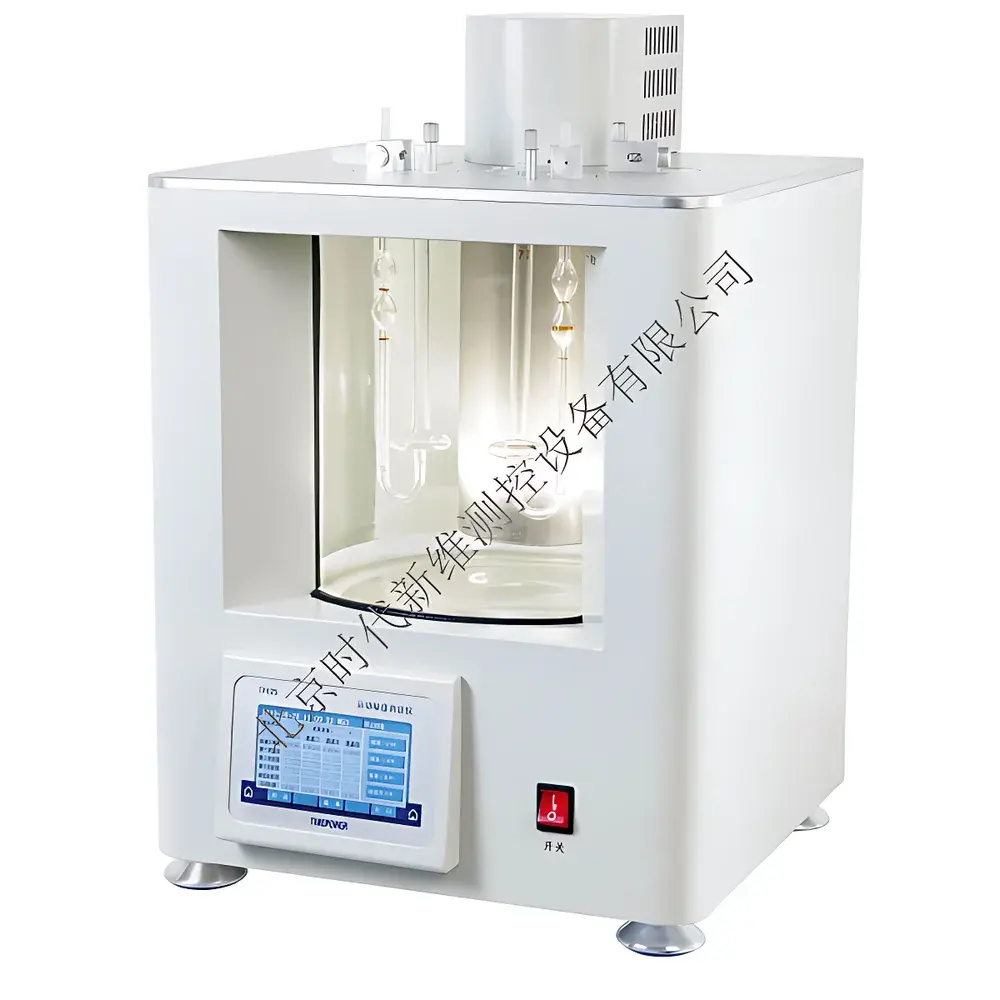
Timepower TP625 Automatic Kinematic Viscometer
| Brand | Timepower |
|---|---|
| Origin | Beijing, China |
| Manufacturer Type | Direct Manufacturer |
| Country of Origin | China |
| Model | TP625 |
| Quotation | Upon Request |
| Temperature Control Range | 0–120 °C (0 °C to ambient requires optional chiller) |
| Temperature Accuracy | ±0.05 °C |
| Temperature Resolution | 0.01 °C |
| Bath Capacity | 4 capillary positions |
| Power Supply | AC 220 V ±10%, 50 Hz ±10% |
| Heating Power | ≤1500 W |
| Dimensions | 510 × 360 × 470 mm |
| Weight | 20 kg |
| Operating Environment | 5–40 °C, ≤85% RH |
| Display | Imported true-color LCD with real-time clock (year/month/day/hour/minute, battery-backed) |
| Control Method | PID temperature regulation |
| Sensor | Imported high-sensitivity platinum RTD |
| Illumination | Integrated LED lighting for capillary observation |
| Optional Accessories | Ubbelohde-type viscometer (standard), reverse-flow viscometer (optional) |
| Compliance | Designed per GB/T 265–1988 (equivalent to ASTM D445 and ISO 3104) |
Overview
The Timepower TP625 Automatic Kinematic Viscometer is a precision laboratory instrument engineered for the standardized determination of kinematic viscosity in transparent and opaque petroleum products, lubricants, and related hydrocarbon-based fluids. It operates on the principle of gravity-driven capillary flow—measuring the time required for a fixed volume of liquid to pass between two etched marks in a calibrated glass capillary tube immersed in a thermostatically controlled bath. This method conforms rigorously to GB/T 265–1988, which is technically aligned with ASTM D445 (Standard Test Method for Kinematic Viscosity of Transparent and Opaque Liquids) and ISO 3104 (Petroleum products — Determination of kinematic viscosity and calculation of dynamic viscosity). The instrument integrates microprocessor-based control, high-stability PID thermal regulation, and real-time monitoring to ensure repeatability within ±0.05 °C across its full operational range (0–120 °C), enabling reliable characterization of viscosity-temperature behavior critical for specification compliance and formulation development.
Key Features
- Four-position constant-temperature bath with independent capillary mounting slots, supporting parallel or sequential testing under identical thermal conditions.
- PID-controlled heating system utilizing imported platinum resistance temperature detectors (RTDs), delivering stable thermal equilibrium with ±0.05 °C accuracy and 0.01 °C digital resolution.
- True-color LCD interface with embedded real-time clock (battery-backed for uninterrupted timekeeping during power loss), providing intuitive navigation and simultaneous display of temperature, elapsed time, and viscosity results.
- Integrated LED illumination system positioned to enhance optical clarity during manual timing verification or capillary inspection—critical for minimizing parallax error in manual mode or operator validation.
- Modular design accommodating both standard Ubbelohde-type capillaries (included) and reverse-flow capillaries (optional), extending applicability to high-viscosity or volatile samples per ASTM D2161 and ISO 1043.
- Optional chiller integration pathway for sub-ambient testing down to 0 °C, supporting low-temperature kinematic viscosity evaluation required for winter-grade fuels and multigrade engine oils.
Sample Compatibility & Compliance
The TP625 is validated for use with mineral oils, synthetic lubricants, transformer oils, diesel fuels, jet fuels, and other Newtonian or near-Newtonian petroleum distillates meeting transparency and volatility criteria defined in ASTM D445 Annex A1. It supports kinematic viscosity reporting in mm²/s (cSt) across ranges from 0.2 to 300,000 mm²/s, contingent upon capillary selection and sample density input. All thermal and timing functions comply with GLP documentation requirements: timestamped test records, operator ID logging (via external software integration), and audit-ready calibration traceability. Instrument design aligns with electrical safety standards IEC 61010-1 and electromagnetic compatibility per EN 61326-1. Routine operation satisfies quality assurance protocols mandated by ISO/IEC 17025-accredited laboratories and regulatory submissions under CNAS, CMA, and state-level market supervision frameworks.
Software & Data Management
While the TP625 operates as a standalone benchtop unit with embedded firmware, its RS-232 serial interface enables bidirectional communication with external LIMS or laboratory data management systems. Exported datasets include raw efflux time(s), bath temperature at measurement, user-defined density value, calculated kinematic viscosity (mm²/s), and metadata (date/time, operator ID if assigned, capillary calibration constant). Firmware supports configurable averaging (2–6 runs per sample), automatic outlier rejection per ASTM D445 Section 11.2, and linear interpolation between reference temperatures. Calibration certificate templates follow ISO/IEC 17025 Annex C guidelines, and all temperature sensor drift logs are retained internally for 12 months to support internal QA audits.
Applications
- Quality control of transformer oil in power generation and transmission facilities, verifying conformance to IEC 60296 and GB/T 7595 specifications.
- Routine assessment of aviation turbine fuel (Jet A-1, JP-8) kinematic viscosity per ASTM D1655 and DEF STAN 91-91.
- Research and development of multigrade engine oils, where viscosity index (VI) calculations depend on precise 40 °C and 100 °C kinematic data per ASTM D2270.
- Import/export inspection of crude oil fractions and refined products under customs laboratory protocols (e.g., CIQ, AQSIQ).
- Academic and industrial studies on temperature-dependent rheological behavior of biofuels and synthetic esters.
FAQ
What capillary viscometers are compatible with the TP625?
Ubbelohde-type capillaries (supplied as standard) and reverse-flow capillaries (available as optional accessories) are supported. Capillary constants must be entered manually or imported via serial interface.
Does the instrument meet ASTM D445 requirements for automated timing?
Yes—the TP625 implements electronic timing initiation and termination synchronized with bath thermal stability detection, satisfying ASTM D445 Section 8.2 for automated systems when used with certified capillaries and validated procedures.
Is GLP-compliant data export possible?
Raw timing and temperature data can be exported in CSV format via RS-232; full audit trails require integration with validated third-party LIMS software supporting 21 CFR Part 11 electronic signatures.
Can the TP625 operate continuously at 100 °C for extended periods?
Yes—its reinforced stainless-steel bath chamber and optimized heat dissipation architecture enable uninterrupted operation at 100 °C for ≥72 hours, verified per manufacturer thermal stress testing reports.
How often should temperature calibration be performed?
Daily verification using a NIST-traceable mercury-in-glass thermometer is recommended prior to first test; full recalibration of the RTD sensor is advised every 6 months or after 500 operating hours, whichever occurs sooner.







