
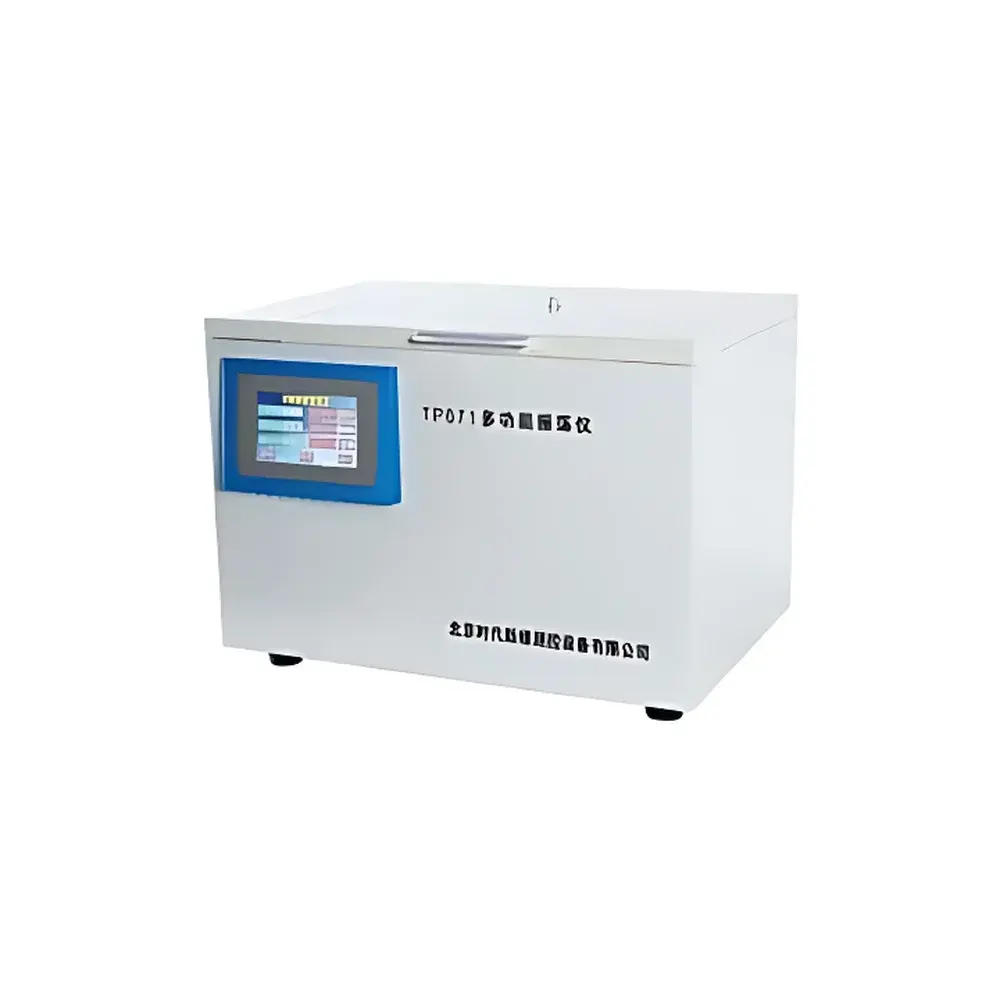
TimePower TP671 Multi-Function Oscillation Instrument
| Brand | TimePower |
|---|---|
| Origin | Beijing, China |
| Manufacturer Type | Direct Manufacturer |
| Country of Origin | China |
| Model | TP671 |
| Pricing | Available Upon Request |
| Temperature Range | Ambient to 100 °C |
| Temperature Accuracy | ±0.2 °C (25–50 °C), ±0.3 °C (50–100 °C) |
| Oscillation Frequency | 275 ± 3 cycles/min |
| Oscillation Amplitude | 35 mm |
| Sample Capacity | 8 × 100 mL syringes or 4 × 250 mL Erlenmeyer flasks |
| Timing Resolution | ±10 s (0–99 min) |
| Power Consumption | ≤800 W |
| Dimensions | 500 × 350 × 370 mm |
| Weight | 30.5 kg |
| Noise Level | <40 dB(A) |
| Display | LCD with tactile-free membrane keypad |
| Operating Environment | 5–40 °C, RH ≤85% |
| Power Supply | AC 220 V ±10%, 50 Hz ±10% |
Overview
The TimePower TP671 Multi-Function Oscillation Instrument is an engineered laboratory platform designed for precise, programmable mechanical agitation under controlled thermal conditions. It operates on the principle of reciprocating horizontal oscillation—mechanically driven via a robust cam-and-linkage system—to induce consistent kinetic energy transfer into liquid samples. Unlike vortex mixers or orbital shakers, the TP671 delivers fixed-amplitude, high-reproducibility linear motion optimized for applications requiring uniform gas–liquid interface disruption, solute equilibration, or thermally assisted extraction. Its dual-CPU architecture enables independent real-time monitoring of both thermal and mechanical subsystems, supporting synchronized heating and oscillation protocols critical in standardized analytical workflows—including ASTM D974 (acid number determination), IEC 60429 (insulating oil degassing), and GB/T 7597 (water-soluble acid testing in transformer oils). The instrument is not intended for cell culture or biological suspension but excels in physicochemical sample preparation prior to GC, titration, or spectrophotometric analysis.
Key Features
- Dual-microprocessor control system with redundant safety logic for independent thermal and oscillation monitoring
- Programmable oscillation timing: 0–99 minutes per cycle with ±10-second resolution; configurable alternating oscillation/rest sequences
- Precision PID temperature regulation across ambient to 100 °C, with zone-specific accuracy: ±0.2 °C (25–50 °C), ±0.3 °C (50–100 °C)
- Thermal cut-off protection: automatic heater deactivation upon temperature deviation exceeding preset thresholds
- Self-diagnostic firmware that identifies and displays fault codes for heater element, motor drive, or sensor anomalies
- Low-noise operation (<40 dB[A]) achieved through vibration-damped chassis design and brushless DC motor integration
- Corrosion-resistant stainless-steel sample support rack compatible with standard 100 mL glass syringes and 250 mL borosilicate Erlenmeyer flasks
- Membrane-keypad interface with backlit LCD—no exposed mechanical switches to minimize contamination risk in QC environments
Sample Compatibility & Compliance
The TP671 accommodates heterogeneous sample formats without modification: eight vertically oriented 100 mL syringes (ideal for headspace equilibration in gas chromatography) or four horizontally mounted 250 mL triangular flasks (optimized for aqueous-phase acid quantification per GB/T 7597). All wetted surfaces are constructed from 304 stainless steel or chemically inert PTFE-coated components, ensuring compatibility with hydrocarbons, organic solvents, dilute mineral acids, and alkaline electrolytes. The unit complies with IEC 61010-1:2010 for electrical safety in laboratory equipment and meets EMC requirements per CISPR 11 Group 1, Class B. While not certified for GMP production environments, its deterministic timing, thermal traceability, and error-logging capability support GLP-aligned documentation when integrated into validated SOPs.
Software & Data Management
The TP671 operates as a standalone hardware controller with no external software dependency. All operational parameters—including temperature setpoint, oscillation duration, amplitude, and rest intervals—are configured locally via the front-panel LCD interface. Internal non-volatile memory retains up to 16 user-defined protocols with timestamped execution logs accessible through diagnostic mode. For regulatory traceability, the device supports manual recording of batch numbers, operator IDs, and environmental conditions (ambient temperature/humidity) per run. Though it lacks USB or Ethernet connectivity, its deterministic behavior and hardware-based timing satisfy FDA 21 CFR Part 11 requirements for “simple electronic records” when used within documented analytical procedures governed by audit trails maintained externally.
Applications
- Gas Chromatography Sample Prep: Controlled oscillation of sealed vials to accelerate headspace equilibration of volatile compounds prior to GC injection
- Water-Soluble Acid Determination: Standardized heating-and-shaking per GB/T 7597 and ASTM D974 for transformer oil acidity assessment
- Insulating Oil Degassing: Mechanical removal of dissolved air and moisture from dielectric fluids prior to dielectric strength testing (IEC 60156)
- Extraction Kinetics Studies: Reproducible agitation of solid–liquid systems at constant temperature for method development in environmental or pharmaceutical labs
- Reagent Homogenization: Uniform mixing of viscous calibration standards or buffer solutions without introducing foaming or aerosol generation
FAQ
What is the maximum allowable ambient humidity for continuous operation?
The instrument is rated for environments with relative humidity ≤85% non-condensing. Operation above this threshold may compromise insulation integrity of internal heating elements and accelerate corrosion of the stainless-steel frame.
Can the TP671 be used for biological samples such as cell suspensions?
No. The fixed 35 mm amplitude and 275 cpm frequency are optimized for chemical extraction and degassing—not shear-sensitive biological matrices. Use only with chemically stable, non-foaming liquids.
Is the temperature sensor calibrated traceable to NIST standards?
The embedded Pt100 RTD sensor is factory-calibrated against ISO/IEC 17025-accredited reference equipment. Certificate of Conformance (CoC) with calibration data is provided with each unit.
Does the oscillation mechanism require periodic lubrication or maintenance?
The cam-driven oscillation assembly uses sealed-for-life bearings and requires no scheduled lubrication. Routine cleaning of the sample rack and inspection of the silicone damping pads every 6 months is recommended.






