
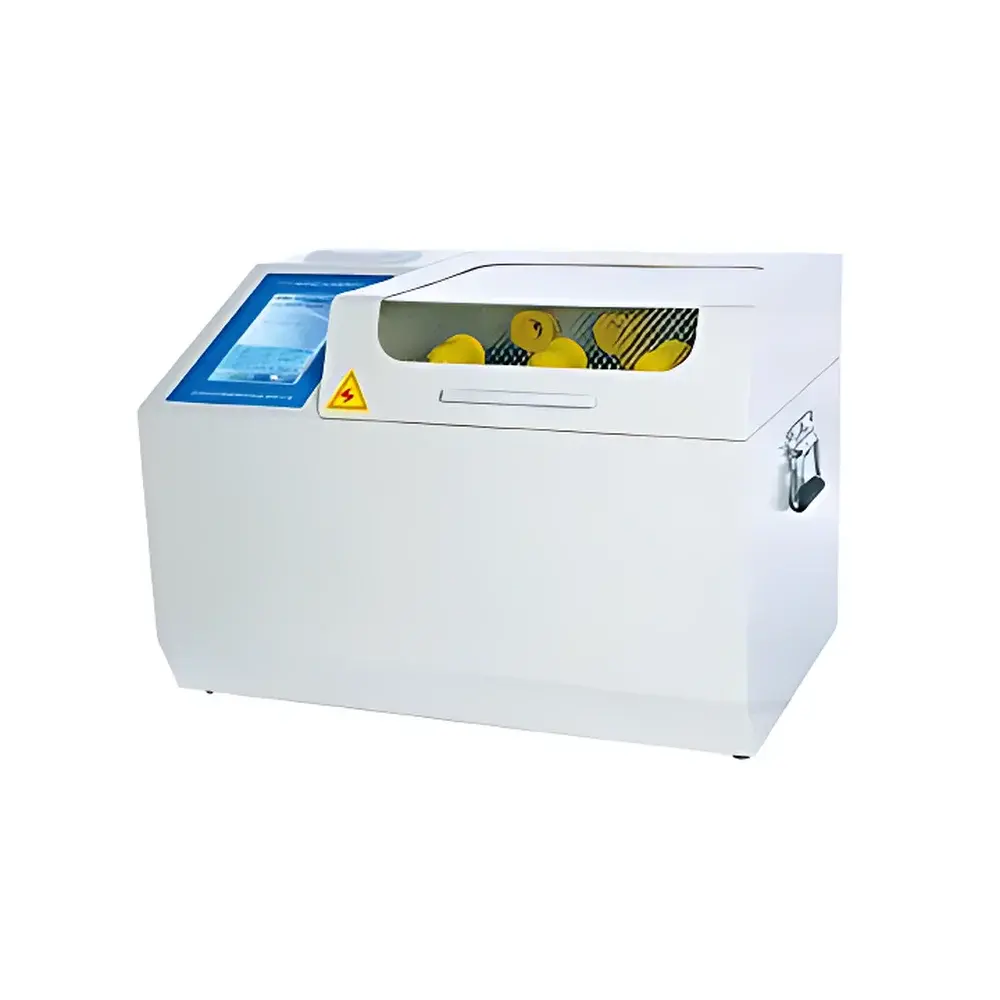
Timepower TP672 Insulating Oil Dielectric Strength Tester
| Brand | Timepower |
|---|---|
| Origin | Beijing, China |
| Manufacturer Type | Direct Manufacturer |
| Country of Origin | China |
| Model | TP672 |
| Quotation | Upon Request |
| Standard Compliance | GB/T 507, IEC 60156 |
| Measurement Principle | AC Dielectric Breakdown Voltage (BDV) under Controlled Ramp Voltage |
| Voltage Range | 0–80 kV |
| Resolution | 0.1 kV |
| Accuracy | ±2% of full scale |
| Rising Rate Options | 2.0 kV/s and 3.0 kV/s (adjustable within 2.0–3.0 kV/s) |
| Test Repetition | 1–9 cycles (default: 6) |
| Oil Cup Configuration | Triple-cup station with magnetic stirring |
| Stirring Duration | Adjustable (0–59 min) |
| Resting Time | Default 15 min (0–59 min adjustable) |
| Inter-test Interval | Adjustable (0–9 min, default 3–5 min) |
| Display | LCD panel with real-time voltage and status feedback |
| Protection | Overvoltage, overcurrent, auto-zero reset, and fail-safe arc suppression |
| Power Supply | AC 220 V ±10%, 50 Hz ±10% |
| Operating Environment | 5–40 °C, ≤85% RH |
| Dimensions | 610 × 410 × 425 mm |
| Weight | 45 kg |
| Transformer Type | Dry-type, compact modular design |
| Data Handling | Internal non-volatile memory for test records |
Overview
The Timepower TP672 Insulating Oil Dielectric Strength Tester is an automated, microprocessor-controlled instrument engineered for precise determination of the dielectric breakdown voltage (BDV) of transformer oils and other insulating liquids used in high-voltage electrical equipment. It operates in strict accordance with internationally recognized standards—including GB/T 507 (China National Standard) and IEC 60156 (International Electrotechnical Commission)—ensuring metrological traceability and regulatory alignment for laboratories engaged in power system maintenance, oil condition monitoring, and preventive maintenance programs. The device applies a continuously increasing sinusoidal AC voltage across two standardized spherical electrodes immersed in a sample volume of insulating oil, until electrical breakdown occurs. This measured breakdown voltage serves as a primary indicator of contamination level, moisture content, and overall dielectric integrity—critical parameters for assessing serviceability of transformer oil in utility substations, generator step-up transformers, circuit breakers, capacitors, and bushings.
Key Features
- Dual-CPU architecture enabling synchronized control of voltage ramping, magnetic stirring, timing sequences, and safety interlocks.
- Programmable voltage rise rates: selectable 2.0 kV/s or 3.0 kV/s (continuously adjustable within 2.0–3.0 kV/s), compliant with both GB/T 507 and IEC 60156 test protocols.
- Triple-oil-cup station supporting sequential or parallel testing with independent electrode alignment and automatic cup indexing.
- Integrated dry-type high-voltage transformer assembly—compact, lightweight, and thermally stable—eliminating oil leakage risks associated with traditional oil-filled units.
- Full-cycle automation: auto-stirring, rest period enforcement, voltage ramp initiation, breakdown detection, voltage decay, and zero-reset—all executed without operator intervention.
- Comprehensive hardware protection suite: real-time overvoltage cutoff, current-limiting circuitry, arc-quenching response <10 ms, and mechanical interlock verification prior to test initiation.
- LCD interface with intuitive menu navigation, real-time kV display, pass/fail flagging, and on-screen test history summary.
Sample Compatibility & Compliance
The TP672 is validated for use with mineral-based, synthetic, and bio-based insulating oils meeting ASTM D877 and ASTM D1816 specifications. It accommodates standard 25-mm-diameter spherical electrodes per IEC 60156 and GB/T 507, with optional electrode calibration kits available for periodic verification. All test sequences adhere to mandatory pre-test conditioning requirements—including minimum 15-minute静止 (rest) time post-stirring—and enforce configurable inter-test intervals (3–5 minutes default) to allow dielectric recovery and thermal stabilization. The instrument’s firmware embeds audit-ready event logging (date/time stamp, operator ID placeholder, test sequence ID), supporting GLP-compliant documentation workflows. While not inherently 21 CFR Part 11 compliant out-of-the-box, its data export capability (via thermal printout) enables integration into validated LIMS or QA documentation systems.
Software & Data Management
No external PC software is required for basic operation; all control logic resides in embedded firmware. Test results—including breakdown voltage (kV), test number, date/time stamp, and pass/fail status—are stored in non-volatile memory (capacity: ≥500 records). Users may recall, review, and print historical data directly from the front panel. Exported printouts include instrument ID, model number, firmware version, and compliance statement referencing GB/T 507 and IEC 60156. For enterprise-level integration, ASCII-formatted data logs can be captured via RS-232 serial output (optional cable kit available) and imported into Excel, LabWare, or custom QA databases. Firmware updates are performed via secure USB interface with version-locking and checksum validation.
Applications
This tester supports routine quality assurance in transmission and distribution utilities, OEM transformer manufacturing facilities, third-party oil analysis laboratories, and industrial plant maintenance departments. Typical use cases include incoming inspection of new oil batches, periodic in-service oil evaluation per IEEE C57.106 guidelines, root-cause analysis following transformer faults, and qualification of reclaimed or reconditioned oils. Its triple-cup configuration enhances throughput in high-volume labs, while adjustable resting/stirring intervals allow method adaptation for aged oils exhibiting slow polarization relaxation. The 80 kV upper range covers all common distribution- and sub-transmission-class equipment; 100 kV variants are available under special order for EHV transformer applications.
FAQ
What standards does the TP672 comply with?
It fully implements GB/T 507 and IEC 60156 for AC dielectric strength testing of insulating oils.
Is calibration certification included with shipment?
A factory calibration report traceable to national metrology institutes is provided; ISO/IEC 17025-accredited calibration services are available upon request.
Can the instrument be used with non-standard electrode geometries?
No—it is configured exclusively for 25-mm spherical electrodes as specified in GB/T 507 and IEC 60156; alternative configurations invalidate compliance claims.
How is safety ensured during high-voltage operation?
Hardware-enforced interlocks prevent test initiation unless the test chamber is fully closed and grounded; overcurrent shutdown activates within 10 ms of arc inception.
What maintenance is required for long-term accuracy?
Annual verification of electrode gap (2.5 ± 0.1 mm), stirrer torque consistency, and high-voltage divider linearity is recommended; full recalibration every 24 months.






