
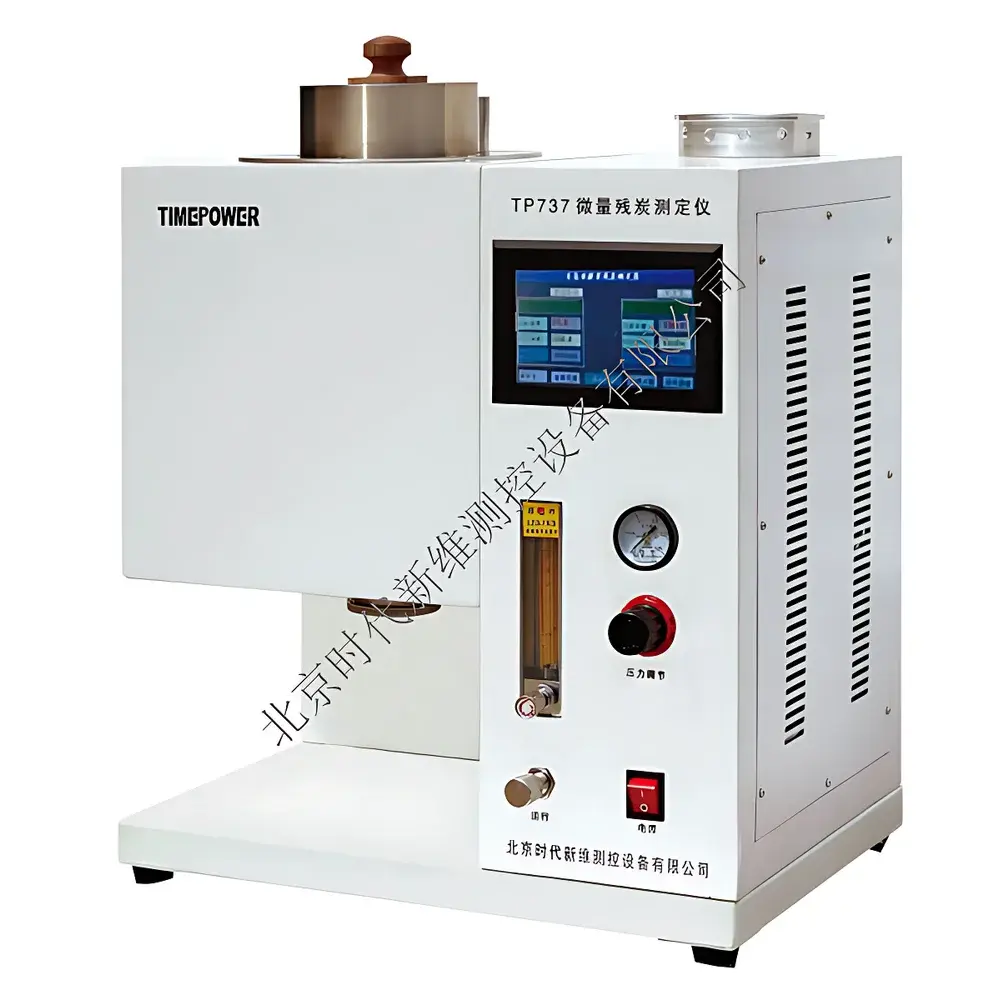
Timepower TP737 Micro Carbon Residue Tester
| Brand | Timepower |
|---|---|
| Model | TP737 |
| Origin | Beijing, China |
| Manufacturer | Timepower Instrument Co., Ltd. |
| Application Standard | ASTM D7042 / GB/T 17144–1997 |
| Temperature Range | 0.0–1372 °C |
| Temp. Resolution | 0.1 °C (≤999.9 °C), 1 °C (>999.9 °C) |
| Temp. Accuracy | ±0.2% of reading |
| Power Supply | AC 220 V ±10%, 50 Hz ±10% |
| Max. Power Consumption | ≤2 kW |
| Dimensions (H×W×D) | 500 × 400 × 360 mm |
| Weight | Approx. 32 kg |
| Gas Requirement | High-purity N₂ (≥99.99%), regulated pressure ≥0.08 MPa |
| Safety Features | Overtemperature alarm (520 °C), low-N₂-pressure interlock, insulated furnace housing, ergonomic heat-shielded lid handle |
Overview
The Timepower TP737 Micro Carbon Residue Tester is an automated, micro-method carbon residue analyzer engineered for precision and regulatory compliance in petroleum product quality control laboratories. It implements the standardized micro carbon residue (MCR) test principle defined in ASTM D7042 and GB/T 17144–1997, which quantifies the carbonaceous deposit formed when a weighed sample of petroleum product undergoes controlled thermal decomposition under an inert nitrogen atmosphere. Unlike the older Conradson or Ramsbottom methods, the MCR procedure uses smaller sample volumes (typically 0.5–1.0 g), minimizes operator intervention, and delivers highly reproducible results with improved inter-laboratory agreement—making it the preferred method for modern refinery QC, lubricant formulation labs, and third-party testing facilities subject to ISO/IEC 17025 accreditation.
Key Features
- 5-inch high-resolution TFT color touchscreen interface with intuitive icon-driven navigation and real-time graphical display of temperature ramp, gas flow rate, and elapsed time.
- Fully automated thermal program execution: pre-configured heating profiles per ASTM D7042 (e.g., 300 °C hold → 500 °C final soak) with PID-controlled furnace zones ensuring ±1 °C stability at target temperatures.
- Integrated mass-flow controller for precise nitrogen purge regulation (0–20 L/min range, ±1% FS accuracy), synchronized with thermal events to ensure complete volatiles removal and prevent oxidative charring.
- Embedded Linux-based operating system with non-volatile flash memory—designed for continuous 24/7 operation without OS-level instability or reboot requirements.
- Double-walled, ceramic-fiber insulated high-temperature furnace chamber (rated to 1372 °C) with redundant thermal cutoffs and surface temperature monitoring to maintain external housing <50 °C during operation.
- On-device data processing engine: automatically calculates MCR (%) as (mass of residue / initial sample mass) × 100, applying tare correction and moisture compensation if integrated with optional balance interface.
- Local data storage capacity for up to 100 complete test records—including sample ID, operator ID, date/time stamp, raw mass values, temperature log, and final MCR result—with searchable chronological indexing.
Sample Compatibility & Compliance
The TP737 accommodates standard ASTM/GB-compliant micro carbon residue sample tubes (both large and small formats) made from high-purity quartz or fused silica. It supports viscous feedstocks (e.g., residual fuel oils, vacuum gas oils, cracked stocks) and lighter distillates (e.g., diesel, jet fuel) following appropriate dilution or pre-treatment protocols. All firmware and calibration routines are traceable to NIST-certified reference standards. The instrument meets electromagnetic compatibility (EMC) requirements per IEC 61326-1 and electrical safety per IEC 61010-1. Its operational logic aligns with GLP and GMP documentation practices, supporting audit-ready record generation for FDA 21 CFR Part 11–compliant environments when paired with validated LIMS integration.
Software & Data Management
While the TP737 operates autonomously via its onboard HMI, optional USB and RS-232 interfaces enable bidirectional communication with laboratory information management systems (LIMS) or Excel-based QA databases. Exported data files follow ASTM E1382-compliant CSV structure, including timestamps, metadata headers, and raw sensor logs. Firmware updates are delivered via encrypted USB key with version-signed checksum verification. Audit trail functionality—recording all parameter modifications, user logins, and calibration events—is enabled by default and stored in write-protected memory.
Applications
- Refinery process control: Monitoring coker feed quality, FCC slurry oil stability, and hydroprocessing feedstock fouling potential.
- Lubricant manufacturing: Assessing base oil purity, additive package thermal stability, and oxidation resistance of finished formulations.
- Fuel certification: Verifying conformance of marine fuels (ISO 8217), aviation turbine fuels (ASTM D1655), and biodiesel blends (ASTM D7467) to maximum allowable MCR limits.
- Research & development: Correlating MCR values with coke yield, catalyst deactivation rates, and thermal cracking kinetics in pilot-scale reactors.
- Contract testing laboratories: Supporting ISO/IEC 17025 accredited reporting for international trade documentation and customs clearance.
FAQ
What sample mass is required for the TP737 test?
Standard test protocol specifies 0.50 ± 0.05 g for most liquid petroleum products; heavier residues may require 1.0 g with corresponding tube selection. Sample mass is manually entered prior to run initiation.
Does the instrument require external cooling water or compressed air?
No. The TP737 is air-cooled only and requires no auxiliary utilities beyond nitrogen supply and AC mains power.
Can the TP737 be used for Conradson Carbon Residue (CCR) testing?
No. CCR (ASTM D189) employs a different furnace geometry, larger sample size, and open-air pyrolysis. The TP737 is strictly configured for micro-method (MCR) per ASTM D7042/GB/T 17144.
How often does the furnace require recalibration?
Annual verification using NIST-traceable thermocouples is recommended. Built-in self-diagnostics monitor thermocouple integrity and heater resistance drift during startup sequences.
Is remote monitoring or network connectivity supported?
Standard configuration includes local HMI only. Optional Ethernet module (TP-ETH-01) enables Modbus TCP communication for SCADA integration and centralized fleet monitoring—subject to site-specific IT security review.




