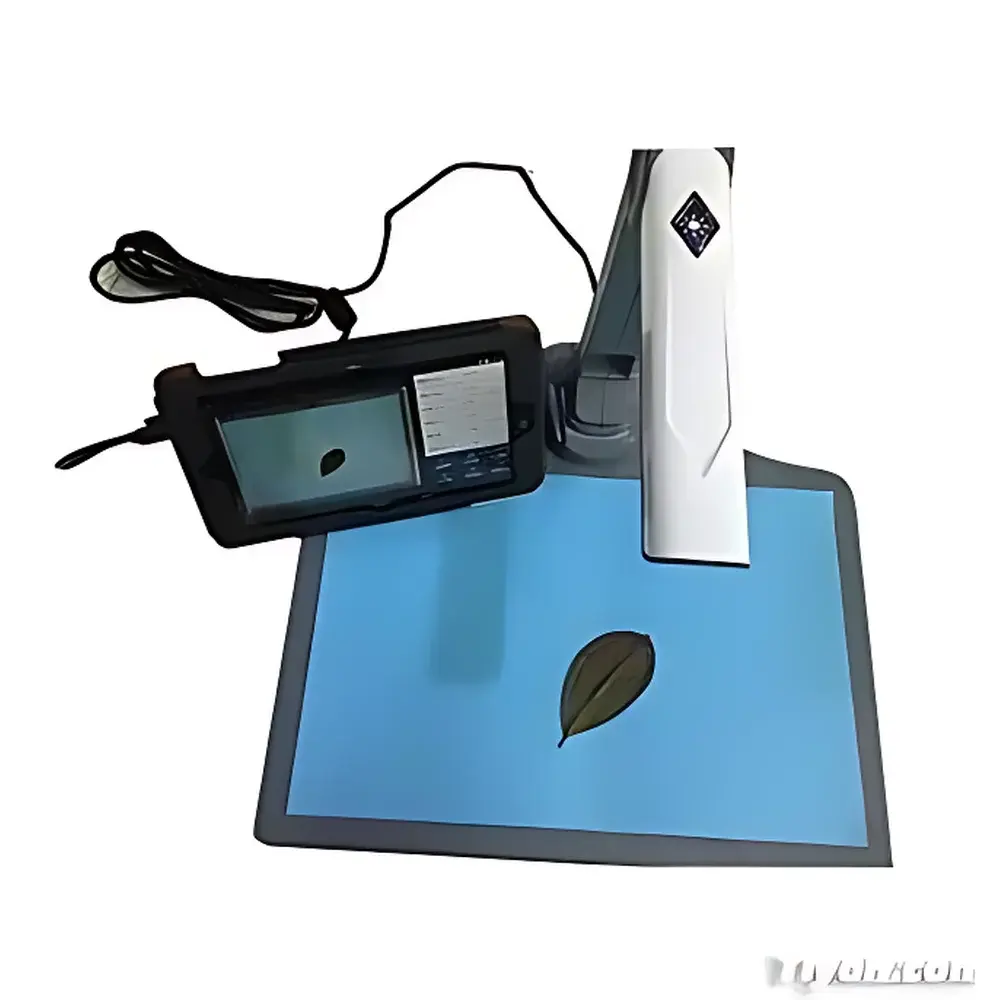
Tlyon LAM-C Smart Imaging Leaf Area Meter
| Brand | Tlyon |
|---|---|
| Origin | Sichuan, China |
| Model | LAM-C |
| Measurement Range | 1–600 cm² |
| Leaf Length | 0–297 mm |
| Max Leaf Width | 0–210 mm |
| Minimum Detectable Hole Area | ≥0.5 cm² |
| Accuracy | ±2% (for leaves >30 cm²), ±3% (for leaves ≤30 cm²) |
| Storage Capacity | >2,000 image-based measurement records |
| Operating Temperature | −30°C to +80°C |
| Relative Humidity | 0–100% RH |
| Response Time | 50 ms |
| Stability | <±2% drift over 12 months |
| Display | 7-inch IPS capacitive touchscreen (Android 4.2.2+) |
| Internal Storage | 32 GB |
| Connectivity | Wi-Fi (802.11 a/b/g/n), Bluetooth 4.0 |
| Interface | micro-USB |
| Power | DC 5 V / 1 A |
| Battery | 3000 mAh |
| Dimensions | 187 × 111 × 9.3 mm |
| Weight | 266 g |
Overview
The Tlyon LAM-C Smart Imaging Leaf Area Meter is a portable, non-destructive digital imaging system engineered for rapid, high-reproducibility quantification of leaf morphometric parameters in field and laboratory settings. Unlike contact-based mechanical planimeters or destructive gravimetric methods, the LAM-C employs calibrated optical imaging combined with proprietary edge-detection and contour segmentation algorithms to convert captured leaf silhouettes into quantitative geometric data. The system operates on the principle of pixel-to-area calibration under controlled illumination, where a uniform LED backlight and anti-reflective transparent compression plate ensure consistent leaf flattening and shadow-free acquisition—critical for minimizing parallax and optical distortion. Designed for plant phenotyping, ecological monitoring, agronomic trials, and physiological stress response studies, the LAM-C delivers sub-second area computation while preserving original image metadata for traceable, auditable measurements.
Key Features
- Integrated 7-inch Android-based tablet with IPS capacitive touchscreen (Android 4.2.2 or higher), enabling intuitive operation, over-the-air software updates, and local application deployment without external computing hardware.
- Dedicated imaging module with adjustable white LED illumination and custom anti-glare acrylic compression plate—ensures repeatable leaf positioning, eliminates ambient light interference, and maintains flatness across irregular venation or curled specimens.
- Real-time automated analysis: computes leaf area, perimeter, maximum length, maximum width, circularity (sphericity), shape factor (length/width ratio), number and total area of herbivory-induced holes—all displayed simultaneously on-screen within ≤1 second post-capture.
- Manual correction suite: supports interactive ROI editing—including leaf-stem separation, contour trimming, hole masking, and edge refinement—to accommodate damaged, overlapping, or compound leaves that challenge full automation.
- Robust environmental rating: operational across −30°C to +80°C and 0–100% relative humidity—validated for use in greenhouse, canopy-level field deployments, and post-harvest storage facilities.
- Built-in 32 GB internal storage retains >2,000 image–metadata pairs; export options include CSV, Excel-compatible .xlsx, and JPEG/PNG with embedded measurement overlays via Wi-Fi, Bluetooth, or micro-USB.
Sample Compatibility & Compliance
The LAM-C accommodates intact or partially damaged monocot and dicot leaves within physical constraints of 297 mm length and 210 mm width. It reliably detects perforations ≥0.5 cm²—suitable for quantifying insect herbivory, fungal lesion expansion, or abiotic necrosis patterns. While not certified to ISO/IEC 17025 or ASTM E2917 (standard for optical area measurement devices), its algorithmic pipeline adheres to principles outlined in ISO 11467 (plant biometry) and supports GLP-compliant workflows through timestamped image archiving, user-defined ID tagging, and audit-ready export logs. Data integrity is preserved via lossless image capture and deterministic pixel calibration—enabling retrospective reanalysis without raw data degradation.
Software & Data Management
The proprietary Android application implements a dual-layer validation architecture: first, geometric calibration using reference standards ensures spatial accuracy across device batches; second, per-session checksum logging guarantees immutability of stored records. Measurement exports include both tabular data (with units and uncertainty annotations) and annotated images—facilitating integration into LIMS platforms or statistical environments such as R, Python (scikit-image, OpenCV), or JMP. Wi-Fi connectivity enables direct upload to institutional servers or cloud repositories configured for HIPAA/FDA 21 CFR Part 11–aligned access control—though native electronic signature or audit-trail encryption is not embedded. All data files retain EXIF metadata including GPS coordinates (if enabled), device serial ID, and firmware version for full experimental provenance.
Applications
- High-throughput phenotyping in crop breeding programs—tracking dynamic leaf expansion rates under drought, salinity, or nutrient limitation treatments.
- Ecological field surveys—comparing specific leaf area (SLA) across successional gradients or invasive vs. native species cohorts.
- Post-treatment assessment in phytopathology studies—quantifying lesion progression kinetics following inoculation with fungal or bacterial pathogens.
- Educational botany labs—visualizing allometric relationships between leaf dimensions and environmental variables without destructive sampling.
- Greenhouse resource optimization—correlating leaf area index (LAI) proxies with irrigation scheduling and light-use efficiency models.
FAQ
Does the LAM-C require external calibration before each use?
No. The system performs factory calibration against NIST-traceable area standards; users may optionally verify accuracy annually using supplied reference templates.
Can the device measure leaves with complex lobing or deep sinuses?
Yes—manual correction tools allow precise contour adjustment, ensuring accurate segmentation even for maple, oak, or fern fronds.
Is image resolution sufficient to resolve fine venation or trichomes?
The optical module prioritizes macro-scale silhouette fidelity over microscopic detail; it is not intended for epidermal structure analysis.
How is measurement uncertainty reported in exported datasets?
Each record includes confidence flags based on leaf coverage ratio and edge continuity metrics, alongside the published accuracy specification (±2–3%) contextualized by measured area magnitude.
Does the Android OS support third-party scientific apps or API integration?
The OS permits sideloading of compatible APKs; however, no public SDK or REST API is provided—data exchange occurs exclusively via file export protocols.