
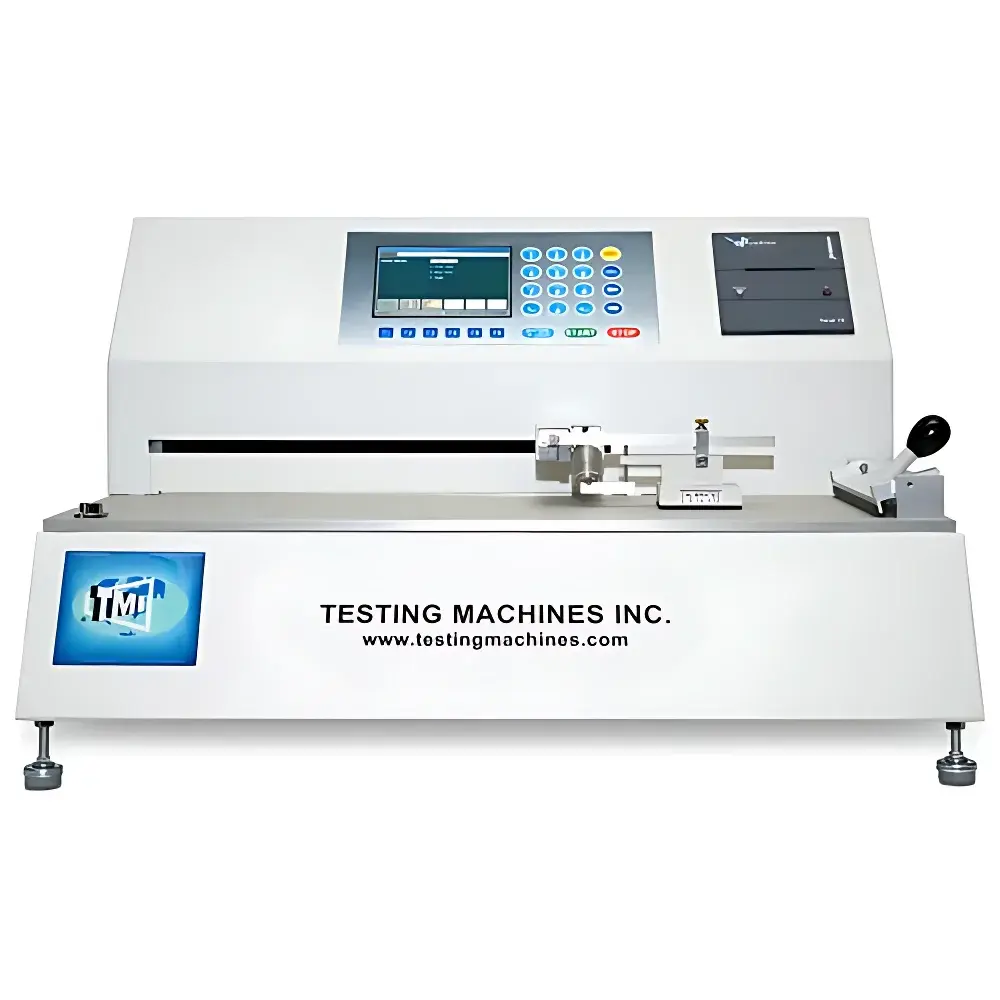
TMI 32-07 Advanced Coefficient of Friction Tester
| Brand | TMI |
|---|---|
| Origin | USA |
| Model | 32-07 |
| Speed Range | 5–43 cm/min |
| Travel Distance | 2.5–30.5 cm |
| Display | 5.7-inch color LCD |
| Weight | 25 kg |
| Dimensions | 515 × 495 × 508 mm |
| Compliance | ASTM D1894, TAPPI T816 & T549 |
| Data Storage | 100 readings with statistical analysis (mean, SD, min/max) |
| Interface | RS232 |
| Optional Heating Chamber | Ambient to 177 °C |
Overview
The TMI 32-07 Advanced Coefficient of Friction Tester is an electromechanical instrument engineered for precision measurement of static (μs) and kinetic (μk) coefficients of friction between two planar surfaces under controlled normal load and relative motion. Based on the fundamental principle of force balance—where the horizontal pull force required to initiate or sustain sliding is measured against a known vertical normal force—the system delivers traceable, repeatable COF values in accordance with internationally recognized test standards. Designed specifically for packaging, paper, polymer film, and coated substrate evaluation, the 32-07 operates within a defined speed and travel envelope to ensure compliance with ASTM D1894 (plastic film and sheeting), TAPPI T816 (paper and board), and TAPPI T549 (coated papers). Its rigid mechanical architecture, coupled with a proprietary guided drive arm and horizontally aligned sled coupling mechanism, eliminates lateral deviation and torsional error—critical for minimizing measurement uncertainty in low-friction or high-adhesion scenarios.
Key Features
- Simultaneous real-time acquisition and display of both static and kinetic COF values in a single test cycle
- Adjustable test speed range from 5 to 43 cm/min (2–17 in/min), programmable in 1 cm/min increments for method-specific validation
- Configurable travel distance from 2.5 to 30.5 cm (1–12 in), supporting standard and custom test geometries
- 5.7-inch full-color graphical LCD interface with intuitive menu navigation, real-time curve visualization, and on-screen parameter configuration
- Onboard data management: stores up to 100 test records with embedded statistical processing—mean, standard deviation, minimum/maximum—calculable per batch or across sessions
- Unit selection between dimensionless COF and gram-force (g) output modes, enabling direct correlation with legacy gravimetric reporting systems
- Integrated thermal printer for immediate hard-copy generation of test reports including date/time stamp, operator ID, sample ID, and pass/fail status against user-defined limits
- RS232 serial interface compliant with SCPI command set for integration into LIMS or automated QC workflows
- Optional temperature-controlled test chamber (ambient to 177 °C) available for evaluating thermally dependent interfacial behavior in heat-seal layers, hot-melt adhesives, or thermoformed polymers
Sample Compatibility & Compliance
The 32-07 accommodates flat, flexible, and semi-rigid specimens up to 150 mm × 150 mm, including but not limited to: biaxially oriented polypropylene (BOPP), polyethylene terephthalate (PET), aluminum foil laminates, kraft paper, clay-coated board, rubber compounds, PVC flooring, printed inks, and multi-layer barrier films. Specimen thickness is unrestricted within mechanical clamping limits (max. 3 mm under standard sled configuration). All operational parameters—including sled mass (200 g standard, optional 500 g or 1000 g weights), surface contact area (typically 63.5 mm × 63.5 mm), and normal force application—are fully documented in the instrument’s calibration certificate and aligned with ISO/IEC 17025-accredited verification protocols. The system meets the procedural requirements of ASTM D1894, TAPPI T816, and T549, and supports audit-ready documentation for GLP and GMP environments through timestamped digital logs and printer-generated reports.
Software & Data Management
While the 32-07 operates as a standalone instrument with embedded firmware, its RS232 port enables bidirectional communication with external PCs running TMI’s optional CoF-Link™ software (v3.2+). This Windows-based application provides extended functionality including automated report generation (PDF/CSV), multi-instrument fleet monitoring, SPC charting (X̄-R, Cpk), electronic signature support per FDA 21 CFR Part 11, and secure user-role access control. All stored measurements retain full metadata—test conditions, environmental notes, calibration history—and are exportable without loss of traceability. Firmware updates are delivered via USB flash drive and validated using SHA-256 checksums to ensure integrity.
Applications
- Quality assurance of packaging film slip performance during high-speed filling and sealing operations
- Evaluation of anti-block additive efficacy in polyolefin extrusion processes
- Development of low-friction release coatings for medical device pouches and pharmaceutical blister lidding
- Comparative analysis of surface treatments (corona, plasma, flame) on polymer substrates
- Validation of ink-to-substrate adhesion stability under shear stress
- Testing of frictional behavior in automotive interior trim materials under elevated temperature conditions (with optional chamber)
- Research-grade tribological screening of biodegradable films and compostable laminates
FAQ
Does the 32-07 comply with FDA-regulated testing requirements for pharmaceutical packaging?
Yes—when operated with enabled audit trail logging, electronic signatures, and calibrated traceability to NIST standards, the system supports compliance with FDA 21 CFR Part 11 for electronic records in regulated environments.
Can the sled mass be modified for non-standard test methods?
Yes—interchangeable sled weights (200 g, 500 g, 1000 g) are available as accessories and can be selected via the instrument’s setup menu to match method-specific normal force requirements.
Is third-party calibration certification included with purchase?
A factory-issued calibration certificate traceable to NIST is provided with each unit; ISO/IEC 17025-accredited calibration services are available upon request.
What maintenance is required to ensure long-term measurement stability?
Annual verification of drive belt tension, sled alignment, load cell linearity, and encoder resolution is recommended; all procedures are documented in the Maintenance Manual (PN: 32-07-MAN-REV4).
How does the heating chamber option integrate with the base instrument?
The chamber mounts directly to the test bed and interfaces via a dedicated I/O port; temperature ramp rate, dwell time, and setpoint are fully programmable from the main display.




