
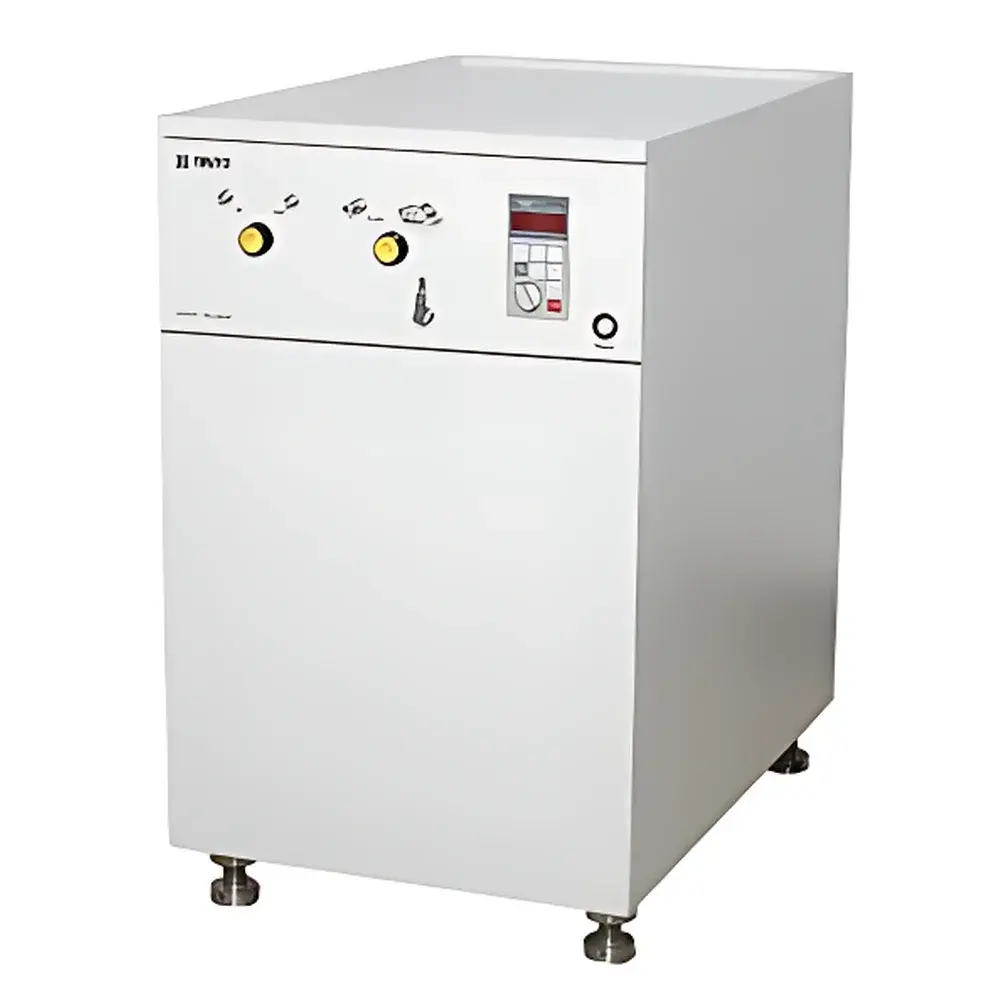
Tongtian TBE-300C High-Speed Counter-Current Chromatography (HSCCC) System
| Brand | Tongtian |
|---|---|
| Origin | Shanghai, China |
| Model | TBE-300C |
| Separation Column | Triple-column with patented switching valve |
| Switching Valve Configuration | Quad-channel, dual six-port valves |
| Total System Capacity | 300 mL |
| Sample Loop Volume | 20 mL |
| Typical Separation Scale | mg to 10 g |
| Rotation Speed Range | 0–1000 rpm (infinitely variable frequency-controlled) |
| Optimal Separation Speed | 700–900 rpm |
| Flow Rate Range | 0.1–50.0 mL/min |
| Recommended Separation Flow Rate | 5.0–30.0 mL/min |
| Maximum System Pressure | 2 MPa |
| Temperature Control Range | 5–40 °C |
| Dimensions (W×D×H) | 500 × 760 × 830 mm |
| Power Consumption | 500 W |
| Net Weight | 180 kg |
Overview
The Tongtian TBE-300C High-Speed Counter-Current Chromatography (HSCCC) System is a robust, multi-column preparative liquid–liquid partition chromatograph engineered for high-resolution, solvent-based separation of thermolabile and nonvolatile compounds without solid-phase adsorption artifacts. Unlike conventional column chromatography, HSCCC operates on the principle of partition equilibrium between two immiscible liquid phases—stationary and mobile—within a rotating coiled column under centrifugal force. The TBE-300C employs a patented triple-column architecture with dual six-port, quad-channel switching valves to enable sequential or parallel elution modes, significantly enhancing throughput and method flexibility. Its design adheres to fundamental requirements for reproducible partition coefficient (K) determination, phase retention control (>70% stationary phase retention at 800 rpm), and stable hydrodynamic equilibrium across extended run times. This system is purpose-built for natural product isolation, pharmaceutical impurity profiling, metabolite purification, and reference standard preparation in compliance with ICH Q5, Q7, and USP chromatographic validation guidelines.
Key Features
- Triple-column configuration with integrated patented switching valve assembly for uninterrupted gradient or multi-step elution protocols
- Dual six-port, quad-channel valve system enabling automatic column reconfiguration without manual tubing manipulation
- Infinitely variable frequency-controlled rotation drive (0–1000 rpm) with precision speed stabilization ±0.5 rpm at 800 rpm
- High-capacity solvent delivery: dual independent piston pumps supporting balanced biphasic flow with real-time pressure monitoring up to 2 MPa
- Thermostatically regulated column compartment (5–40 °C, ±0.3 °C stability) to maintain consistent partition coefficients during temperature-sensitive separations
- Modular design accommodating optional UV/Vis flow cell (200–600 nm), fraction collector synchronization, and external data acquisition interfaces
Sample Compatibility & Compliance
The TBE-300C supports a broad polarity range of analytes—including alkaloids, flavonoids, terpenoids, saponins, peptides, and glycosides—using solvent systems such as hexane/ethyl acetate/methanol/water (HEMWat), chloroform/methanol/water, or tert-butyl methyl ether/acetonitrile/water. Its liquid–liquid mechanism eliminates irreversible adsorption, ensuring quantitative recovery and structural integrity of labile biomolecules. The system conforms to ISO 9001:2000 quality management standards (certified by DNV) and bears CE marking per EU Directive 2014/30/EU (EMC) and 2014/35/EU (LVD). It supports GLP-compliant operation through audit-trail-ready parameter logging, user-access controls, and electronic signature compatibility when integrated with validated LIMS or chromatography data systems (CDS).
Software & Data Management
The TBE-300C operates via embedded firmware with USB and RS-232 connectivity for remote parameter setting, real-time rotation speed/flow/temperature monitoring, and event-triggered fraction collection. Raw operational logs—including rpm profiles, pump stroke counts, valve actuation timestamps, and thermal deviation alerts—are stored internally and exportable in CSV format. When interfaced with third-party CDS platforms compliant with FDA 21 CFR Part 11 (e.g., Waters Empower, Thermo Chromeleon), the system enables full electronic record retention, role-based access, and retrospective audit trail generation for regulatory submissions.
Applications
- Preparative isolation of bioactive constituents from botanical extracts (e.g., huperzine A from Huperzia serrata, ginkgolides from Ginkgo biloba)
- Purification of natural product reference standards for pharmacopoeial use (EP, USP, ChP)
- Separation of enantiomeric mixtures using chiral aqueous two-phase systems
- Downstream processing of fermentation broths and cell lysates for protein-bound metabolites
- Method development for orthogonal purification workflows preceding LC-MS or NMR analysis
FAQ
What is the maximum stationary phase retention achievable on the TBE-300C at 800 rpm?
Typical stationary phase retention exceeds 70% under optimized flow and rotational conditions, verified gravimetrically per ASTM D6300 protocol.
Can the system be validated for GMP manufacturing environments?
Yes—when operated with qualified peripherals and documented SOPs, the TBE-300C meets core equipment qualification requirements (IQ/OQ/PQ) for Category 3 chromatographic systems under EU Annex 15 and WHO TRS 986.
Is method transfer supported between analytical and preparative HSCCC instruments?
Partition coefficient (K) values are scalable; retention time prediction models based on column volume ratio and flow rate enable reliable translation from analytical-scale (e.g., TBE-100) to TBE-300C preparative runs.
Does the system support automated fraction collection synchronized with UV signal thresholds?
Yes—the built-in TTL-compatible trigger output enables precise coordination with commercial fraction collectors (e.g., Gilson FC204, Teledyne ISCO Foxy R1) based on real-time absorbance thresholds.
What maintenance intervals are recommended for long-term reliability?
Valve rotor seals require replacement every 12 months under continuous operation; coil columns should be flushed with methanol/chloroform (1:1) for 30 min post-run to prevent phase crystallization and residual buildup.






