
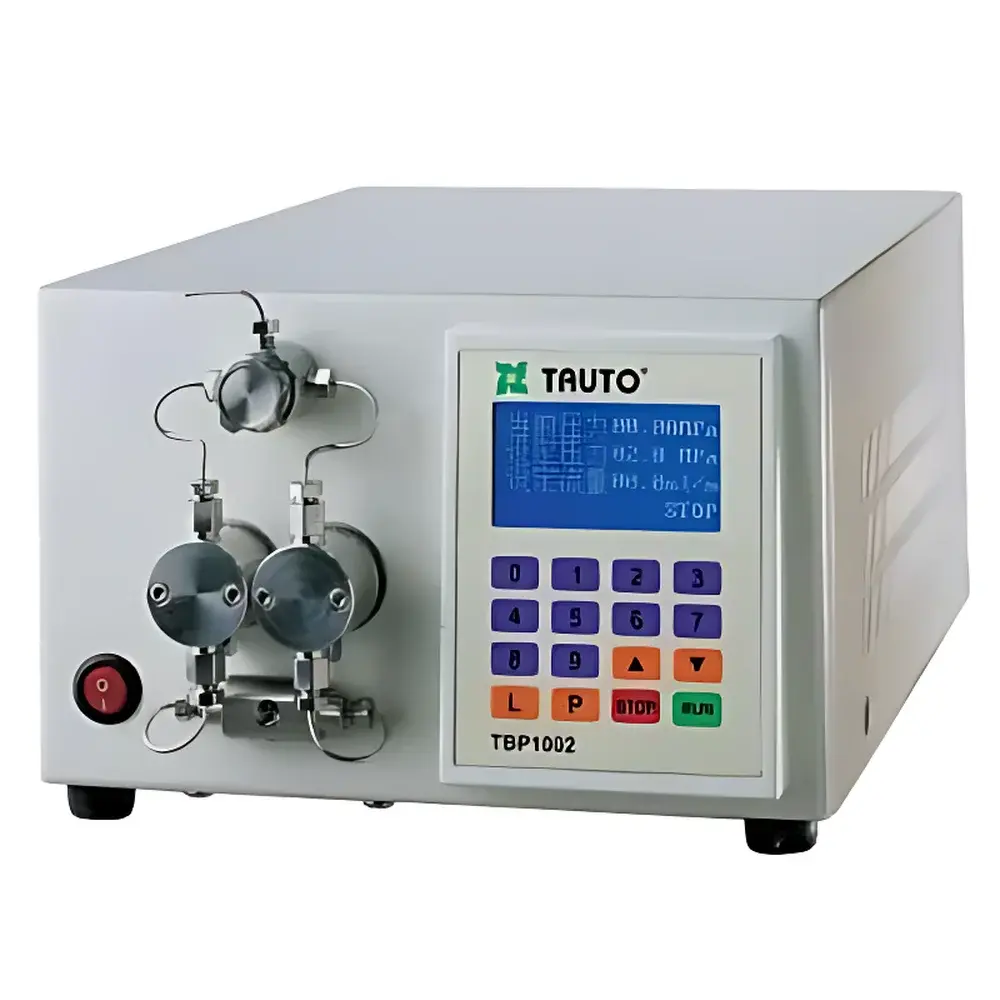
Tongtian TBP-1010 Medium-Pressure Dual-Piston Constant Flow Pump
| Brand | Tongtian |
|---|---|
| Origin | Shanghai, China |
| Model | TBP-1010 |
| Pressure Range | 0–10.0 MPa |
| Flow Rate Range | 0.1–10.0 mL/min |
| Pressure Pulsation | ≤0.08 MPa |
| Pressure Accuracy | ≤0.05 MPa |
| Flow Setting Error | ≤1% |
| Flow Precision (RSD) | ≤1% |
| Power Supply | 220 V ±10%, 50/60 Hz |
| Power Consumption | 75 W |
| Dimensions | 360 × 255 × 160 mm |
| Weight | 12 kg |
| Wetted Materials | Sapphire pistons & balls, 316L stainless steel, zirconia ceramic |
| Communication Interface | RS232 |
Overview
The Tongtian TBP-1010 is a medium-pressure, dual-piston constant flow pump engineered for precision liquid delivery in analytical and preparative chromatographic systems. It operates on positive displacement principle using two synchronized sapphire-tipped pistons driven by a high-resolution stepper motor and controlled by an embedded microprocessor. This architecture ensures minimal pressure pulsation (≤0.08 MPa), high flow stability (RSD ≤1%), and long-term reproducibility—critical for HPLC, flash chromatography, solvent delivery in reaction monitoring, and continuous-feed synthesis applications. Designed for operation up to 10.0 MPa (1450 psi), the TBP-1010 bridges the performance gap between low-pressure peristaltic pumps and high-end analytical HPLC systems, offering robustness without compromising on accuracy or chemical compatibility.
Key Features
- Dual-piston reciprocating design with sapphire pistons and sapphire check valves—ensuring exceptional wear resistance, chemical inertness, and extended service life in organic solvent environments.
- Wetted path constructed from 316L stainless steel, zirconia ceramic, and sapphire—fully compatible with acetonitrile, methanol, THF, chloroform, DCM, and other aggressive solvents commonly used in chromatography and synthetic chemistry.
- Microprocessor-based control system with real-time pressure and flow monitoring; large backlit LCD display provides intuitive local operation and status feedback.
- RS232 serial interface enables bidirectional communication with host PCs or laboratory automation platforms for remote parameter setting, data logging, and integration into GLP-compliant workflows.
- Integrated overpressure protection circuitry automatically halts operation if system pressure exceeds user-defined limits—preventing column damage and ensuring operator safety.
- Self-priming capability with optimized degassing manifold reduces entrained gas bubbles, minimizing baseline noise and improving gradient fidelity in multi-solvent applications.
- Calibration-friendly architecture supports on-site flow rate verification and pressure sensor recalibration using standard traceable reference instruments.
Sample Compatibility & Compliance
The TBP-1010 is validated for use with aqueous, polar aprotic, and moderately aggressive organic solvents across pH 1–14. Its wetted materials meet USP Class VI biocompatibility requirements and are resistant to hydrolysis, oxidation, and stress corrosion cracking. While not certified to ISO 9001 or FDA 21 CFR Part 11 out-of-the-box, the pump’s firmware architecture supports audit-trail-capable software extensions, enabling compliance with GLP and GMP documentation standards when deployed with validated control software. It conforms to IEC 61010-1 for electrical safety in laboratory equipment and meets CE marking requirements for EMC (EN 61326-1) and low-voltage directive (2014/35/EU).
Software & Data Management
The pump includes a native Windows-compatible control application that supports real-time plotting of pressure vs. time and flow rate vs. time curves, event-triggered data capture, and export of CSV-formatted logs for post-processing in MATLAB, Python, or LIMS platforms. All parameter changes—including setpoints, timers, and calibration offsets—are timestamped and logged locally. Optional SDK access allows OEM integration into custom instrument control suites. The software enforces password-protected configuration modes and supports user-level privilege assignment—facilitating multi-user lab environments where SOP adherence is mandatory.
Applications
- Isocratic and gradient elution in medium-pressure liquid chromatography (MPLC) and preparative HPLC systems.
- Solvent delivery for continuous-flow reactors, including photochemical and electrochemical synthesis setups.
- Automated sample introduction in elemental analysis (ICP-OES, AAS) and hyphenated techniques (LC-MS interface priming).
- Controlled reagent dosing in quality control labs performing dissolution testing (USP ) or extractables/leachables studies.
- Long-duration stability testing requiring uninterrupted flow over 72+ hours at constant pressure and temperature.
- Field-deployable environmental monitoring stations where ruggedness, low power draw (75 W), and wide ambient operating range (5–40 °C) are essential.
FAQ
What is the maximum allowable backpressure for continuous operation?
The TBP-1010 is rated for continuous operation up to 10.0 MPa at ambient temperatures between 15–30 °C. Operation above 8.5 MPa requires active heat dissipation and periodic duty-cycle management to maintain thermal stability.
Can the pump be operated in gradient mode with two solvents?
The TBP-1010 is a single-channel isocratic pump. For binary gradient applications, Tongtian recommends the Grad series dual-pump system, which enables precise low-dead-volume mixing at the pump outlet.
Is firmware upgrade supported via RS232?
Yes—field-upgradable firmware is available through Tongtian’s authorized service partners and includes enhancements to pressure compensation algorithms, communication protocol robustness, and diagnostic reporting depth.
What maintenance intervals are recommended for optimal performance?
Sapphire components require no scheduled replacement under normal usage. We recommend quarterly inspection of seals, annual verification of flow accuracy against gravimetric standards, and biannual cleaning of the inlet filter and purge valve assembly.
Does the pump support analog input/output for PLC integration?
Not natively—but optional DIN-rail-mountable signal converters (0–5 V / 4–20 mA) are available as accessories for industrial process control integration.



