
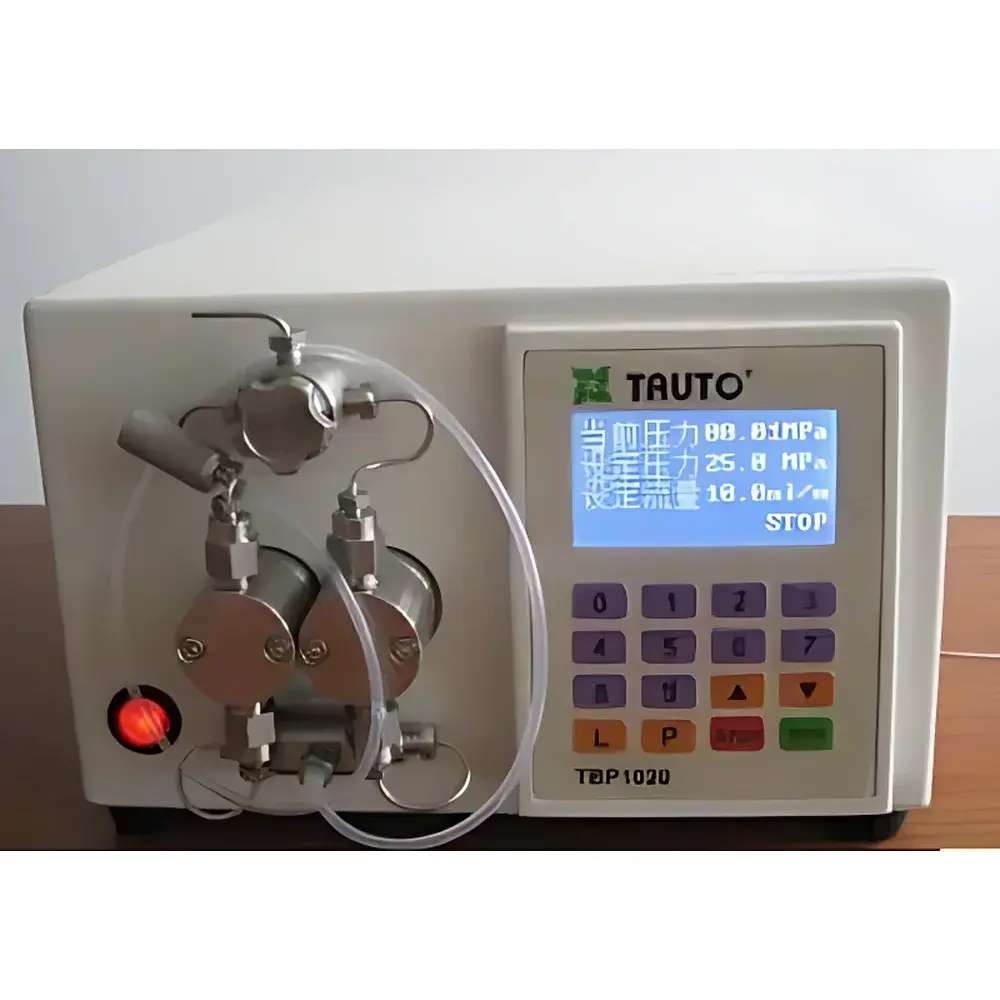
Tongtian TBP-1020 Dual-Piston Constant Flow Pump (20 MPa)
| Brand | Tongtian |
|---|---|
| Model | TBP-1020 |
| Max Pressure | 20.0 MPa |
| Flow Range | 0.1–10.0 mL/min |
| Pressure Pulsation | ≤ 0.10 MPa |
| Pressure Accuracy | ≤ 0.05 MPa |
| Flow Setting Error | ≤ 1% |
| Flow Repeatability | ≤ 1% |
| Wetted Materials | Sapphire, 316L Stainless Steel, Zirconia Ceramic |
| Power Supply | 220 V ±10%, 50/60 Hz |
| Power Consumption | 75 W |
| Dimensions | 360 × 260 × 160 mm |
| Weight | 12 kg |
| Communication Interface | RS232 |
Overview
The Tongtian TBP-1020 Dual-Piston Constant Flow Pump is a high-pressure, precision liquid delivery system engineered for applications requiring stable, pulse-free flow under sustained backpressure up to 20.0 MPa. Based on dual reciprocating piston architecture with sapphire ball valves and ceramic-coated plungers, it operates on positive displacement principles—ensuring volumetric accuracy independent of fluid viscosity or system resistance. Unlike peristaltic or diaphragm pumps, this design eliminates elastomer degradation and provides long-term metrological stability essential for quantitative analytical workflows. Its microprocessor-controlled actuation delivers consistent flow profiles across the full operating range (0.1–10.0 mL/min), making it suitable for preparative HPLC, supercritical fluid extraction, catalytic reaction feeding, and high-pressure synthesis monitoring where pressure integrity and flow reproducibility are non-negotiable.
Key Features
- Dual-piston configuration with sapphire check valves and zirconia-coated stainless steel plungers—engineered for >10,000-hour service life in aggressive organic solvents including THF, DCM, DMF, and acetonitrile
- Pressure pulsation <0.10 MPa at full load—achieved via phase-shifted piston timing and integrated passive dampening circuitry
- Real-time pressure and flow monitoring via built-in high-stability piezoresistive transducers with digital compensation
- RS232 serial interface compliant with standard SCPI command sets—enabling seamless integration into LabVIEW, Python-based control environments, or third-party chromatography data systems (CDS)
- Onboard overpressure protection with automatic shutdown at 105% of set limit—meets IEC 61000-6-2 electromagnetic immunity requirements
- Integrated air purge manifold with calibrated venting sequence—reduces entrained gas content to <50 ppm without external degassers
- Backlit LCD display with intuitive menu navigation and dual-unit support (MPa/bar, mL/min/µL/min)
Sample Compatibility & Compliance
The TBP-1020’s wetted path—comprising sapphire, 316L stainless steel, and yttria-stabilized zirconia—exhibits exceptional chemical inertness toward halogenated hydrocarbons, strong acids (e.g., concentrated HCl, HNO₃), bases (up to 1 mol/L NaOH), and oxidizing agents (e.g., H₂O₂, ozone solutions). It complies with ASTM D471 for elastomer compatibility testing (though no elastomers contact fluid) and meets ISO 8573-1 Class 4 purity requirements for delivered fluid streams. For regulated environments, the firmware supports audit-trail-enabled operation (timestamped parameter changes, error logs, and calibration records), aligning with FDA 21 CFR Part 11 Annex 11 expectations for electronic records in GMP/GLP laboratories. CE marking confirms conformity with Machinery Directive 2006/42/EC and Low Voltage Directive 2014/35/EU.
Software & Data Management
The included PC control software provides deterministic real-time supervision of pump operation—including dynamic pressure/flow curve overlay, programmable gradient tables (linear, step, or custom), and automated calibration routines traceable to NIST-certified reference standards. All operational parameters—including elapsed runtime, total delivered volume, and cumulative pressure exposure—are logged in CSV format with UTC timestamps. The software supports scheduled start/stop sequences, remote fault diagnosis via diagnostic port polling, and export of compliance-ready reports formatted for internal QA review or regulatory submissions. Optional OPC UA server module enables interoperability with MES and SCADA platforms in industrial pilot-scale deployments.
Applications
- Preparative and analytical HPLC systems requiring stable flow at pressures exceeding 15 MPa—particularly for sub-2 µm particle column operation
- High-pressure reaction monitoring in continuous-flow chemistry rigs, including hydrogenation, oxidation, and photochemical synthesis
- Supercritical fluid processing (SFC) using CO₂ or CO₂/co-solvent mixtures at densities >0.6 g/mL
- Calibration of flow meters and pressure transducers in metrology labs accredited to ISO/IEC 17025
- Long-duration environmental leaching studies (e.g., TCLP, SPLP) demanding uninterrupted 72+ hour delivery at constant head
- Microfluidic device priming and reagent loading where bubble-free, low-shear delivery is critical to preserve biomolecular integrity
FAQ
What materials are in direct contact with the fluid path?
Sapphire (ball valves and seats), 316L stainless steel (pump head body and inlet/outlet manifolds), and yttria-stabilized zirconia (plunger coating and seal surfaces). No polymers or elastomers contact the fluid.
Is the pump compatible with aqueous alkaline solutions above pH 12?
Yes—zirconia and sapphire exhibit negligible corrosion rates (<0.1 µm/year) in 1 M NaOH at 60°C per ASTM G31 immersion testing protocols.
Can flow calibration be performed in-house without specialized tools?
Yes—the firmware includes a gravimetric calibration mode that uses user-provided analytical balance data (±0.1 mg resolution) to update flow coefficients with NIST-traceable uncertainty propagation.
Does the pump support analog input for external flow rate modulation?
No—it operates exclusively via digital command (RS232); however, optional OEM firmware variants include 0–10 V analog setpoint interface upon request.
What maintenance intervals are recommended for continuous 24/7 operation?
Plunger seals require replacement every 6,000 hours; sapphire valves every 12,000 hours. Full preventive maintenance—including torque verification and transducer zero drift correction—is advised every 18 months per ISO 13374 condition monitoring guidelines.



