
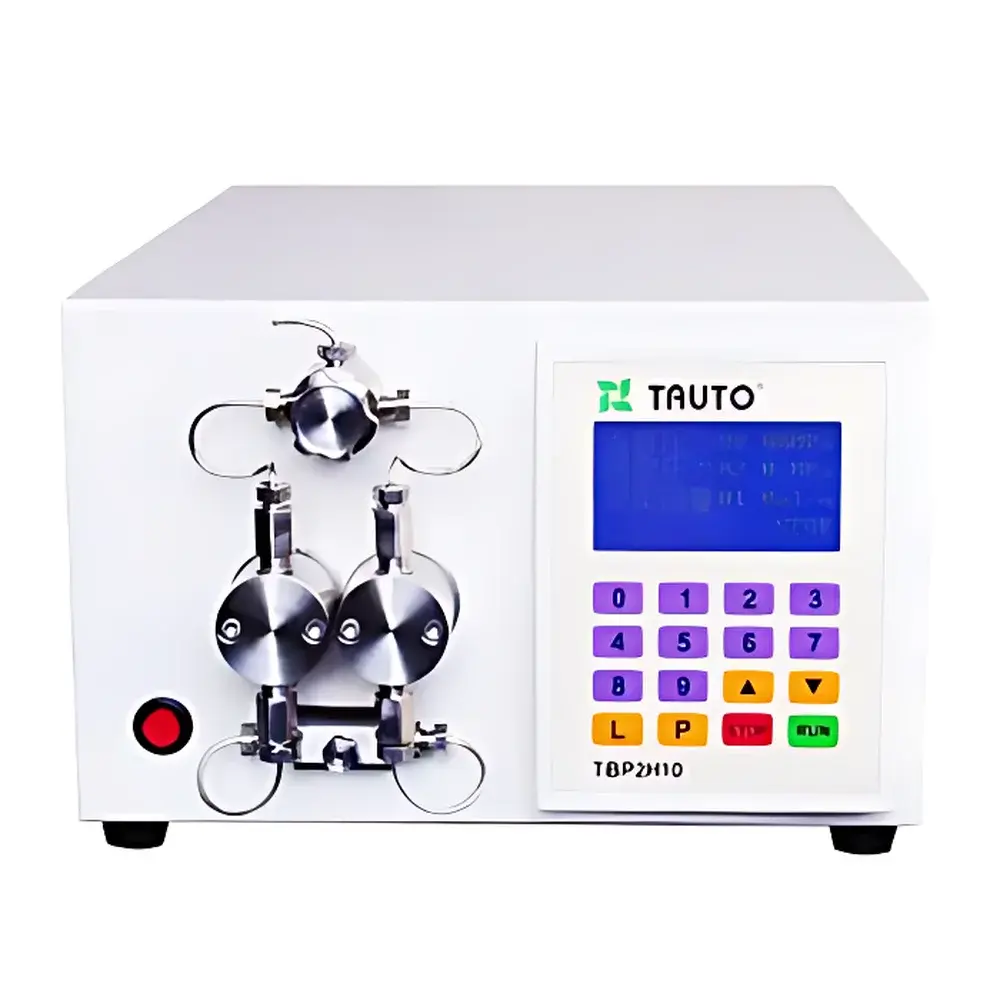
Tongtian TBP-2H10 Dual-Piston Medium-Pressure Constant Flow Pump
| Brand | Tongtian |
|---|---|
| Model | TBP-2H10 |
| Pressure Range | 0–10 MPa |
| Flow Rate Range | 0.1–200 mL/min |
| Flow Accuracy | ≤2% (1–10 mL/min), ≤1.5% (10–50 mL/min) |
| Flow Precision | RSD ≤1.5% (1–50 mL/min), RSD ≤1% (50–200 mL/min) |
| Pressure Pulsation | ≤0.2 MPa |
| Pressure Accuracy | ≤0.1 MPa |
| Wetted Materials | Sapphire, 316L Stainless Steel, Zirconia Ceramic |
| Power Supply | 220 V ±10%, 50/60 Hz |
| Power Consumption | 75 W |
| Dimensions | 360 × 255 × 160 mm |
| Weight | 12 kg |
| Communication Interface | RS232 |
| Overpressure Protection | Integrated |
| Air Elimination | Dedicated degassing mechanism |
Overview
The Tongtian TBP-2H10 is a dual-piston, medium-pressure constant flow pump engineered for precision liquid delivery in analytical and preparative chromatographic systems, continuous reaction monitoring, and automated synthesis workflows. It operates on the principle of positive displacement via synchronized reciprocating sapphire-tipped pistons, delivering stable volumetric flow rates under variable backpressure—critical for applications requiring high reproducibility and minimal flow disturbance. Unlike peristaltic or diaphragm-based alternatives, the TBP-2H10’s mechanical design eliminates elastomer degradation and ensures long-term calibration stability. Its maximum pressure rating of 10 MPa (1450 psi) positions it between low-pressure infusion pumps and high-performance liquid chromatography (HPLC) systems, making it suitable for flash chromatography, simulated moving bed (SMB) setups, catalyst screening reactors, and inline spectroscopic process analytics. The pump’s microprocessor-controlled drive system enables closed-loop feedback adjustment of piston stroke and dwell time, compensating for compressibility effects and viscosity-induced flow lag.
Key Features
- Dual-piston architecture with sapphire balls and zirconia ceramic check valves—engineered for >10,000 hours of maintenance-free operation in aggressive solvent environments
- Wetted path constructed from 316L stainless steel, sapphire, and zirconia—validated for compatibility with acetonitrile, THF, DMF, dichloromethane, concentrated HCl (≤6 M), and NaOH (≤2 M)
- Low-pressure pulsation (≤0.2 MPa peak-to-peak) achieved through phase-shifted piston actuation and integrated damping chambers
- Real-time pressure and flow monitoring via built-in piezoresistive transducers with digital compensation algorithms
- RS232 serial interface compliant with standard SCPI command syntax—enables integration into LabVIEW, Python-controlled automation frameworks, or custom PLC architectures (optional Modbus RTU firmware available)
- Onboard memory stores up to 16 user-defined methods—including flow ramp profiles, pressure limits, and timed start/stop sequences
- Integrated overpressure cutoff (<10.2 MPa threshold) with automatic piston halt and audible alarm—meets IEC 61010-1 functional safety requirements for laboratory equipment
Sample Compatibility & Compliance
The TBP-2H10 is designed for use with non-particulate, low-viscosity (<50 cP) aqueous and organic solutions. Its chemically inert fluid path supports ISO 8573-1 Class 2 compressed air–free operation and complies with ASTM D3231 for hydrocarbon solvent handling. While not certified for intravenous or implantable device manufacturing, the pump meets GLP documentation standards when operated with audit-trail-enabled software (e.g., Tongtian PumpControl v3.2). All electrical components conform to CE marking directives (2014/30/EU EMC, 2014/35/EU LVD), and mechanical housing satisfies IP20 ingress protection for dry laboratory environments. For GMP-regulated pharmaceutical processes, optional 21 CFR Part 11-compliant electronic signature modules are available upon request.
Software & Data Management
Tongtian PumpControl software (Windows 10/11 compatible) provides real-time graphical display of pressure vs. time and flow rate vs. time curves, with export to CSV or HDF5 format for post-acquisition analysis in MATLAB or OriginLab. The interface supports dual-channel logging when paired with auxiliary sensors (e.g., inline UV absorbance or conductivity probes). All parameter changes—including flow setpoints, pressure limits, and timer configurations—are timestamped and stored in an immutable log file. Remote control via TCP/IP gateway (optional Ethernet adapter) allows centralized management across multi-pump networks. Firmware updates preserve historical calibration coefficients and retain factory-certified flow verification data.
Applications
- Flash chromatography systems requiring precise gradient formation at ≤5 MPa (paired with Grad-series dual-pump configuration)
- Continuous-flow hydrogenation and oxidation reactors where stoichiometric reagent dosing must remain invariant across temperature shifts
- Automated sample introduction for ICP-MS and AAS—minimizing polyatomic interferences via pulse-free nebulizer feed
- Process analytical technology (PAT) deployments compliant with USP guidelines for analytical instrument qualification
- Academic research in electrochemical flow cells, microreactor kinetics, and polymerization initiation studies
- Environmental testing labs performing EPA Method 8081B (PCB analysis) and Method 525.3 (pesticide extraction) with solvent-resistant pump heads
FAQ
What solvents are compatible with the standard 316L stainless steel wetted path?
Acetonitrile, methanol, ethanol, isopropanol, tetrahydrofuran, ethyl acetate, dichloromethane, chloroform, and aqueous buffers (pH 2–12) are fully compatible. Avoid hydrofluoric acid, molten alkali metals, and oxidizing mixtures containing perchloric acid.
Can the TBP-2H10 be used in explosion-proof environments?
No—the pump lacks ATEX or IECEx certification. For hazardous area deployment, consult Tongtian’s intrinsically safe enclosure option (TBP-2H10-EX, pending IEC 60079-0 certification).
Is flow calibration traceable to NIST standards?
Yes—each unit ships with a certificate of calibration verified against gravimetrically measured water flow at 25 °C, traceable to NIST SRM 2809 (viscosity standard) and SRM 3120a (density standard).
How often does the pump require recalibration?
Annual recalibration is recommended for GLP/GMP compliance; however, internal flow verification routines (performed daily via integrated syringe test mode) provide ongoing performance assurance without external hardware.
Does the pump support analog input for external flow modulation?
Yes—0–5 V DC analog input is available on the rear panel (optional accessory) for real-time flow adjustment from external PID controllers or process logic signals.



