
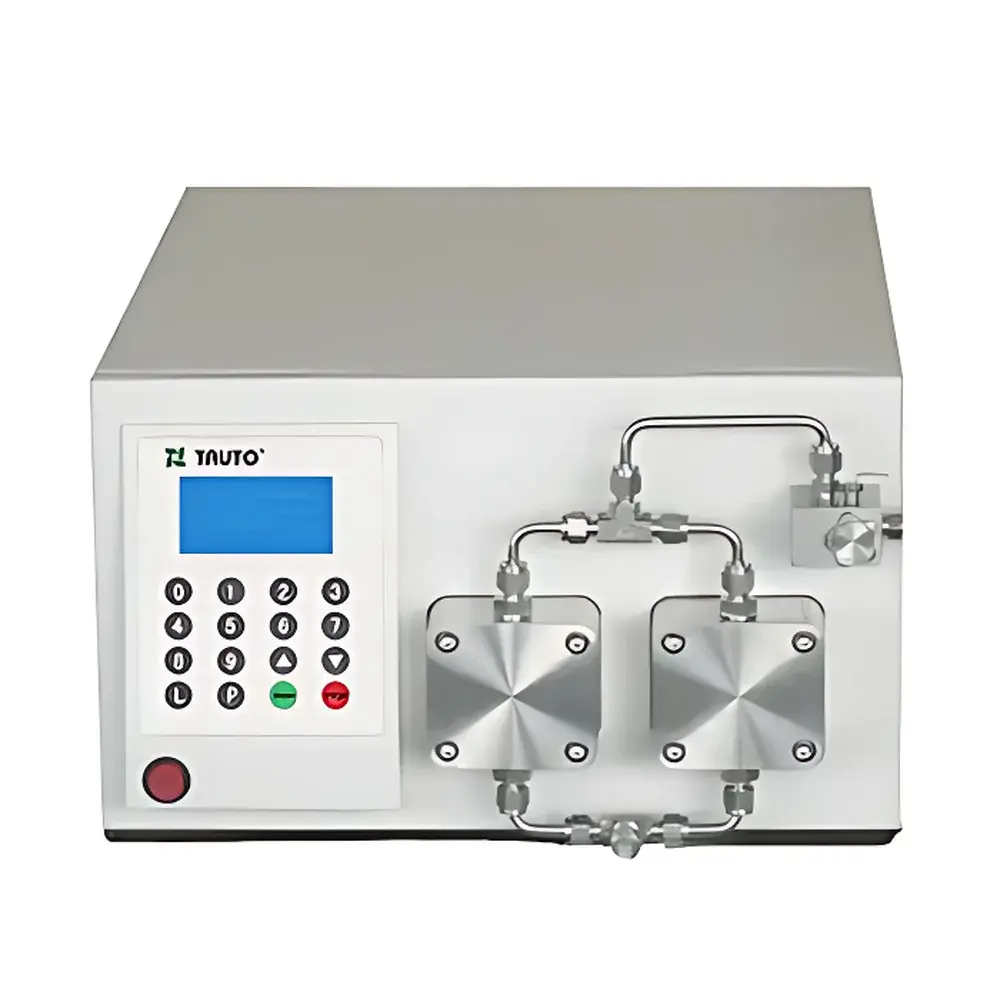
Tongtian TBP1T02S Precision Dual-Piston Constant Flow Pump
| Brand | Tongtian |
|---|---|
| Origin | Shanghai, China |
| Model | TBP1T02S |
| Pressure Range | 0–2.0 MPa |
| Flow Rate Range | 1–1000 mL/min |
| Pressure Pulsation | ≤0.05 MPa |
| Pressure Accuracy | ≤0.10 MPa |
| Flow Setting Error | ≤3% (1–100 mL/min), ≤1.5% (100–1000 mL/min) |
| Flow Repeatability | ≤1.5% (1–100 mL/min), ≤1% (100–1000 mL/min) |
| Power Supply | 220 V ±10%, 50/60 Hz |
| Power Consumption | 1 kW |
| Weight | 48 kg |
| Dimensions (W×D×H) | 380 × 560 × 230 mm |
| Flow Path Materials | Sapphire ball valves, ceramic plungers |
| pump head options | 316L stainless steel (L), pure titanium (T), PEEK (K), PTFE (F) |
| Communication Interface | RS232 |
Overview
The Tongtian TBP1T02S Precision Dual-Piston Constant Flow Pump is an engineered solution for applications demanding stable, pulse-minimized liquid delivery under medium-pressure conditions (up to 2.0 MPa). Based on dual-piston reciprocating displacement architecture with active phase-offset control, it achieves continuous flow by alternating suction and discharge strokes between two synchronized ceramic-plunger assemblies. This design inherently suppresses pressure pulsation—critical for chromatographic elution stability, reaction quenching in kinetic studies, and solvent delivery in automated synthesis platforms. Unlike single-piston or peristaltic systems, the TBP1T02S delivers high volumetric reproducibility across its full 1–1000 mL/min operating range without flow degradation at low or high endpoints. Its microprocessor-based closed-loop control continuously monitors real-time pressure feedback and dynamically adjusts stroke timing and motor torque to maintain setpoint fidelity—even during viscosity fluctuations or backpressure variations typical in packed-column or membrane filtration setups.
Key Features
- Dual-ceramic-plunger assembly with imported sapphire ball check valves—ensuring chemical inertness, wear resistance, and long-term flow accuracy retention.
- Modular flow path construction with four selectable wetted material configurations: 316L stainless steel (L), commercially pure titanium (T), medical-grade PEEK (K), and fluoropolymer-lined PTFE (F)—enabling compatibility with aggressive solvents (e.g., concentrated acids, halogenated organics, supercritical CO₂ co-solvents).
- Integrated overpressure protection circuitry and automatic flow calibration routine—activates shutdown if system pressure exceeds user-defined threshold (configurable within 0.1–2.0 MPa range) and permits in-situ volumetric verification without disassembly.
- Front-accessible pump head design—allows inspection, valve replacement, or plunger cleaning while maintaining system integrity; no need to depressurize or disconnect tubing.
- Large-bore fluidic architecture: standard tubing ports accommodate 2 mm, 3 mm, and 6 mm ID tubing; optional 1/8″ NPT or Swagelok®-compatible fittings available—minimizing clogging risk in suspensions, slurries, or particulate-laden feeds where HPLC-grade capillary paths would fail.
- Intelligent air-removal mechanism with multi-stage venting chamber—reduces dissolved gas entrainment and eliminates microbubble-induced flow instability during aqueous or volatile solvent delivery.
Sample Compatibility & Compliance
The TBP1T02S supports a broad spectrum of liquid-phase applications involving corrosive, viscous, or particulate-containing media—including but not limited to acetonitrile/water gradients, 30% HNO₃ digestions, molten polymer melts (≤150 °C), and biopolymer solutions (e.g., alginate, chitosan). Its wetted-material options meet ASTM F2027 (implantable device material biocompatibility) and ISO 10993-5 cytotoxicity screening requirements when configured with PEEK or PTFE components. The RS232 interface enables integration into GLP/GMP-compliant workflows via third-party LIMS or SCADA systems; audit-trail-capable software packages (e.g., LabVIEW™ or custom Python-based controllers) may record timestamped pressure/flow logs satisfying FDA 21 CFR Part 11 data integrity criteria when paired with electronic signature modules.
Software & Data Management
Built-in firmware provides real-time display of actual pressure, set pressure, and programmed flow rate on a high-contrast LCD panel. The RS232 serial protocol supports ASCII command syntax (e.g., “FSET=500” for 500 mL/min) and returns telemetry strings including “PACT=1.23”, “FSET=500.0”, and “ERR=0”. Optional PC software enables graphical trend logging (pressure vs. time), scheduled start/stop sequences (e.g., ramp from 5 mL/min to 200 mL/min over 15 min), and parameter recall—each of up to 10 user-defined profiles stored in non-volatile memory. All operational parameters—including last-used flow/pressure values, total runtime hours, and error event history—are retained after power cycling. Export functions support CSV-formatted output for post-acquisition analysis in MATLAB®, OriginLab®, or Excel®.
Applications
- Preparative and analytical liquid chromatography (LC, SFC, MPLC) requiring robust gradient delivery at 1–50 mL/min with <±0.5% RSD over 8-hour runs.
- Continuous-flow chemical synthesis reactors—precise stoichiometric reagent metering under elevated backpressure (e.g., hydrogenation, photochemistry, electrochemical oxidation).
- Environmental sample extraction systems (e.g., ASE, PLE) delivering organic solvents at 5–100 mL/min into pressurized extraction cells.
- Pharmaceutical dissolution testing apparatus complying with USP and , where constant flow across variable filter resistances is mandated.
- Materials science slurry dispensing for battery electrode coating, ceramic tape casting, or inkjet-printed electronics precursor delivery.
FAQ
What flow path materials are recommended for handling hydrofluoric acid (HF)?
Pure titanium (T-series) pump heads are required for HF concentrations ≥0.1%; avoid stainless steel or PEEK due to rapid corrosion and fluoride-induced embrittlement.
Can the TBP1T02S operate in parallel mode with another unit for higher total flow?
Yes—RS232 synchronization allows master-slave configuration; flow summation is linear within ±2% deviation when both units share identical calibration and tubing geometry.
Is firmware upgrade supported in the field?
Firmware updates are performed via RS232 using Tongtian’s proprietary DFU utility; version history and release notes are available upon request under NDA.
Does the pump meet IP rating requirements for laboratory splash environments?
The enclosure meets IP54 classification—dust-protected and resistant to water splashes from any direction; optional conformal coating on PCBs available for humid or saline lab settings.
How often should the sapphire check valves be replaced under continuous operation?
Under typical use with filtered, non-abrasive solvents, service life exceeds 12,000 hours; replacement intervals reduce to 4,000–6,000 hours when pumping slurries or >5 µm particulates—monitor via increased pulsation amplitude (>0.07 MPa) or flow drift >2% over 24 h.



