
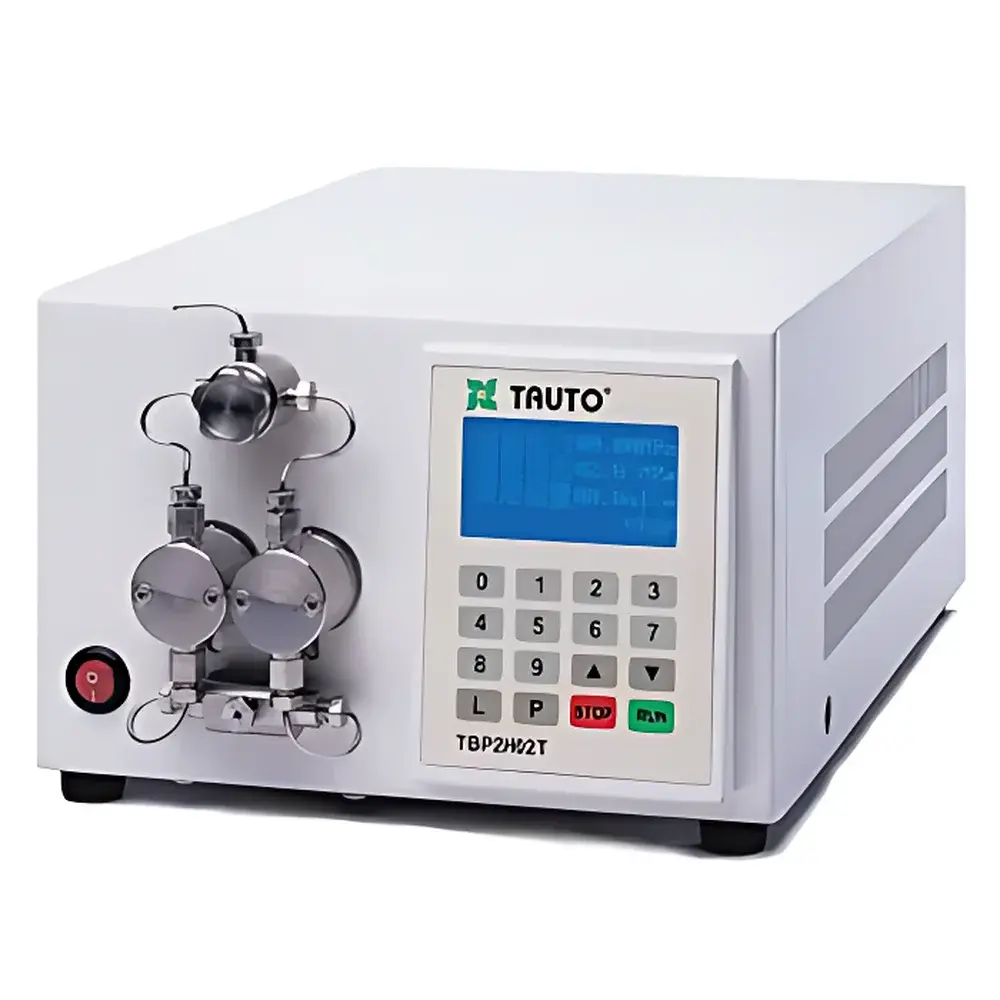
Tongtian TBP2H02T Titanium Dual-Piston Constant Flow Pump
| Brand | Tongtian |
|---|---|
| Model | TBP2H02T |
| Construction Material | Grade 2 Pure Titanium (ASTM B348) |
| Pressure Range | 0–2.0 MPa |
| Flow Rate Range | 1–200 mL/min |
| Pressure Pulsation | ≤ 0.2 MPa |
| Flow Accuracy | ≤ 2% (1–50 mL/min), ≤ 1.5% (50–200 mL/min) |
| Flow Precision (RSD) | ≤ 1.5% (1–50 mL/min), ≤ 1% (50–200 mL/min) |
| Pressure Accuracy | ≤ 0.1 MPa |
| Wetted Materials | Grade 2 Titanium, Sapphire Balls, Zirconia Ceramic |
| Interface | RS232 |
| Power Supply | 220 V ±10%, 50/60 Hz |
| Power Consumption | 75 W |
| Dimensions | 360 × 255 × 160 mm |
| Weight | 12 kg |
Overview
The Tongtian TBP2H02T is a high-integrity dual-piston constant flow pump engineered for continuous, precise liquid delivery under aggressive chemical conditions. It operates on positive displacement principle with synchronized dual-piston actuation to minimize pressure pulsation and ensure stable volumetric output across its full operational range. Unlike single-piston or peristaltic alternatives, the TBP2H02T delivers true constant-flow performance independent of backpressure fluctuations—critical for applications requiring strict hydraulic stability, such as preparative chromatography, electrochemical synthesis, corrosion-resistant reagent dosing, and long-duration process validation. Its core architecture integrates microprocessor-based closed-loop control with real-time pressure and flow monitoring, enabling deterministic operation in environments where solvent compatibility, material longevity, and metrological traceability are non-negotiable.
Key Features
- Grade 2 pure titanium (ASTM B348) wetted path—including pump head, fluidic tubing, and sealing interfaces—provides exceptional resistance to strong acids (e.g., nitric, sulfuric, phosphoric), alkaline solutions (e.g., concentrated ammonia, chlorate electrolytes), and halogenated solvents commonly encountered in metallurgical leaching, precious metal refining, and battery electrolyte handling.
- Dual-piston design with sapphire balls and zirconia ceramic valves ensures mechanical durability, low wear particulation, and extended service life—even under abrasive or high-ionic-strength media.
- Pressure pulsation ≤ 0.2 MPa (measured at 10 MPa equivalent load) supports high-fidelity detection in downstream analytical systems and minimizes column stress in preparative HPLC/FPLC workflows.
- RS232 serial interface enables direct integration with laboratory automation controllers, SCADA systems, or custom PC-based software for remote parameter setting, real-time data logging, and audit-trail generation compliant with GLP/GMP requirements.
- Onboard overpressure protection, automatic flow calibration routines, and integrated degassing manifold reduce operator intervention and improve system robustness during unattended operation.
- Large LCD display with intuitive menu navigation provides immediate access to setpoints, real-time pressure/flow curves, elapsed runtime, and historical parameter recall—without requiring external software.
Sample Compatibility & Compliance
The TBP2H02T is validated for use with corrosive aqueous and non-aqueous media including but not limited to: nitric acid (≤ 70%), sulfuric acid (≤ 98%), hydrochloric acid (≤ 37%), phosphoric acid (≤ 85%), sodium/potassium hydroxide (≤ 50%), ammonium hydroxide (≤ 30%), sodium chlorate solutions, copper/nickel electrolytes, and organic solvents compatible with titanium (e.g., acetone, THF, acetonitrile, methanol). It is explicitly incompatible with hydrofluoric acid, hot concentrated sulfuric acid (>150 °C), molten alkalis, and reducing agents that disrupt titanium’s passive oxide layer. The pump meets CE marking requirements for electromagnetic compatibility (EN 61326-1) and low-voltage safety (EN 61010-1). Its construction adheres to ISO 8502-3 for surface cleanliness verification and supports FDA 21 CFR Part 11-compliant electronic record retention when paired with validated third-party control software.
Software & Data Management
The embedded firmware supports bidirectional RS232 communication using ASCII protocol commands (e.g., “SET FLOW=50.0”, “READ PRESSURE”). Users may configure timed start/stop sequences, store up to 10 user-defined protocols, and export timestamped pressure/flow logs in CSV format via terminal emulation or custom Python/LabVIEW drivers. Optional OEM SDK enables integration into LIMS or ELN platforms with full metadata tagging (operator ID, batch number, instrument serial). All parameter changes are logged with date/time stamps and user-accessible revision history—satisfying ALCOA+ data integrity principles for regulated laboratories.
Applications
- Continuous feed of aggressive etchants in semiconductor wafer cleaning and metal surface treatment lines.
- Precise metering of acidic leaching solutions in hydrometallurgical pilot plants (e.g., gold recovery from refractory ores).
- Stable eluent delivery in titanium-compatible preparative ion chromatography systems analyzing anions in nuclear waste simulants.
- Controlled reagent addition in electroplating baths containing Ni²⁺/Cu²⁺ sulfates and chloride accelerators.
- Long-term infusion of pH-adjusted buffers in corrosion testing rigs (ASTM G31, ISO 9223) where stainless steel pumps would fail prematurely.
- Integration into automated synthesis reactors handling air-sensitive organometallic precursors dissolved in THF or toluene.
FAQ
Is the TBP2H02T suitable for use with hydrofluoric acid (HF)?
No. Hydrofluoric acid rapidly attacks titanium by disrupting its protective TiO₂ layer and must be handled exclusively with fluoropolymer-based pumping systems.
What is the maximum operating temperature for the titanium fluid path?
The pump is rated for continuous operation up to 80 °C ambient; however, sustained exposure to liquids above 60 °C may accelerate gasket aging and should be verified against specific seal material specifications (Viton® or Kalrez® optional).
Can flow calibration be performed in-house without factory service?
Yes. The firmware includes a guided gravimetric calibration mode that accepts user-entered reference mass measurements and automatically updates internal flow coefficients.
Does the pump support analog I/O for PLC integration?
Standard configuration includes RS232 only; 0–10 V / 4–20 mA analog input/output is available as a factory-configured option (model suffix “-AIO”).
How often should sapphire components be inspected for wear?
Under typical usage with non-abrasive media, sapphire balls and seats require inspection every 6,000 operating hours or annually—whichever occurs first—as defined in the maintenance schedule (Document No. TT-TBP2H02T-MAN-REV4).



