
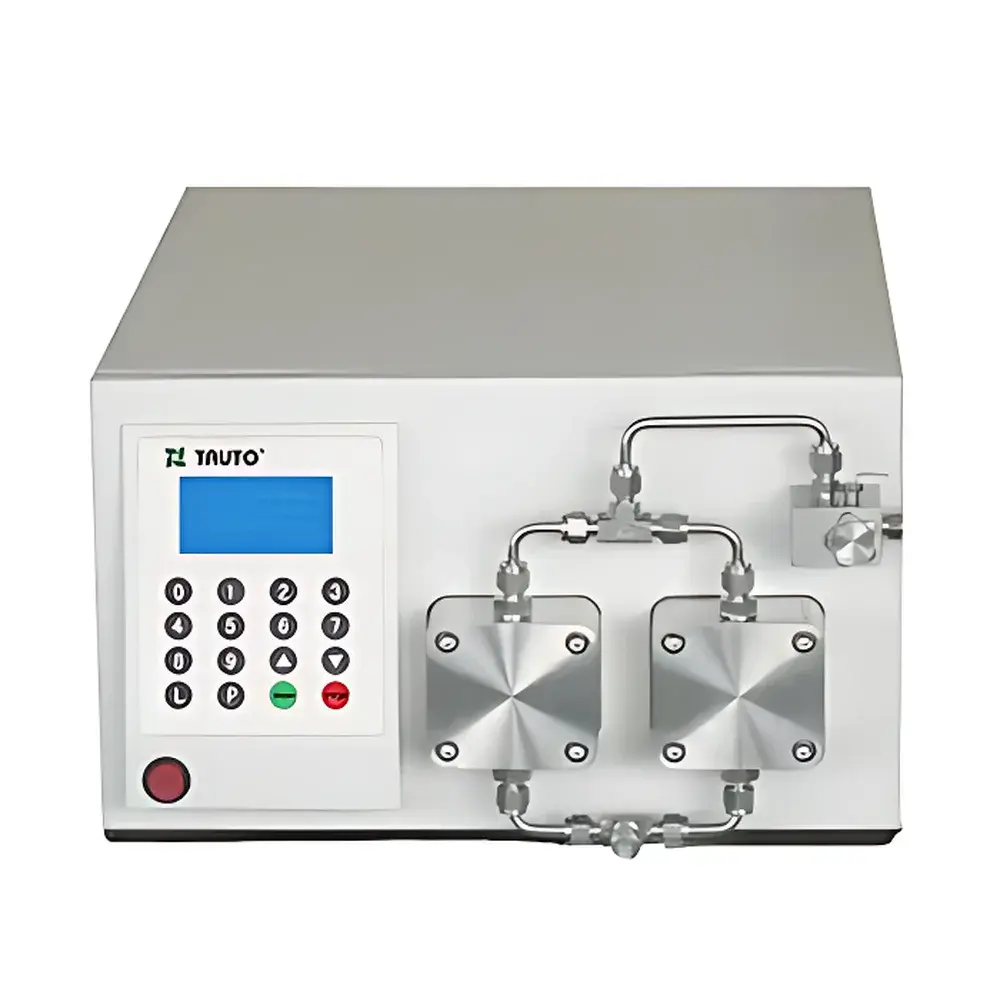
Tongtian TBP2H05S Dual-Piston Constant-Flow Pump
| Brand | Tongtian |
|---|---|
| Origin | Shanghai, China |
| Model | TBP2H05S |
| Pressure Range | 0–5.0 MPa |
| Flow Rate Range | 1–200 mL/min |
| Pressure Pulsation | ≤0.05 MPa |
| Pressure Accuracy | ≤±0.20 MPa |
| Flow Setting Error | ≤±2% (1–50 mL/min), ≤±1.5% (50–200 mL/min) |
| Flow Repeatability | ≤±1.5% (1–50 mL/min), ≤±1% (50–200 mL/min) |
| Power Supply | 220 V ±10%, 50/60 Hz |
| Power Consumption | 750 W |
| Weight | 32 kg |
| Dimensions (W×D×H) | 320 × 480 × 200 mm |
| Wetted Materials | Sapphire ball valves, ceramic plungers |
| pump head options | 316L stainless steel (L) or pure titanium (T) |
| Communication Interface | RS232 |
| Safety Features | Built-in overpressure protection, flow calibration system, modular sealing architecture, integrated degassing mechanism |
| Tubing Compatibility | 2 mm, 3 mm, 6 mm ID |
Overview
The Tongtian TBP2H05S Dual-Piston Constant-Flow Pump is an engineered solution for precision liquid delivery in mid-pressure analytical and preparative applications. Designed around a dual-plunger reciprocating architecture, it operates on positive displacement principles to deliver stable, pulse-dampened flow across a broad operational envelope—critical for applications demanding high reproducibility in chromatography, extraction, reaction feeding, and continuous process monitoring. Unlike single-piston systems, the TBP2H05S employs staggered stroke timing and dual sapphire ball check valves to minimize pressure pulsation (<0.05 MPa), ensuring compatibility with sensitive downstream detectors and packed-bed columns. Its microprocessor-based control system enables real-time regulation of flow rate and backpressure, supporting both open-loop setpoint operation and closed-loop pressure-compensated delivery modes. The pump is rated for continuous operation at up to 5.0 MPa (725 psi), making it suitable for medium-pressure HPLC, SFC, and preparative-scale solvent delivery where robustness and long-term stability are non-negotiable.
Key Features
- Dual-plunger architecture with phase-shifted actuation for inherently low pressure ripple and enhanced flow continuity
- High-integrity fluid path constructed with sapphire ball valves and ceramic plungers—resistant to abrasion, chemical corrosion, and thermal drift
- Selectable wetted materials: 316L stainless steel (L) or commercially pure titanium (T) pump heads, enabling compatibility with aggressive solvents (e.g., halogenated organics, strong acids/bases)
- Modular, tool-free pump head design allows in-situ inspection and maintenance without system shutdown—reducing downtime during routine service
- Integrated degassing chamber with optimized flow geometry to eliminate entrained gas prior to metering—critical for bubble-sensitive applications such as electrochemical detection or UV absorbance measurement
- RS232 serial interface compliant with standard SCPI command syntax, enabling seamless integration into LabVIEW, Python-controlled automation frameworks, or third-party chromatography data systems (CDS)
- Built-in overpressure cutoff and auto-recalibration routines aligned with ISO 5167 and ASTM D3231 guidelines for safety-critical fluid handling
Sample Compatibility & Compliance
The TBP2H05S accommodates a wide range of liquid-phase samples—including aqueous buffers, organic solvents (acetonitrile, THF, chloroform), corrosive reagents (HF-containing etchants, concentrated HNO₃), and viscous solutions (polymer melts <500 cP). Its large-bore flow path (2–6 mm ID tubing support) mitigates clogging risks common in narrow-bore analytical pumps, particularly when handling particulate-laden extracts or crude biological lysates. All wetted components comply with USP Class VI biocompatibility standards and meet ISO 13485 requirements for medical device manufacturing environments. For regulated laboratories, the firmware supports audit-trail-enabled operation under FDA 21 CFR Part 11-compliant software configurations when paired with validated host applications.
Software & Data Management
The native control software provides real-time visualization of pressure (setpoint vs. actual), flow rate (setpoint vs. calibrated output), and elapsed runtime. Users may configure dual-mode operation: either fixed-flow mode with pressure monitoring, or pressure-regulated mode with adaptive flow compensation. Data logging is performed at 10 Hz resolution, with timestamped CSV export capability for post-acquisition analysis in MATLAB or Excel. Critical parameters—including current pressure, flow deviation, valve cycle count, and thermal status—are stored in non-volatile memory and persist across power cycles. Optional API libraries (DLL and Python bindings) permit script-driven method sequencing, remote diagnostics, and integration into LIMS or MES platforms.
Applications
- HPLC and preparative LC solvent delivery for pharmaceutical purity testing (ICH Q2-compliant method transfer)
- Supercritical fluid chromatography (SFC) mobile phase pumping with CO₂/co-solvent mixtures
- Continuous-flow synthesis reactors requiring precise stoichiometric reagent addition
- Environmental sample extraction (Soxhlet, ASE, QuEChERS) with elevated temperature/pressure solvent delivery
- Quality control workflows in food safety labs (pesticide residue analysis per EU SANTE/11312/2021)
- Materials science applications including slurry pumping for battery electrode coating and ceramic precursor delivery
FAQ
What is the maximum allowable viscosity for stable operation?
The pump maintains rated accuracy up to 500 mPa·s at 25°C when operated within the 50–200 mL/min range and using titanium-wetted components.
Does the TBP2H05S support gradient elution?
No—it is a single-solvent constant-flow device. Gradient functionality requires external proportioning valves or multi-pump synchronization via master-slave RS232 protocol.
Is calibration traceable to national standards?
Yes—factory calibration certificates include NIST-traceable reference standards for flow (gravimetric method per ISO 4064-2) and pressure (deadweight tester per ISO 9001:2015 Annex A.5).
Can the pump be operated in vacuum-assisted inlet mode?
Yes—the inlet port is rated for −0.08 MPa (−80 kPa) absolute pressure, supporting passive suction from reservoirs located up to 1.2 m below the pump centerline.
What maintenance intervals are recommended for continuous 24/7 operation?
Plunger seals and check valves require inspection every 3,000 operating hours; full recalibration is advised annually or after any wetted-part replacement.



