
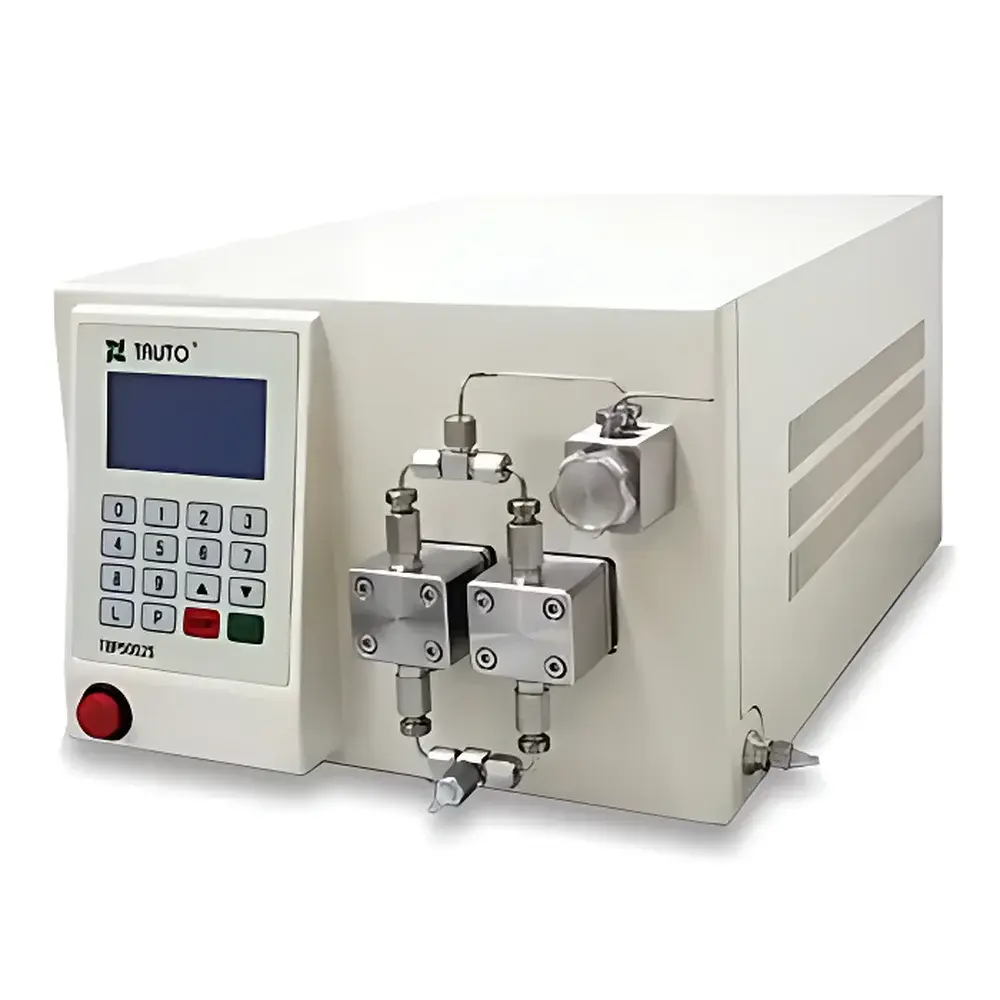
Tongtian TBP5002S Precision Constant-Flow Parallel-Plunger Pump
| Brand | Tongtian |
|---|---|
| Origin | Shanghai, China |
| Model | TBP5002S |
| Flow Rate | 0.1–50.0 mL/min |
| Maximum Pressure | 0.0–2.0 MPa |
| Pressure Pulsation | ≤ 0.02 MPa |
| Flow Accuracy | ≤ ±0.5% |
| Flow Repeatability | ≤ ±0.5% |
| Pressure Accuracy | ≤ ±0.10 MPa |
| Wetted Materials Options | 316L SS / Titanium / PEEK / PTFE |
| Drive System | Sealed Dual-Plunger Mechanism with Sapphire Ball Valves & Ceramic Plungers |
| Power Supply | 220 V ±10%, 50/60 Hz |
| Power Consumption | 75 W |
| Dimensions (W×D×H) | 270 × 400 × 190 mm |
| Weight | 17 kg |
Overview
The Tongtian TBP5002S is a high-precision, dual-plunger constant-flow pump engineered for applications demanding continuous, pulse-free liquid delivery under stable pressure and flow conditions. Based on parallel-plunger architecture—distinct from serial or single-plunger designs—the TBP5002S achieves intrinsically low pulsation by phase-shifting the stroke cycles of two independently actuated ceramic plungers. This mechanical synchronization, combined with sapphire ball check valves and fully sealed drive train, eliminates hydraulic shock and ensures laminar, time-invariant volumetric displacement. Unlike peristaltic or diaphragm pumps, the TBP5002S delivers true constant-flow performance across its full operating range (0.1–50.0 mL/min) without reliance on active electronic flow compensation. It is specifically designed for integration into modular chemical synthesis platforms, preparative chromatography systems, and corrosion-resistant reagent dosing lines where long-term stability, solvent compatibility, and regulatory traceability are critical.
Key Features
- Parallel dual-ceramic plunger mechanism with sapphire ball valves for extended service life and minimal wear in aggressive solvents
- Wetted path material flexibility: user-selectable configurations using 316L stainless steel, pure titanium, PEEK, or PTFE—enabling compatibility with halogenated, acidic, basic, and oxidizing media
- Pressure pulsation ≤ 0.02 MPa (measured at 10 mL/min, 1.0 MPa, water), ensuring undisturbed flow profiles essential for microreactor feeding and gradient HPLC pre-pumping
- Microprocessor-based control with real-time digital display of setpoint and actual pressure/flow values; local keypad + RS232/USB interface for remote command execution
- Onboard timer function supporting programmable start/stop sequences, multi-step flow/pressure profiles, and automatic shutdown after elapsed time
- Passive thermal management design with no forced-air cooling—reducing vibration transmission and acoustic noise in sensitive lab environments
Sample Compatibility & Compliance
The TBP5002S accommodates a broad spectrum of process liquids—including acetonitrile, concentrated HCl, NaOH solutions, THF, DMF, and chlorinated hydrocarbons—without degradation of wetted components. All fluid-contact materials comply with USP Class VI biocompatibility standards (for PEEK and PTFE variants) and meet ASTM F2136 requirements for elastomer-free sealing integrity. The pump’s pressure and flow calibration protocols support GLP-compliant documentation: audit trails for parameter changes, timestamped operational logs, and exportable CSV reports satisfy 21 CFR Part 11 data integrity prerequisites when used with validated host software. While not certified to ATEX or IECEx for hazardous areas, its sealed motor housing and non-sparking drive train permit safe operation in standard laboratory fume hoods and controlled manufacturing suites.
Software & Data Management
The TBP5002S supports bidirectional communication via ASCII-based SCPI commands over RS232 or USB virtual COM port. Native Windows-compatible configuration software provides graphical real-time pressure curve plotting, batch parameter saving (up to 20 user-defined methods), and automated report generation—including pressure history snapshots and flow deviation histograms. All logged data includes ISO 8601 timestamps, instrument ID, firmware revision, and operator tag fields. Export formats include .csv (for Excel/LabVIEW ingestion) and .pdf (for QA archival). Firmware updates are delivered via signed binary packages with SHA-256 checksum verification to ensure integrity during field deployment.
Applications
- Modular continuous-flow chemistry: precise co-feeding of reagents into microstructured reactors (e.g., Corning AFR, Chemtrix BTR) with sub-second response to flow setpoint changes
- Medium-pressure preparative chromatography: stable eluent delivery for flash and MPLC systems operating up to 2.0 MPa, minimizing baseline drift during fraction collection
- Corrosive reagent metering: titanium- or PTFE-head configurations enable direct pumping of >30% HNO₃, aqua regia, or molten salt precursors in battery electrolyte R&D
- Bioprocess perfusion: steady nutrient/media infusion into hollow-fiber bioreactors where pulsation-induced shear stress must remain below 0.5 Pa
- Calibration reference source: traceable flow output (±0.5% repeatability) used to verify turbine flowmeter accuracy in ISO/IEC 17025-accredited labs
FAQ
What is the maximum allowable backpressure for continuous operation at 50 mL/min?
The TBP5002S maintains rated flow accuracy up to 2.0 MPa at all flow rates; however, sustained operation above 1.5 MPa at ≥40 mL/min requires active heat dissipation via external mounting on thermally conductive surfaces.
Can the pump be operated in gradient mode with variable flow rate over time?
Yes—via external TTL-triggered step changes or internal timer-based multi-segment programming; ramping between setpoints occurs in discrete 0.1 mL/min increments with 100 ms minimum dwell time.
Is firmware validation documentation available for GMP environments?
Yes—IQ/OQ protocol templates, calibration certificate samples, and 21 CFR Part 11 configuration worksheets are provided upon request with purchase confirmation.
How often should the sapphire valves and ceramic plungers be inspected?
Under typical organic solvent use (e.g., methanol, acetone), inspection is recommended every 2,000 operating hours; in halogenated media, interval reduces to 1,000 hours—both defined in the maintenance logbook included with shipment.
Related Products



