
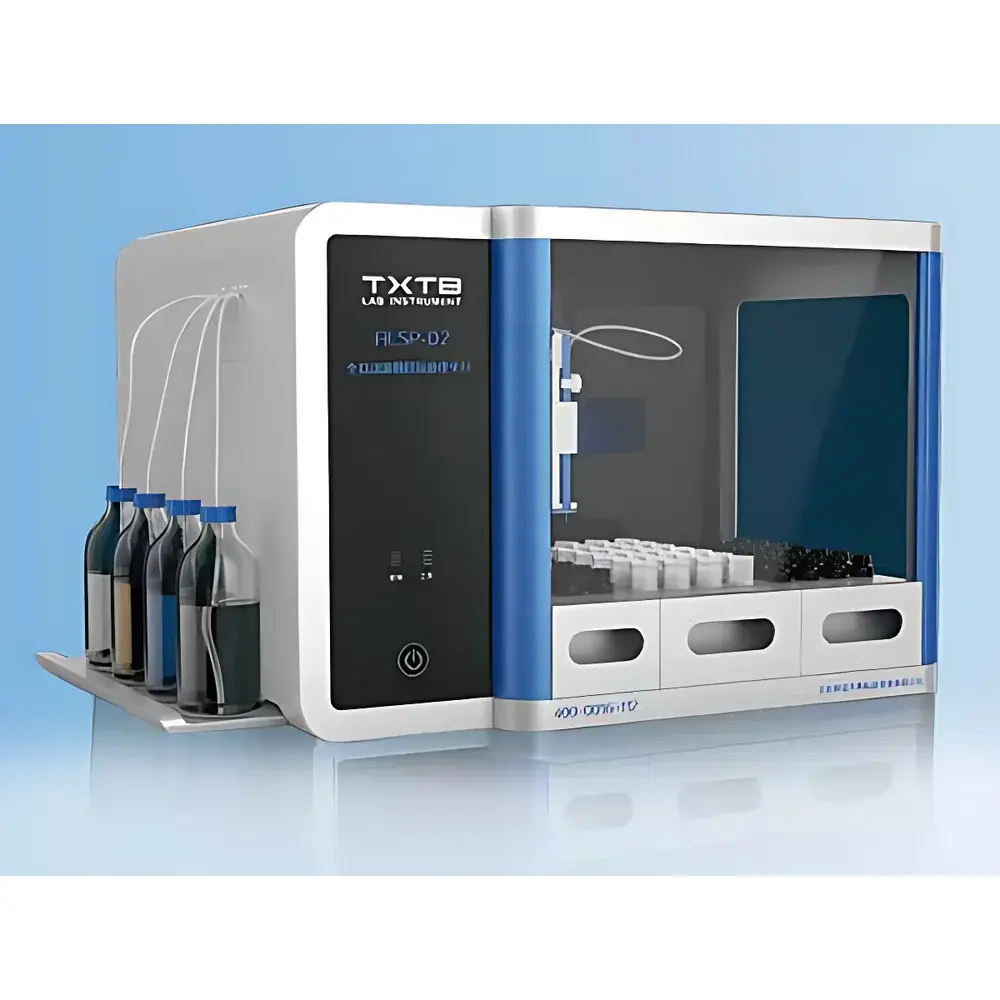
Tongxintianbo ALSP-02/02A Fully Automated Liquid Sample Processing Workstation
| Brand | Tongxintianbo |
|---|---|
| Origin | Beijing, China |
| Model | ALSP-02/02A |
| Liquid Handling Range | 10–10,000 µL |
| Sample Tube Compatibility | 2 mL, 4 mL, 10 mL, 40 mL, 50 mL, 100 mL |
| Communication | Wi-Fi (up to 1000 m range) |
| Platform Type | Dual-use (inorganic for ALSP-02 |
| Pressure Equilibration | Integrated needle internal/external pressure balance system |
| Operation Mode | One-touch protocol execution for dilution, transfer, reagent addition, colorimetric reagent dispensing, and final volume adjustment |
Overview
The Tongxintianbo ALSP-02/02A Fully Automated Liquid Sample Processing Workstation is an integrated, programmable liquid handling platform engineered for precision, reproducibility, and operational safety in regulated laboratory environments. Designed around positive-displacement and air-assisted pipetting principles with active pressure equilibration, the system ensures consistent aspiration and dispensing across a broad dynamic range (10–10,000 µL) without cross-contamination or evaporation-induced error. Unlike modular or single-function liquid handlers, the ALSP-02/02A unifies standard solution preparation, multi-step dilution, volumetric transfer, reagent addition (including colorimetric agents), and final volume adjustment into a single, validated workflow engine. Its dual-platform architecture—ALSP-02 optimized for aqueous and inorganic matrices (e.g., acids, metal salt solutions, ICP-grade standards), and ALSP-02A chemically resistant for organic solvents (e.g., acetonitrile, methanol, chloroform, ethyl acetate)—enables laboratories to maintain method integrity while minimizing instrument footprint and procedural redundancy.
Key Features
- Dual-platform chemical compatibility: ALSP-02 supports inorganic calibration standards (e.g., for ICP-MS, AAS, ICP-OES); ALSP-02A features solvent-resistant fluidic pathways and seals for organic-phase sample preparation (e.g., LC-MS/MS extraction, GC derivatization).
- Wi-Fi-enabled remote operation: Secure wireless control up to 1000 meters enables walkaway operation from fume hoods, cleanrooms, or adjacent labs—reducing analyst exposure to hazardous vapors and improving ergonomic compliance.
- Needle-based pressure equilibration system: Actively balances internal and external pressure during aspiration and dispense cycles to eliminate bubble formation, meniscus instability, and volume drift—critical for low-volume (<100 µL) and high-viscosity organic transfers.
- One-touch protocol execution: Predefined workflows for serial dilution, spike recovery, matrix-matched standard preparation, reagent addition (e.g., chromogenic agents for spectrophotometry), and final volume adjustment (to 2–100 mL tubes) are executed with traceable parameter logging.
- Modular tube rack configuration: Accommodates standard screw-cap and crimp-top vials ranging from 2 mL microcentrifuge tubes to 100 mL volumetric flasks—eliminating manual tube handling and enabling direct integration with downstream analytical instrumentation.
Sample Compatibility & Compliance
The ALSP-02/02A meets core requirements for GLP and GMP-aligned sample preparation workflows. Its hardware architecture supports traceable, auditable liquid handling events—including timestamped step logs, user ID association, and protocol version tracking—facilitating alignment with FDA 21 CFR Part 11 electronic record controls when deployed with compliant LIMS or ELN interfaces. The platform accommodates common regulatory sample formats: EPA Method 200.8/6020B (ICP-MS), USP Analytical Instrument Qualification (AIQ) for automated liquid handlers, and ISO/IEC 17025 clause 7.2.2 on method validation for sample preparation steps. All wetted materials comply with USP Class VI biocompatibility standards and exhibit minimal extractables in both acidic (1% HNO₃) and organic (acetonitrile/water 90:10) media.
Software & Data Management
The workstation operates via a dedicated Windows-based control application supporting protocol creation, scheduling, and audit trail export (CSV/PDF). Each run generates a structured metadata file containing pipette tip lot IDs, calibration timestamps, environmental temperature/humidity (if connected to optional sensors), and per-step volume verification flags. Raw log files include digital signatures and are write-protected post-execution. Software architecture permits integration with third-party data systems via OPC UA or RESTful API endpoints—enabling automated ingestion into CDS (e.g., Thermo Chromeleon, Agilent OpenLab), LIMS (e.g., LabWare, STARLIMS), or electronic lab notebooks compliant with ALCOA+ principles.
Applications
- Preparation of certified reference material (CRM)-based calibration curves for ICP-MS, ICP-OES, AAS, and UV-Vis spectrophotometry.
- Automated dilution series for method linearity assessment per ICH Q2(R2) guidelines.
- Multi-analyte spiking in environmental water testing (EPA 525.3, 8270) and pesticide residue analysis (AOAC 2007.01).
- Reagent-controlled derivatization workflows for GC-ECD or LC-FLD assays.
- High-throughput sample conditioning for pharmaceutical dissolution testing (USP ) and stability-indicating assays.
FAQ
What distinguishes ALSP-02 from ALSP-02A?
ALSP-02 uses fluoropolymer-coated stainless steel and PTFE fluid paths optimized for strong mineral acids and metal salt solutions. ALSP-02A replaces select elastomers and seals with perfluoroelastomer (FFKM) and incorporates chemically inert sapphire-coated syringe barrels—validated for repeated use with halogenated solvents, ketones, and esters.
Does the system support gravimetric verification?
Yes—optional integration with METTLER TOLEDO or Sartorius analytical balances via RS-232 or Ethernet enables real-time mass feedback during dispensing, supporting USP and ASTM E2706 gravimetric accuracy validation.
Can protocols be exported for regulatory review?
All protocols are stored as XML-based definition files with embedded checksums. Audit trails include digital signatures and may be exported in PDF/A-2b or CSV format with ISO 8601 timestamps and UTC synchronization.
Is routine maintenance documented within the software?
Yes—preventive maintenance schedules (e.g., syringe lubrication, seal replacement, tip ejector calibration) are tracked in the system’s service log, with alerts triggered based on cycle count or calendar intervals.
How is cross-contamination prevented between samples?
The system employs positive-pressure air purge between aspirates, disposable low-retention tips (0.1–10 mL), and automated tip-wash stations using configurable solvent sequences (e.g., water → methanol → air dry) per ICH Q5C recommendations.



