
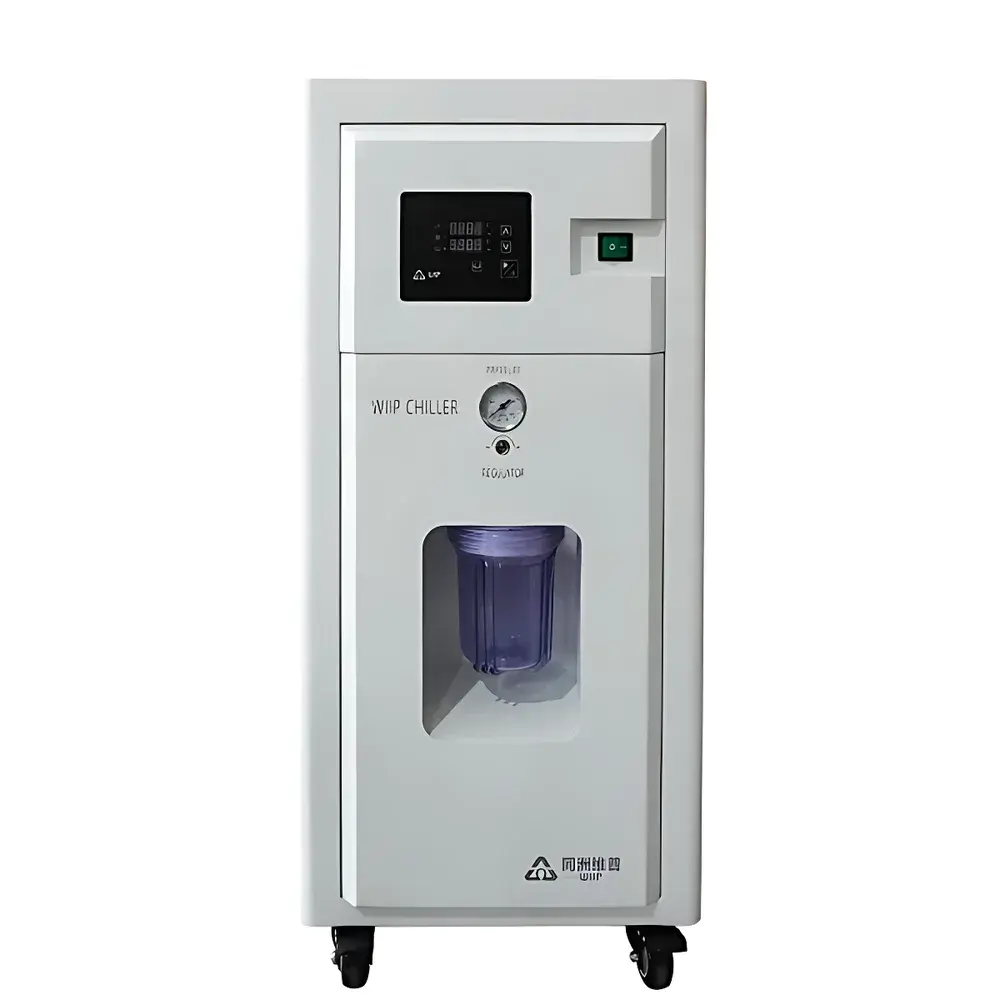
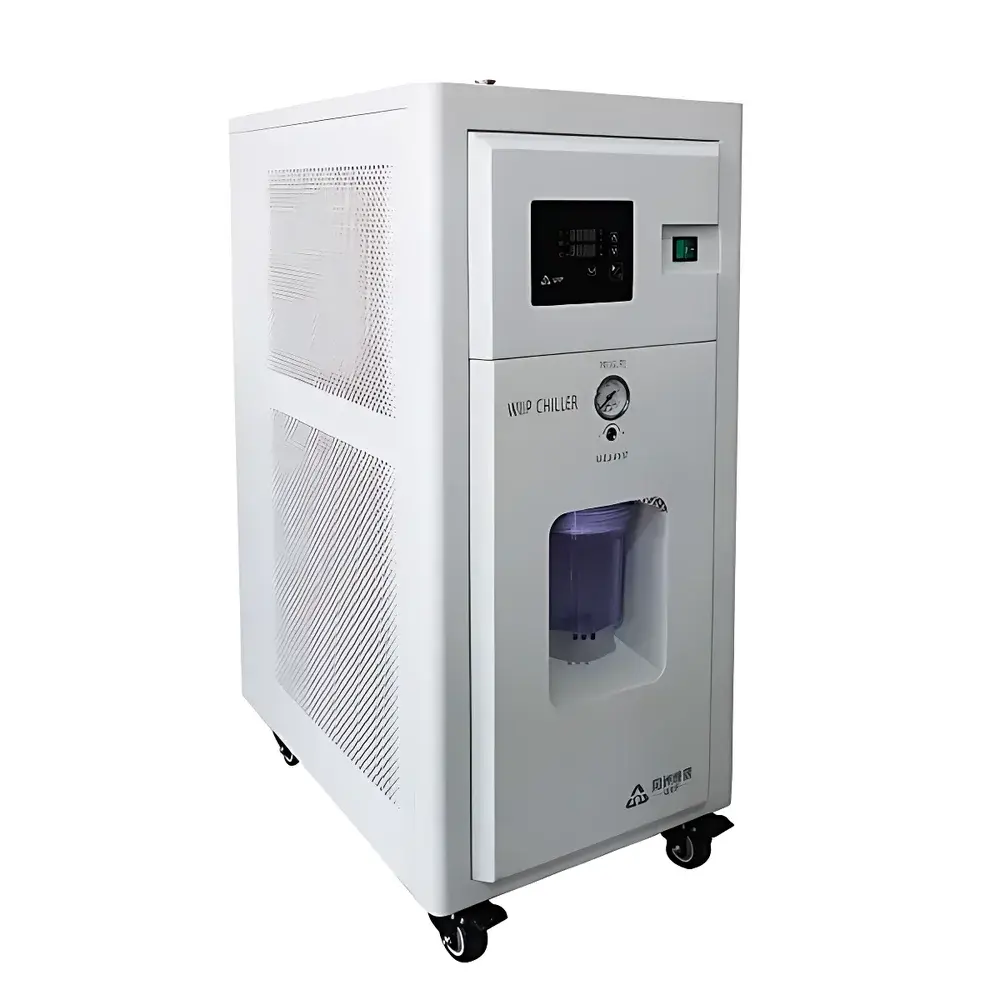
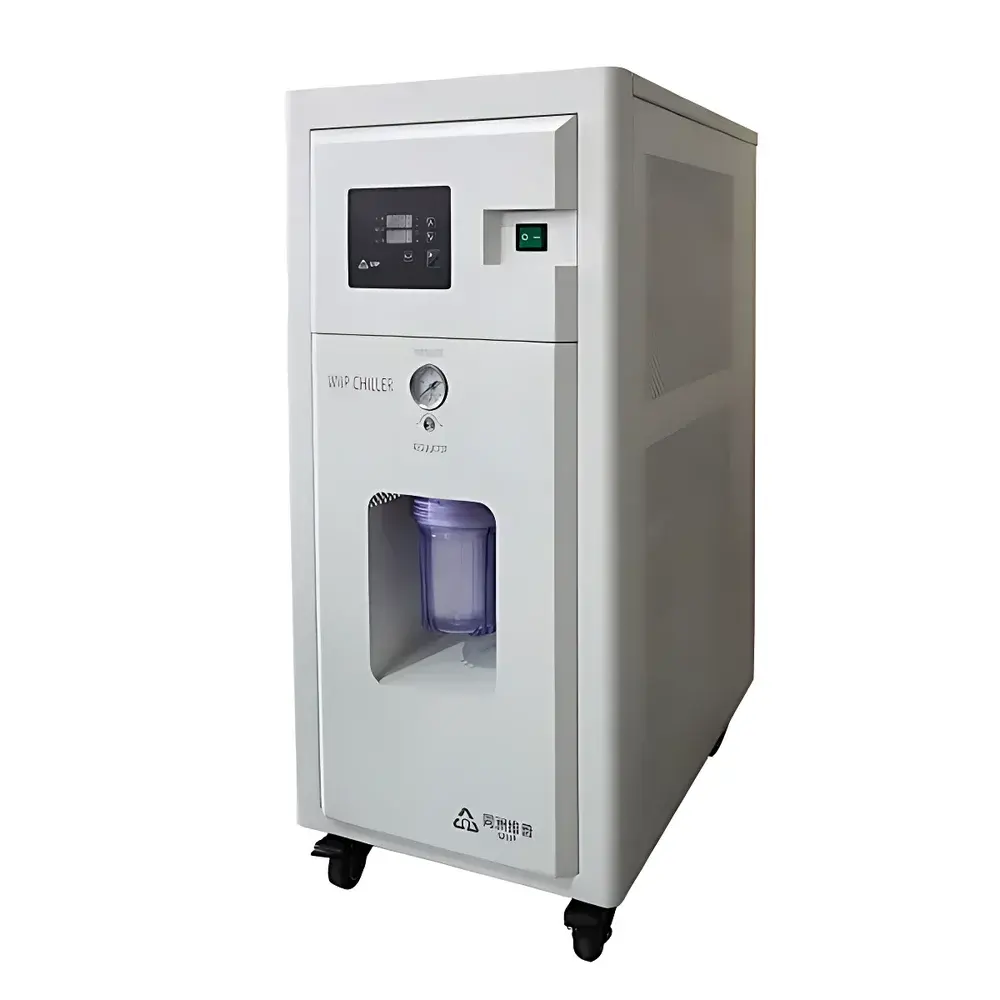
Tongzhou Weipu H2 Circulating Chiller for Scanning Electron Microscopes
| Brand | Tongzhou Weipu |
|---|---|
| Origin | Beijing, China |
| Manufacturer Type | Direct Manufacturer |
| Product Category | Domestic |
| Model | H2 Circulating Chiller for SEM |
| Instrument Type | Integrated Unit |
| Cooling Method | Water-Cooled |
| Temperature Control Range | −40 °C to 95 °C |
| Cooling Capacity | 900 W to 6400 W |
| Temperature Stability | ±0.1 °C to ±0.3 °C |
Overview
The Tongzhou Weipu H2 Circulating Chiller is an integrated, vertically configured refrigeration system engineered specifically to provide stable, high-precision temperature control for electron-optical and high-sensitivity analytical instrumentation—including scanning electron microscopes (SEM), transmission electron microscopes (TEM), focused ion beam (FIB) systems, and other vacuum-based or thermally sensitive laboratory platforms. Operating on a closed-loop water-glycol circulation principle, the H2 employs a dual-stage compression refrigeration architecture with optimized heat exchange pathways to maintain consistent thermal loading across variable ambient conditions. Its design prioritizes low-vibration operation and electromagnetic compatibility (EMC), minimizing thermal drift and mechanical interference that could compromise electron beam stability or detector signal integrity. The chiller’s wide operational range (−40 °C to 95 °C) supports both cryogenic specimen stages and high-temperature sample preparation modules—enabling seamless integration into multi-instrument laboratories where thermal management requirements span extremes.
Key Features
- Vertically oriented compact chassis minimizes footprint—ideal for space-constrained instrument rooms and cleanroom environments.
- Low-RPM, large-diameter axial fan assembly ensures acoustic performance ≤52 dB(A) at 1 m distance—critical near vibration-sensitive electron optical columns.
- Integrated deionized water filtration system with replaceable 5-µm particulate cartridge and optional conductivity monitoring to prevent scaling and corrosion in recirculated coolant loops.
- Dual-sensor redundant temperature monitoring with real-time PID feedback control, delivering stability within ±0.1 °C under steady-state load and ±0.3 °C during dynamic thermal transients.
- CE-certified electrical architecture compliant with EN 61000-6-3 (EMI) and EN 61000-6-2 (immunity); compatible with global voltage inputs (100–240 VAC, 50/60 Hz) via auto-ranging power supply.
- Eco-friendly R-410A refrigerant (GWP = 2088) selected per EU F-Gas Regulation (EU) No 517/2014; fully sealed refrigeration circuit with leak detection ports for preventive maintenance.
Sample Compatibility & Compliance
The H2 chiller is validated for continuous duty cycles with SEMs requiring coolant flow rates of 2–12 L/min and pressure differentials up to 3.5 bar. It interfaces directly with OEM cooling manifolds from leading manufacturers including Thermo Fisher Scientific (Verios, Apreo), Zeiss (Sigma, Gemini), JEOL (JSM, JED), and Hitachi (Regulus, SU). All fluid-contact wetted parts are constructed from 316 stainless steel, EPDM elastomers, and borosilicate glass—ensuring chemical resistance to common coolant additives (e.g., biocides, corrosion inhibitors) and compatibility with ISO 8573-1 Class 2 compressed air supply lines used in purge gas systems. The unit meets ISO/IEC 17025:2017 requirements for supporting equipment in accredited testing laboratories and includes audit-ready event logs traceable to UTC timestamps—supporting GLP and GMP documentation workflows.
Software & Data Management
Equipped with an embedded ARM Cortex-M7 controller running a real-time OS, the H2 provides local operation via a 5.7″ resistive touchscreen with intuitive menu navigation and multilingual UI (English, German, French, Japanese). Remote monitoring and control are supported through standard Ethernet (TCP/IP) and RS-485 Modbus RTU protocols. Optional firmware enables secure HTTPS API access for integration into LabVantage, STARLIMS, or custom LIMS platforms. All operational parameters—including inlet/outlet temperatures, flow rate, compressor runtime, filter life counter, and alarm history—are logged with 1-second resolution and exportable as CSV or XML. Audit trails comply with FDA 21 CFR Part 11 requirements when paired with user authentication and digital signature modules.
Applications
- Stabilizing SEM column temperature to mitigate thermal lensing effects and improve spatial resolution below 1 nm.
- Cooling backscatter electron (BSE) and energy-dispersive X-ray spectroscopy (EDS) detectors to reduce dark current noise and enhance spectral peak-to-background ratio.
- Maintaining cryo-stage temperatures during in-situ low-temperature SEM imaging of biological specimens or battery electrode materials.
- Thermal conditioning of RF generators in plasma etch tools interfaced with SEM-FIB dual-beam systems.
- Providing secondary cooling for laser ablation ICP-MS sample introduction systems co-located in shared microscopy suites.
FAQ
What is the maximum allowable coolant conductivity for optimal SEM compatibility?
For long-term reliability with electron optical components, maintain coolant conductivity below 5 µS/cm using deionized water mixed with ≥99.9% purity ethylene glycol (15–30% v/v) and certified biocide packages.
Can the H2 chiller be integrated into a building management system (BMS)?
Yes—the unit supports BACnet MS/TP and Modbus TCP protocols via optional gateway module, enabling centralized HVAC coordination and predictive maintenance alerts.
Is remote firmware update capability available?
Firmware updates may be performed securely over HTTPS using signed .bin files; version history and rollback options are retained in non-volatile memory.
Does the H2 meet seismic certification requirements for installation in earthquake-prone regions?
The chiller complies with IEC 60068-2-64 (vibration) and IEC 60068-2-57 (shock) standards; optional seismic anchoring kits are available for Zone 4 compliance per ASCE 7-22.
How frequently should the particulate filter be replaced under continuous SEM operation?
Under typical lab conditions (8 hrs/day, 5 days/week), replace the 5-µm filter every 6 months—or sooner if differential pressure exceeds 0.8 bar—as indicated by the onboard sensor dashboard.



