
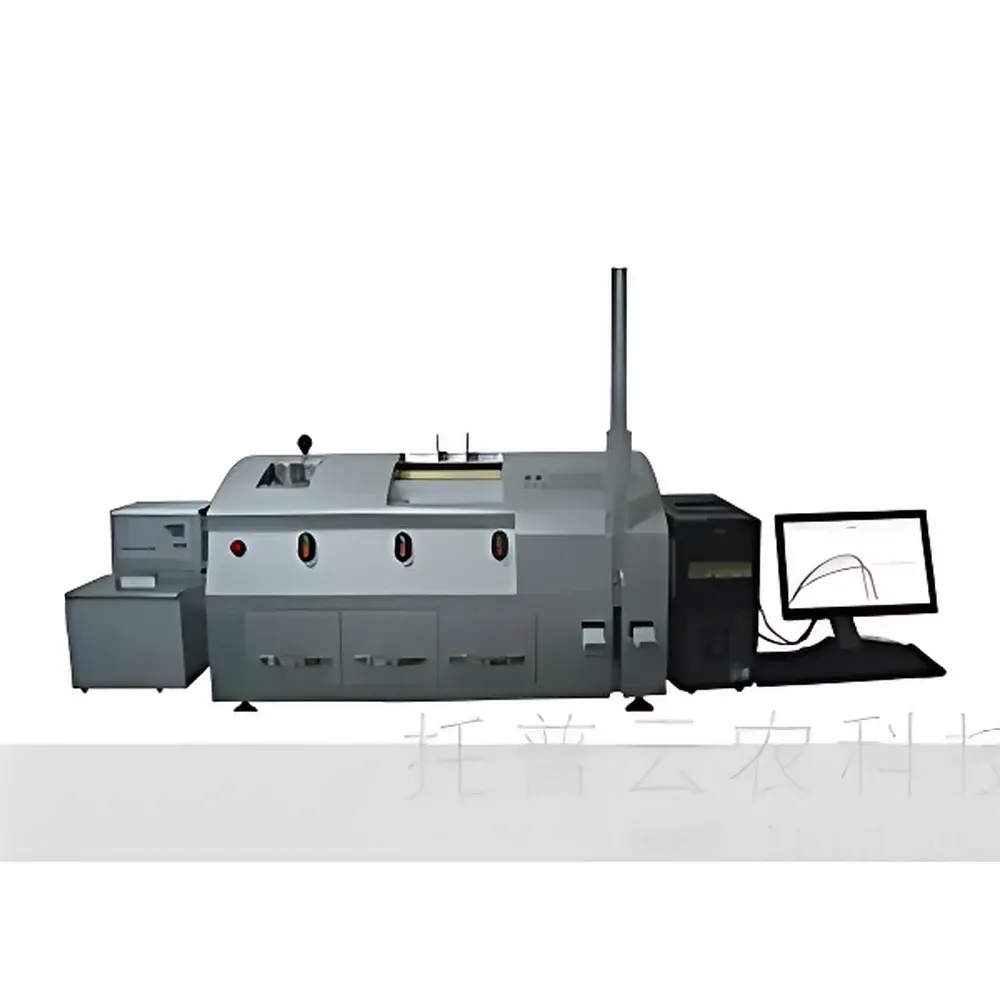
Top Cloud-agri HZL-350 Electronic Extensograph
| Brand | Top Cloud-agri |
|---|---|
| Origin | Zhejiang, China |
| Manufacturer Type | Direct Manufacturer |
| Instrument Type | Electronic Tensile Testing Machine for Flour Dough |
| Model | HZL-350 |
| Sample Mass | 300 g flour + 6 g salt + distilled water |
| Mixer Speed | 83 ± 2 rpm (auto-stop after 20 revolutions) |
| Rounding Speed | 15 ± 1 rpm |
| Stretching Hook Speed | 1.45 ± 0.05 cm/s |
| Resistance Unit Calibration | 12.3 ± 0.3 mN/Eu |
| Force Measurement | High-stability electronic load cell |
| Data Output Format | Microsoft Access database (.accdb) |
| Curve Display | Up to 5 superimposed extensogram traces |
Overview
The Top Cloud-agri HZL-350 Electronic Extensograph is a dedicated laboratory instrument engineered for standardized evaluation of dough rheological properties—specifically extensibility, resistance to extension (R), and energy absorption (area under the curve)—in accordance with internationally recognized cereal science methodologies. It operates on the fundamental principle of uniaxial tensile deformation: a standardized dough sample, prepared using controlled hydration and mixing protocols, is formed into a cylindrical strand and subjected to constant-speed elongation while force and displacement are continuously recorded. The resulting extensogram—a plot of resistance (mN) versus extension distance (mm)—provides quantitative metrics essential for wheat quality assessment, breeding program selection, and miller’s formulation optimization. Unlike generic universal testing machines, the HZL-350 integrates purpose-built mechanical subsystems—including a precision-controlled stretching hook drive, calibrated dough conditioning chamber, and ISO-aligned sensor architecture—to ensure metrological consistency across repeated tests and inter-laboratory comparisons.
Key Features
- Dual-stage mechanical design: Integrated dough rounding unit (15 ± 1 rpm) and high-torque mixer (83 ± 2 rpm, auto-stop at 20 revs) conform to AACC Method 54–40A and GB/T 14614–2023 specifications for dough development.
- Drawer-type proofing chamber with spring-assisted, oil-damped linear guides ensures smooth, vibration-free access and maintains stable temperature/humidity during resting—critical for reproducible gluten network relaxation.
- Enclosed arc-shaped housing minimizes ambient dust ingress and thermal drift, supporting compliance with GLP environmental control requirements in regulated QC laboratories.
- Real-time multi-curve overlay capability (up to five simultaneous extensograms) enables direct visual and statistical comparison of cultivar batches, additive trials, or time-series fermentation studies.
- High-fidelity electronic load cell (rated capacity ≥ 1500 mN, resolution ≤ 0.5 mN) delivers traceable force measurement aligned with ASTM E4 and ISO 7500-1 Class 1 accuracy standards.
- Fully automated zero-point calibration and plot initiation eliminate operator-induced timing variance; start trigger is synchronized with hook engagement detection.
Sample Compatibility & Compliance
The HZL-350 is validated for use with wheat flour samples meeting ISO 27971:2012 (Cereals and cereal products — Determination of dough extensibility by the extensograph method) and equivalent national standards including GB/T 14614–2023 and AACC International Approved Method 54–40A. It accommodates standard 300 g flour + 6 g NaCl + distilled water formulations, with optional adaptability for modified hydration levels via software-defined protocol templates. All mechanical components—including stainless-steel dough hooks, anodized aluminum mixing bowls, and food-grade silicone sealing gaskets—comply with FDA 21 CFR Part 177 and EU Regulation (EC) No 1935/2004 for indirect food contact. Instrument validation documentation supports IQ/OQ protocols required under ISO/IEC 17025-accredited testing laboratories.
Software & Data Management
Data acquisition and analysis are performed via proprietary Windows-based software compliant with FDA 21 CFR Part 11 requirements for electronic records and signatures. Raw force/displacement data streams are captured at ≥100 Hz sampling rate and stored in native Microsoft Access (.accdb) format—enabling direct SQL querying, export to CSV/Excel, and integration with LIMS platforms via ODBC drivers. Software modules include automatic peak detection (Rmax), extensibility (E, mm), and area calculation (EU); configurable pass/fail thresholds per sample group; audit trail logging with user ID, timestamp, and parameter change history; and PDF report generation with embedded metadata (operator, date, ambient conditions, calibration status). Firmware updates are delivered via secure HTTPS channel with cryptographic signature verification.
Applications
- Wheat breeding programs: Objective ranking of genotypes based on dough strength (Rmax), elasticity ratio (Rmax/E), and baking potential (EU).
- Flour mill quality control: Routine monitoring of incoming wheat lots and finished flour batches against contractual specifications (e.g., R > 450 mN, E > 120 mm).
- Ingredient functionality testing: Quantitative assessment of enzyme additives (e.g., glucose oxidase, transglutaminase), vital wheat gluten, or hydrocolloids on dough viscoelastic balance.
- Research in cereal chemistry: Correlation studies between protein composition (HMW-GS alleles), starch damage, and extensographic parameters under controlled environmental variables.
- Regulatory compliance reporting: Generation of auditable datasets for certification bodies (e.g., USDA Organic, GMP-certified bakeries) requiring documented dough performance metrics.
FAQ
What international standards does the HZL-350 support for dough extensibility testing?
It fully implements ISO 27971:2012, AACC 54–40A, and GB/T 14614–2023, with mechanical tolerances and procedural logic validated against reference materials from ICC Standard No. 171.
Is the instrument suitable for non-wheat flours such as rye or spelt?
Yes—software-defined test protocols allow adjustment of mixing speed, resting time, and stretching rate to accommodate alternative cereal matrices, though method validation per ISO 21747 is recommended prior to routine use.
How is force calibration maintained over time?
The system includes NIST-traceable dead-weight calibration kits (100/500/1000 mN) and automated linearity verification routines; calibration logs are retained within the audit trail and exportable as PDF.
Can raw data be exported for third-party statistical analysis?
Yes—time-stamped .csv files containing force (mN), extension (mm), and timestamp (ms) columns are generated for each test, compatible with JMP, Minitab, R, and Python pandas workflows.
Does the software support multi-user role-based access control?
Yes—administrator, analyst, and reviewer roles enforce separation of duties; password policies, session timeouts, and failed-login lockouts comply with ISO 27001 Annex A.9 controls.



