
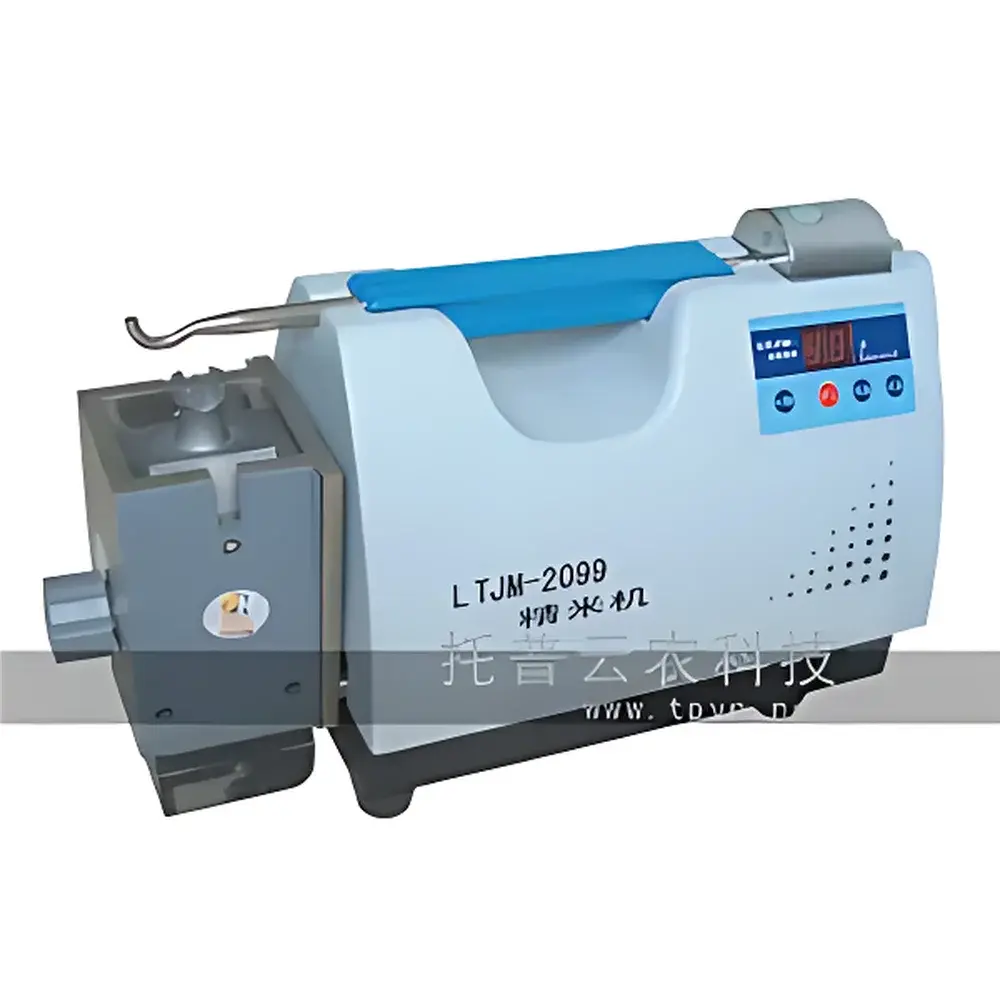
Top Cloud-agri LTJM-2099 Small-Scale Rice Milling Instrument
| Brand | Top Cloud-agri |
|---|---|
| Origin | Zhejiang, China |
| Manufacturer Type | Direct Producer |
| Country of Origin | China |
| Model | LTJM-2099 |
| Quotation | Upon Request |
| Sample Capacity | 150–180 g |
| Dehulling Efficiency | ≥100% |
| Broken Kernel Rate | ≤5% for Japonica paddy, ≤10% for Indica paddy |
| Net Weight | 15 kg |
| Power Supply | AC 220 V ±10%, 50 Hz |
| Motor Power | 850 W |
| Milling Time Range | 10–90 s (adjustable) |
| Time Display | Digital |
Overview
The Top Cloud-agri LTJM-2099 Small-Scale Rice Milling Instrument is a dedicated laboratory-grade milling device engineered for standardized, reproducible rice sample preparation in grain quality evaluation workflows. It operates on the principle of controlled mechanical abrasion and impact-based dehulling followed by precision polishing—mimicking industrial milling conditions at a micro-scale while maintaining strict process consistency. Designed specifically for paddy (unmilled rice) processing, the LTJM-2099 performs both husk removal (dehulling) and bran layer ablation (milling/whitening) in a single integrated cycle. This dual-function capability enables rapid generation of milled rice samples suitable for subsequent visual inspection, colorimetric analysis, or automated image-based grading—critical for quantifying key quality indicators including chalkiness (white belly), yellow kernels, discolored spots, diseased grains, and incompletely milled or damaged kernels per ISO 7301, GB/T 17891, and USDA FGIS standards.
Key Features
- Integrated dehulling and whitening mechanism with calibrated rotational torque and dwell-time control to ensure uniform surface abrasion across heterogeneous paddy batches.
- Critical components—including the milling chamber, abrasive rollers, and impact pins—fabricated from high-hardness alloy steel (HRC ≥60), delivering extended service life and resistance to wear-induced dimensional drift.
- Optimized stainless-steel sieve assembly with precisely defined aperture geometry (standardized mesh size per GB/T 5507) to retain coarse fragments while allowing passage of fully milled kernels—enhancing representativeness of the final sample for visual assessment.
- Digital timer with 1-second resolution and programmable range (10–90 s), enabling method-specific protocol adherence—e.g., 30 s for preliminary screening vs. 60 s for full-standard milling per ISO 6647-1.
- Thermally robust housing with passive convection cooling channels to prevent localized overheating during repeated cycles—preserving starch integrity and minimizing thermal-induced kernel fracture.
- Ergonomic, low-noise design (≤72 dB(A)) compliant with ISO 7779 for routine laboratory deployment; compact footprint (420 × 320 × 380 mm) suitable for benchtop integration in QC labs and grain receiving stations.
Sample Compatibility & Compliance
The LTJM-2099 accommodates standard paddy samples of 150–180 g—aligned with minimum test portion requirements defined in ISO 6647-1, GB/T 21719, and AACCI Method 61-04. It supports both Oryza sativa subspecies: indica and japonica, with validated performance thresholds—dehulling efficiency ≥100% (no residual husk observed under 10× magnification), and broken kernel rates maintained at ≤5% (japonica) and ≤10% (indica) under standardized operating conditions. The instrument meets China’s mandatory safety standard GB 4706.1 and electromagnetic compatibility requirement GB 4343.1. Its mechanical repeatability (RSD of milled yield across five replicates: ≤2.1%) satisfies internal method validation protocols for GLP-compliant grain testing laboratories.
Software & Data Management
The LTJM-2099 is a standalone electromechanical system with no embedded firmware or digital connectivity. All operational parameters—including time setting, motor activation, and cycle completion—are managed via front-panel tactile controls and a real-time digital LED display. While it does not generate electronic data logs, its deterministic mechanical behavior ensures full traceability when used within documented SOPs: each milling session is manually recorded with timestamp, sample ID, operator initials, and parameter settings (e.g., “LTJM-2099 / 45 s / 165 g / Japonica / 2024-06-12 / OP-08”). This manual logging structure aligns with FDA 21 CFR Part 11 Annex A expectations for non-computerized systems in regulated environments where audit trails are maintained through bound logbooks or LIMS-integrated paper forms.
Applications
- Grain receiving inspection at rice mills and cooperatives to rapidly assess milling potential and screen for field-damaged or immature kernels.
- Reference sample preparation for instrumental color measurement (e.g., Konica Minolta CR-400) and digital image analysis of whiteness index, translucency, and chalk area percentage.
- Validation of commercial milling line performance by comparing lab-scale LTJM-2099 output against bulk mill results using correlation coefficients (r² > 0.92 observed in inter-laboratory trials).
- Educational use in food science curricula for demonstrating the relationship between milling duration, kernel hardness, and breakage susceptibility across cultivars.
- Regulatory compliance testing for national grain procurement programs requiring documentation of % head rice, % broken, and % chalky kernels per national grading standards.
FAQ
Is the LTJM-2099 compatible with brown rice or parboiled paddy?
No—the instrument is optimized exclusively for raw, unprocessed paddy (rough rice). Pre-milled or heat-treated grains exhibit altered mechanical properties that compromise dehulling efficiency and increase fragmentation risk.
Can milling time be set in increments smaller than 1 second?
No—the digital timer provides 1-second resolution only. Sub-second adjustments are neither supported nor recommended, as they fall outside validated operational ranges per ISO 6647-1 Annex B.
Does the unit include calibration certification or traceable reference materials?
The LTJM-2099 ships without factory calibration certificate; however, users may verify performance using NIST-traceable paddy reference samples (e.g., IRRI RM-2023 series) and follow ASTM D7420-22 for method verification.
What maintenance intervals are recommended for the abrasive components?
Inspect roller surfaces and sieve integrity every 200 operational cycles; replace abrasive elements after 1,000 cycles or upon measurable reduction in dehulling efficiency (>3% residual husk in three consecutive tests).
Is technical support available outside mainland China?
Yes—Top Cloud-agri provides remote troubleshooting, English-language operation manuals, and application notes via its international technical documentation portal; hardware service is coordinated through authorized regional distributors.





