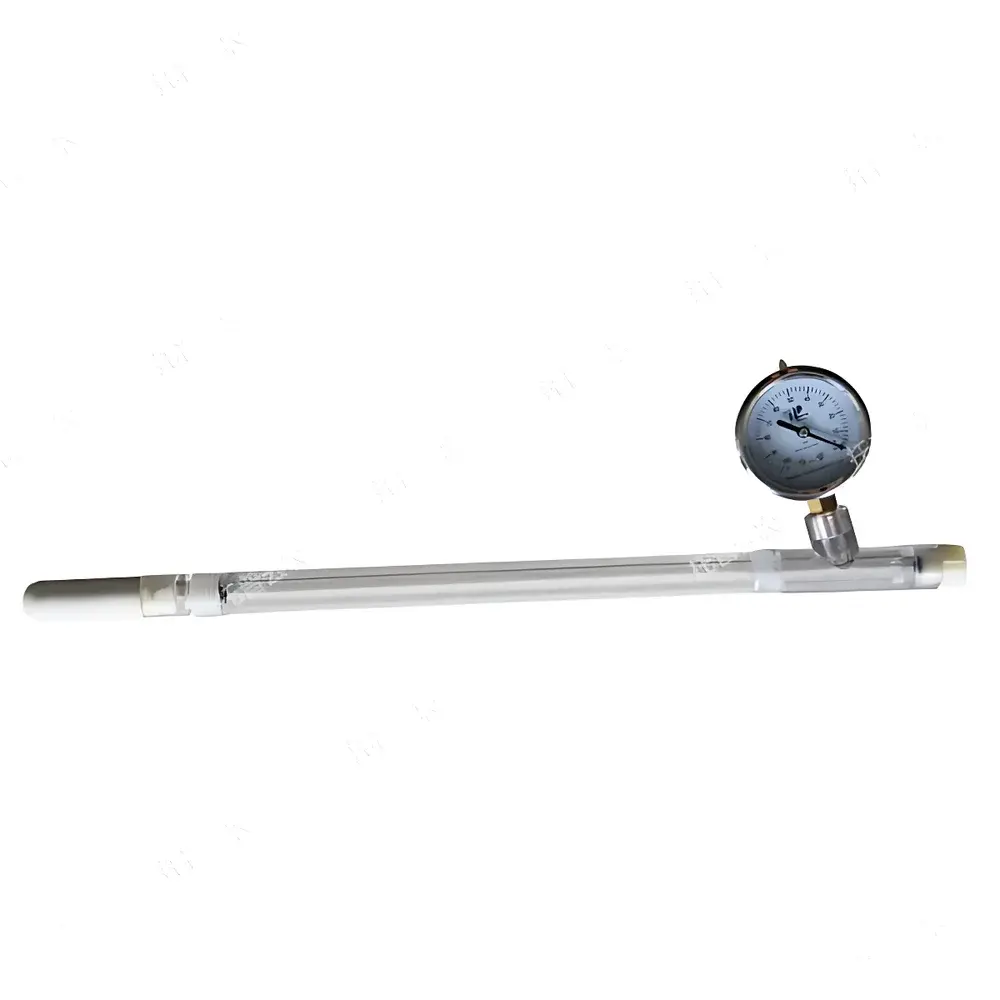
Top Cloud-agri TEN Series Soil Moisture Tensiometer
| Brand | Top Cloud-agri |
|---|---|
| Origin | Zhejiang, China |
| Manufacturer Type | Direct Manufacturer |
| Product Origin | Domestic (China) |
| Model | TEN Series |
| Measurement Principle | Load-cell-based hydrostatic equilibrium |
| Pressure Type | Differential (Suction) |
| Measurement Range | 0–100 kPa (0–1 bar) |
| Accuracy Class | 0.05 |
| Measured Medium | Liquid (soil water) |
| Overpressure Capability | Specified per model |
| Construction | Polycarbonate tensiometer tube, ceramic porous cup (2–5 µm pore size), analog Bourdon-tube vacuum gauge |
| Customizable Active Sensing Length | 15 cm / 30 cm / 40 cm / 50 cm / 60 cm (standardized as TEN-15 to TEN-60) |
Overview
The Top Cloud-agri TEN Series Soil Moisture Tensiometer is a field-deployable, analog differential pressure instrument engineered for direct in situ measurement of soil water potential (suction tension) in the range of 0–100 kPa (0–1 bar). It operates on the fundamental principle of hydrostatic equilibrium between a saturated reference water column and the surrounding soil matrix. When installed, the ceramic tip—characterized by a nominal pore size of 2–5 µm—equilibrates with the soil solution via capillary flow. As soil dries and its matric potential becomes more negative, water migrates from the tensiometer’s internal reservoir into the soil until hydraulic equilibrium is achieved. The resulting sub-atmospheric pressure within the sealed water column is transmitted mechanically to a calibrated analog Bourdon-tube vacuum gauge, providing a real-time, zero-power, passive readout of soil water suction. This method is grounded in classical soil physics and complies with established methodologies described in ASTM D4944 (Standard Test Method for Field Determination of Soil Moisture Content) and ISO 11274 (Soil Quality — Determination of Water Retention Characteristic).
Key Features
- Robust polycarbonate tensiometer body with UV-stabilized transparency for visual monitoring of water level and air bubble detection
- High-purity sintered ceramic cup (Al₂O₃-based) with controlled pore distribution (2–5 µm), optimized for rapid equilibration and long-term stability in loam to clay-textured soils
- Analog Bourdon-tube pressure gauge with 0.05 accuracy class—NIST-traceable calibration available upon request
- Modular design supporting five standardized active sensing lengths (TEN-15 through TEN-60), enabling selection based on root zone depth and soil horizon structure
- No external power requirement—fully passive operation ensures deployment continuity in remote or off-grid agricultural sites
- Hermetically sealed water reservoir with integrated air-bleed port for initial saturation and periodic maintenance
Sample Compatibility & Compliance
The TEN Series is validated for use in mineral soils ranging from sandy loam to heavy clay, provided the soil’s air-entry value remains within the 0–100 kPa operational window. It is not suitable for saturated or flooded conditions (where suction ≈ 0 kPa) nor for soils with significant organic content (>20% OM) where ceramic clogging or non-capillary water movement may compromise equilibration. The device conforms to general requirements for field-deployable environmental sensors under IEC 60529 (IP67-rated housing for moisture and dust ingress protection) and meets mechanical durability benchmarks outlined in ISO 9001-certified manufacturing protocols. While the analog gauge does not provide electronic audit trails, documentation of calibration certificates, installation logs, and manual reading records supports GLP-aligned data integrity workflows.
Software & Data Management
As an analog, non-digital instrument, the TEN Series does not interface with software or data acquisition systems natively. However, it is routinely integrated into larger environmental monitoring networks via third-party digital loggers (e.g., Campbell Scientific CR1000X, HOBO U12) using optional analog-to-digital transducers (e.g., 4–20 mA or 0–5 V output adapters). For regulatory reporting, manual readings are recorded in laboratory notebooks or LIMS-compliant spreadsheets; traceability is maintained through operator ID, timestamp, location ID, and gauge serial number. Calibration verification intervals follow ISO/IEC 17025 recommendations—typically every 6 months or after physical shock or prolonged desaturation events.
Applications
- Irrigation scheduling in precision agriculture—especially for high-value row crops (e.g., vineyards, orchards, vegetables) where deficit irrigation strategies rely on real-time root-zone suction thresholds
- Soil hydraulic characterization in lysimeter studies and vadose zone modeling
- Validation of soil moisture sensor networks (e.g., capacitance or TDR probes) across varying textures and wetting/drying cycles
- Educational demonstrations of soil water retention curves (pF curves) and plant-available water estimation
- Long-term ecological monitoring in grassland, forest, and restoration sites where low-maintenance, drift-free baselines are required
FAQ
How often must the tensiometer be refilled with deionized water?
Refilling frequency depends on soil drying rate and ambient temperature; typically every 1–4 weeks under active evapotranspiration. A visible meniscus drop >5 mm in the transparent tube indicates imminent need.
Can the ceramic tip be cleaned or regenerated if clogged?
Yes—soak the tip in 10% HCl for 2 hours followed by thorough rinsing with deionized water; verify permeability via distilled water infiltration test before reinstallation.
Is the TEN Series compatible with automated irrigation controllers?
Not directly—but when paired with an analog-output transducer and compatible PLC or controller (e.g., Rain Bird ESP-TM2), it can serve as a feedback input for closed-loop irrigation control.
What is the recommended installation depth for TEN-30 in wheat production?
For winter wheat, install at 15–20 cm depth to monitor topsoil depletion during tillering and stem elongation stages; pair with a deeper TEN-50 at 40 cm to assess subsoil water contribution.
Does the 0.05 accuracy class apply across the full 0–100 kPa range?
Yes—the gauge is linearly calibrated per EN 837-1, with maximum permissible error of ±0.05% of full scale (±0.05 kPa) at any point within the specified range.