
Top Cloud-agri TPDS-X-1 Plus Rice Panicle Morphometric Analyzer
| Brand | Top Cloud-agri |
|---|---|
| Origin | Zhejiang, China |
| Manufacturer Type | Direct Manufacturer |
| Country of Origin | China |
| Model | TPDS-X-1 Plus |
| Pricing | Upon Request |
Overview
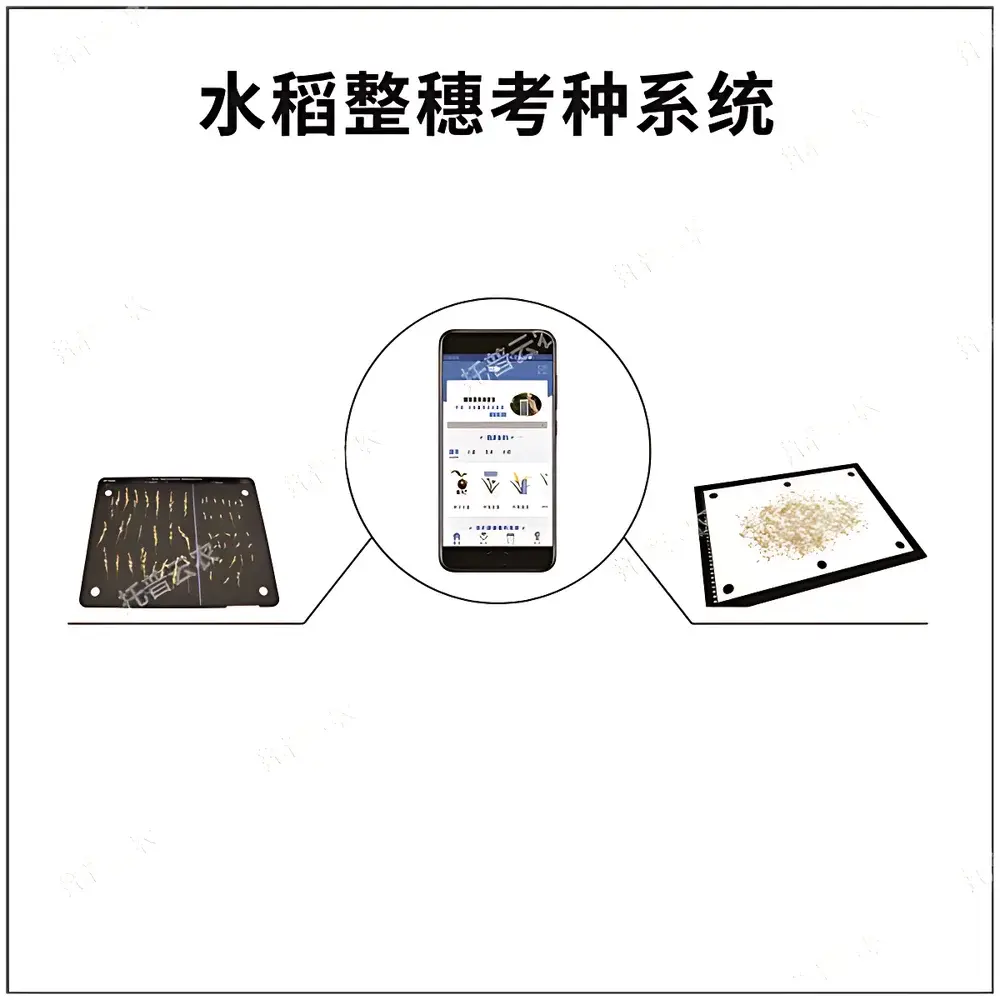
The Top Cloud-agri TPDS-X-1 Plus Rice Panicle Morphometric Analyzer is a non-destructive, image-based phenotyping instrument engineered for high-throughput quantitative analysis of rice panicle architecture during indoor seed-setting evaluation. It operates on the principle of calibrated digital imaging combined with deep learning–enhanced computer vision algorithms to extract morphometric features from whole-panicle images captured under standardized backlighting conditions. Unlike traditional manual counting or destructive sampling methods, this system preserves panicle integrity while delivering reproducible measurements of structural traits critical to yield component analysis—including spikelet distribution, branching hierarchy, density metrics, and mass-derived grain weight estimation. Designed specifically for controlled-environment laboratory use in rice breeding programs, it supports standardized phenotyping workflows aligned with international cereal research protocols.
Key Features
- Automated multi-parameter quantification: Simultaneously extracts 23 standardized morphometric descriptors—including primary and secondary branch length, spikelet count per branch order, branch-level and panicle-level spikelet density, total spikelet number, panicle length, and derived thousand-grain weight (TGW).
- Flexible branch-level analysis: Supports independent or integrated processing of primary and secondary rachis branches, enabling hierarchical trait decomposition essential for QTL mapping and ideotype modeling.
- Optimized optical acquisition: Integrated A4-format ultra-thin LED backlight panel (33.5 × 23.3 × 0.4 cm) with matte-black diffusion surface minimizes specular reflection, shadow artifacts, and particulate interference—ensuring consistent contrast and segmentation fidelity across diverse grain translucency and hull coloration.
- Calibrated TGW derivation: Accepts user-input panicle dry weight to compute thousand-grain weight directly from digitally counted spikelets, eliminating manual weighing errors and reducing inter-operator variability.
- Perspective-invariant imaging: Proprietary scale-correction algorithm compensates for angular distortion and lens-induced warping in smartphone-captured images, supporting field-deployable data collection without dedicated macro lenses or fixed-mount rigs.
- Interactive validation interface: Touch-enabled real-time correction layer allows manual adjustment of detected spikelet boundaries or branch termini, achieving traceable, auditable refinement with documented edit history.
- Regulatory-compliant data handling: Implements role-based access control, timestamped audit logs, and encrypted local storage—supporting GLP-aligned documentation practices for breeding trial records.
Sample Compatibility & Compliance
The TPDS-X-1 Plus is validated for intact, air-dried rice panicles (Oryza sativa L.) at physiological maturity, including indica, japonica, and hybrid varieties. It accommodates panicle lengths up to 46 cm and maximum widths within standard A4 imaging area constraints. The system complies with ISO/IEC 17025 principles for measurement uncertainty management, and its analytical output aligns with FAO-recommended rice phenotyping descriptors (FAO Crop Ontology, CO_333). While not certified for regulatory submission under OECD GLP, its data structure and metadata tagging support traceability required for GxP-aligned internal R&D reporting.
Software & Data Management
The embedded Android application (v4.2+) provides on-device image capture, AI-driven segmentation, parameter computation, and interactive editing. All analyses generate structured JSON metadata files containing raw pixel coordinates, confidence scores, operator annotations, and calibration parameters. Export options include Excel (.xlsx) with tabular summaries and CSV-compatible trait matrices suitable for downstream statistical analysis in R, Python (pandas), or SAS. Data synchronization supports secure cloud backup via TLS 1.3–encrypted channels; sharing integrations include WeChat, QQ, and DingTalk—each preserving original timestamps and edit histories. Role-based account management enforces concurrent session limits and dynamic OTP authentication, satisfying basic IT security requirements for shared lab environments.
Applications
This analyzer serves core functions across public and private-sector rice research domains: high-resolution phenotyping in genome-wide association studies (GWAS) and genomic selection pipelines; longitudinal monitoring of panicle development under abiotic stress (e.g., heat, drought); validation of CRISPR-edited alleles affecting branching architecture; routine seed quality assessment in national seed certification programs; and teaching applications in plant breeding and quantitative genetics curricula. Its throughput (≤15 panicles/hour with minimal training) makes it suitable for medium-scale breeding nurseries requiring >1,000 annual observations.
FAQ
What sample preparation is required prior to imaging?
Air-dried, unthreshed panicles should be gently flattened on the backlight panel without overlapping branches. No staining, sectioning, or chemical treatment is needed.
Can the system distinguish between filled and unfilled spikelets?
No—the current version identifies all spikelet primordia visible in dorsal view but does not classify fertility status. Integration with near-infrared reflectance modules is under development.
Is calibration required before each use?
A one-time reference scale calibration suffices; the system auto-recalibrates perspective distortion per image using embedded fiducial markers on the backlight panel.
How is measurement uncertainty reported?
Each exported dataset includes confidence intervals derived from intra-panicle replicate counts and inter-operator repeatability studies (n=30), conforming to ISO 5725-2 guidelines.
Does the software support batch processing of previously captured images?
Yes—offline analysis mode accepts JPEG/PNG files with embedded EXIF metadata, applying identical preprocessing and model inference as live capture.






