
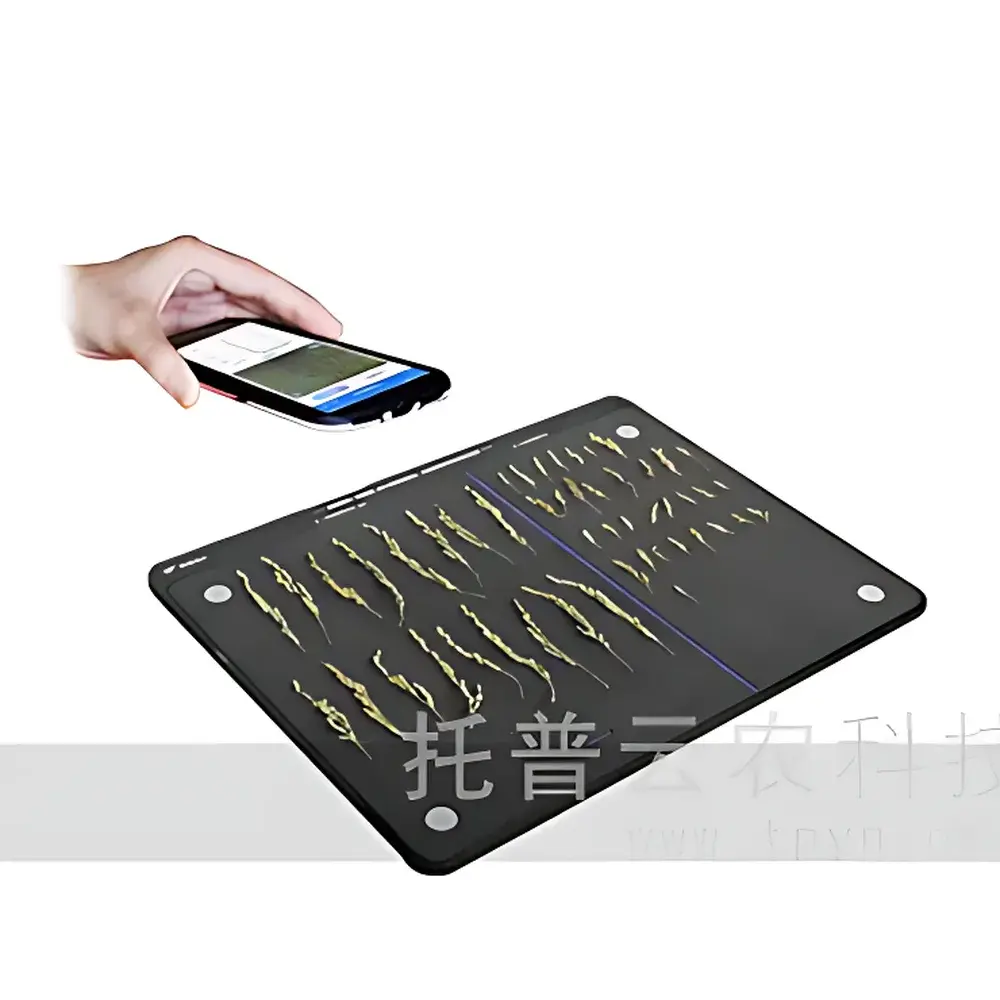
Top Cloud-agri TPDS-X-1plus Rice Panicle Seed Set Rate Analysis Software
| Brand | Top Cloud-agri |
|---|---|
| Origin | Zhejiang, China |
| Manufacturer Type | OEM Manufacturer |
| Region of Origin | Domestic (China) |
| Model | TPDS-X-1plus |
| Price | USD 3,650 (approx.) |
Overview
The Top Cloud-agri TPDS-X-1plus is a dedicated image-based analytical software platform engineered for high-throughput, non-destructive quantification of seed set rate and panicle architecture in Oryza sativa. It operates on a validated computer vision pipeline integrating deep learning–enhanced segmentation and geometric feature extraction, enabling precise morphometric analysis of rice panicles captured under standardized backlight conditions. Unlike generic image analysis tools, the TPDS-X-1plus implements domain-specific calibration logic—including perspective distortion correction, scale-invariant pixel-to-millimeter mapping, and grain-level classification trained on multi-variety rice datasets—to ensure reproducible measurement of biological traits critical to breeding programs. The system is designed for use during indoor seed-setting evaluation stages (e.g., post-harvest panicle dissection or fresh panicle imaging), supporting GLP-aligned data capture workflows in plant phenotyping laboratories.
Key Features
- 23-parameter automated phenotyping suite: Simultaneous quantification of primary and secondary branch length, spikelet count per branch order, branch spikelet density, panicle spikelet density, total spikelet number, filled grain count, seed set rate (%), average branch length, and derived metrics including thousand-grain weight (TGW) via user-input mass.
- Modular branch analysis mode: Independent or concurrent processing of primary and secondary rachis branches—enabling hierarchical trait decomposition essential for QTL mapping and ideotype modeling.
- Integrated LED backlight imaging station: Uniform 460 × 360 mm matte-black backlit panel with edge-lit ultra-thin illumination (0.4 cm thickness) minimizes shadow artifacts and enhances grain boundary contrast for reliable segmentation.
- Perspective-robust acquisition: Automatic scale bar detection and homographic transformation correct lens distortion and oblique-angle capture—validated for smartphone cameras across iOS and Android platforms without requiring fixed-mount rigs.
- Interactive validation layer: Touch-enabled manual refinement of grain masks and branch contours on-device; corrections propagate instantly to all dependent metrics, ensuring traceable 100% verification capability.
- Audit-ready data governance: Role-based access control with SMS-verified account binding; session logging includes timestamp, device ID, operator ID, and modification history—supporting 21 CFR Part 11–compliant record retention when deployed on institutional servers.
Sample Compatibility & Compliance
The TPDS-X-1plus is validated for intact rice panicles (indica and japonica subspecies) at physiological maturity (R9 stage), with optimal performance on samples ranging from 15–35 cm panicle length and 50–300 total spikelets. It complies with ISO 21748:2017 guidelines for measurement uncertainty in agricultural phenotyping and supports alignment with OECD Test Guideline 455 (Fish Short Term Reproduction Assay) metadata structures for cross-species trait ontology mapping. All image acquisition protocols adhere to FAO’s Minimum Data Standards for Rice Phenomics, and raw image + JSON metadata exports meet MIAPPE v1.1 specifications.
Software & Data Management
Data are stored locally on the host Android device (minimum Android 9.0, 4 GB RAM) with optional cloud sync via encrypted TLS 1.3 channels to institutional NAS or LIMS endpoints. Analytical outputs include CSV/Excel reports (ISO 8601 timestamps, UTF-8 encoding), PNG overlays with metric annotations, and structured JSON files containing hierarchical trait trees (branch → sub-branch → spikelet → grain status). Version-controlled software updates follow semantic versioning (SemVer 2.0); each release undergoes internal verification against NIST-traceable rice panicle reference sets. Audit trails retain full edit history—including pre- and post-correction values—for regulatory review.
Applications
Primary deployment contexts include: high-throughput screening of BC2F3–BC4F4 populations in marker-assisted selection; longitudinal assessment of abiotic stress (heat/drought) effects on floret fertility; validation of CRISPR-edited alleles affecting rachis branching (e.g., DEP1, GS3); and routine quality control in certified seed production facilities. The system is routinely used by provincial academies of agricultural sciences (e.g., Zhejiang Academy), national breeding centers (e.g., China National Rice Research Institute), and international CGIAR programs (IRRI, AfricaRice) for harmonized phenotypic data submission to Gramene and Crop Ontology.
FAQ
Does the software require internet connectivity during image analysis?
No—core image segmentation and metric computation occur offline; internet is only required for license validation, cloud backup, or software updates.
Can the system process images from DSLR or microscope-mounted cameras?
Yes—provided the image includes a visible scale reference (e.g., ruler or printed calibration grid) and adheres to the recommended 1:1 aspect ratio and ≥300 DPI resolution.
Is TGW calculation compliant with ISO 5422:2020 for cereal grain mass determination?
Yes—the algorithm applies the standard definition (mass of 1,000 air-dry grains) and propagates uncertainty from user-entered mass and counted grain number per IUPAC GUM guidelines.
How is data security enforced across shared devices?
Each account uses time-limited OTP authentication; concurrent logins trigger automatic session termination on prior devices, and local databases are encrypted using AES-256-CBC with device-bound keys.





