
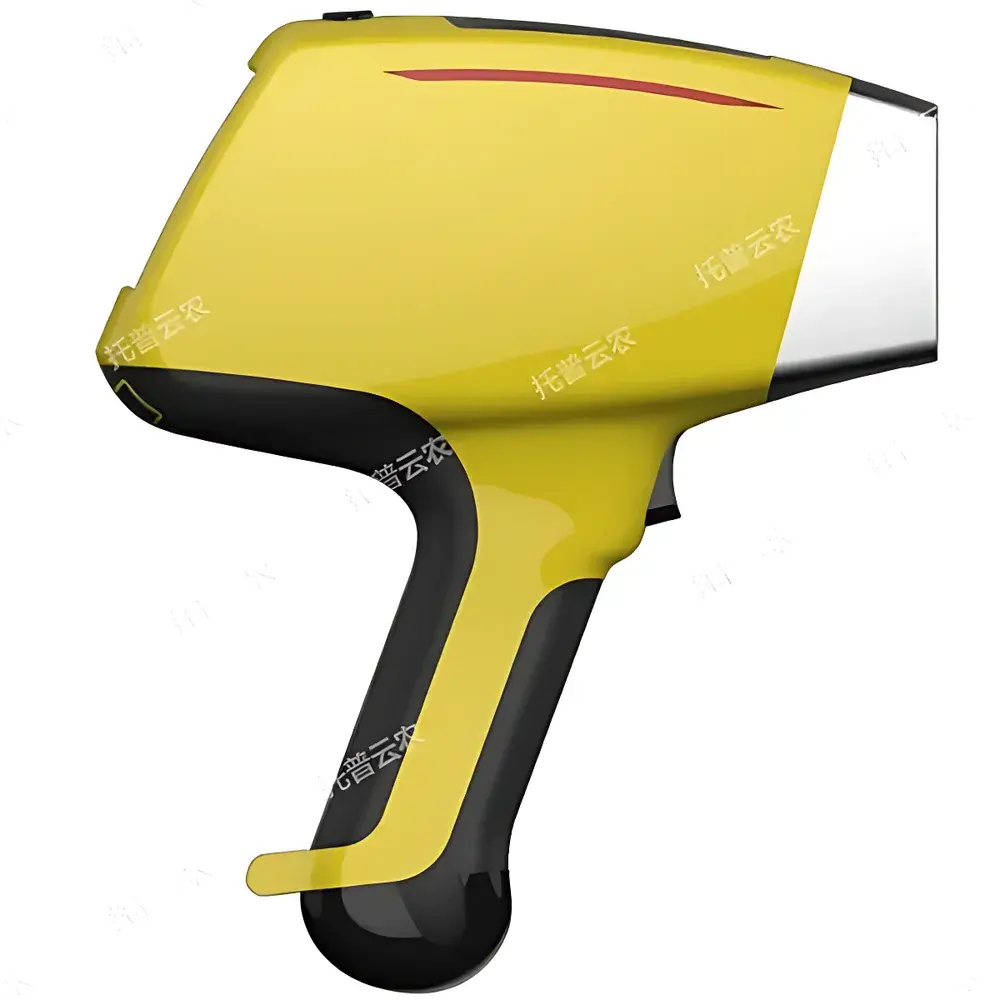
Top Cloud-agri TPJS-B Handheld XRF Soil Heavy Metal Analyzer
| Brand | Top Cloud-agri |
|---|---|
| Origin | Zhejiang, China |
| Manufacturer Type | Manufacturer |
| Country of Origin | Domestic (China) |
| Model | TPJS-B |
| Instrument Type | Multi-Element Handheld X-ray Fluorescence (XRF) Soil Analyzer |
| Weight | 1.6 kg (with battery) |
| Dimensions | 254 × 79 × 280 mm (L×W×H) |
| Excitation Source | Integrated micro-focus X-ray tube (6–50 kV, 0–200 µA), Ag anode (standard), optional Au/W/Rh anodes |
| Detector | High-sensitivity Silicon Drift Detector (SDD), resolution <125 eV |
| Detection Range | Mg (12) to U (92) |
| Analysis Time | ≤80 s per measurement |
| Operating Temperature | –20 °C to +50 °C |
| Battery Life | Up to 8 hours per charge |
| Data Storage | 32 GB internal memory (≥300,000 spectra) |
| Connectivity | USB, Bluetooth 5.0, Wi-Fi 802.11 b/g/n |
| Display | 4.3″ industrial resistive touchscreen, glove-compatible, auto-brightness adjustment |
| Environmental Rating | IP54-rated housing with shock-absorbing T-slot thermal management system |
| Safety Certifications | CE, FCC, UN 38.3, compliant with IEC 61000-4 EMC standards |
| GPS | Built-in GNSS module (GPS/BeiDou/GLONASS), geotagged spectral data with altitude logging |
Overview
The Top Cloud-agri TPJS-B Handheld XRF Soil Heavy Metal Analyzer is a field-deployable, non-destructive elemental analyzer engineered for rapid in situ quantification of heavy metals and major/minor nutrients in heterogeneous soil matrices. Based on energy-dispersive X-ray fluorescence (EDXRF) spectroscopy, the instrument operates via primary X-ray excitation of sample atoms, followed by detection of characteristic secondary X-rays emitted during electron shell relaxation. Its optimized geometry—featuring a collimated Ag-target microfocus X-ray tube, high-efficiency SDD detector, and real-time pulse processing—enables quantitative analysis of 34 regulated elements (K, Ca, Ti, V, Cr, Mn, Fe, Co, Ni, Cu, Zn, As, Se, Rb, Sr, Y, Zr, Nb, Mo, Ag, Cd, Sn, Sb, W, Re, Pd, Au, Hg, Pb, Bi, Cs, Ba, Th, U) at parts-per-million (ppm) sensitivity levels. Designed for compliance with environmental screening protocols—including EPA Method 6200 and ISO 18227—the TPJS-B delivers laboratory-comparable precision under variable ambient conditions without sample digestion or chemical reagents.
Key Features
- Field-ready EDXRF platform with integrated GNSS positioning for geo-referenced spectral mapping and GIS integration
- Robust industrial design: IP54 ingress protection, drop-tested chassis, T-slot passive thermal management, and shock-dampened detector housing
- Real-time adaptive interface: Auto-brightness-adjusting 4.3″ resistive touchscreen operable with gloves and in direct sunlight
- Smart power architecture: MSBUS-enabled smart battery with state-of-charge telemetry, 8-hour runtime, and UN 38.3-certified air transport compliance
- Automated measurement logic: Proximity sensing initiates analysis; gravity-based auto-shutdown upon free-fall detection enhances operational safety
- Multi-modal connectivity: Simultaneous USB 2.0, Bluetooth 5.0, and IEEE 802.11 b/g/n support for remote configuration, firmware updates, and live data streaming
- On-device spectral processing: Embedded Linux OS with real-time deconvolution algorithms, peak fitting, and matrix correction routines
Sample Compatibility & Compliance
The TPJS-B accepts unprepared, bulk soil samples—including agricultural topsoil, dredged sediments, landfill leachate solids, sludge cakes, and contaminated fill material—without grinding, drying, or pelletization. Its open-beam configuration accommodates irregular geometries and high-moisture matrices (up to 35% w/w), with automatic attenuation correction for organic content and particle size effects. Analytical performance meets the repeatability requirements of ISO 12847 (soil characterization) and ASTM D7219 (field screening of metals in solid waste). All measurement reports include full traceability metadata: timestamp, GPS coordinates (±3 m CEP), altitude, ambient temperature/humidity logs, tube operating parameters, and detector live-time normalization factors—supporting GLP-aligned documentation and audit readiness per ISO/IEC 17025.
Software & Data Management
Data acquisition and reporting are managed via the proprietary TopCloud SoilAnalyzer Suite, compatible with Windows and macOS. Spectral libraries include NIST SRM reference materials (e.g., 2709a San Joaquin Soil, 2710a Montana Soil), enabling empirical calibration transfer across instrument fleets. Raw spectra (.spc), processed results (.csv), and annotated PDF reports—including customizable headers, logos, QA/QC flags, and overlayable XRF contour maps—are exportable directly from device storage or cloud-synced repositories. Cloud synchronization employs TLS 1.2-encrypted HTTPS endpoints, supporting role-based access control (RBAC), automated backup retention policies, and API-driven integration with LIMS, ERP (e.g., SAP S/4HANA), and environmental data warehouses. Audit trails record all user actions, parameter changes, and calibration events in accordance with FDA 21 CFR Part 11 electronic signature requirements.
Applications
- Rapid site characterization for brownfield redevelopment and regulatory compliance (e.g., RCRA, CLP)
- In-field monitoring of phytoremediation progress and soil amendment efficacy
- Pre-harvest assessment of heavy metal bioavailability in food-crop production zones
- Forensic soil sourcing in ecological crime investigations
- Quality assurance of soil amendments, composts, and biosolids prior to land application
- Academic research on elemental cycling in pedogenic systems and anthropogenic contamination gradients
FAQ
Does the TPJS-B require sample preparation before analysis?
No—analysis is performed directly on intact, moist, or dry soil surfaces without homogenization, sieving, or acid digestion.
Can the instrument differentiate between total element concentration and bioavailable fractions?
The TPJS-B measures total elemental mass fraction. Bioavailability assessment requires complementary extraction methods (e.g., EDTA or DTPA extraction) followed by ICP-MS/OES analysis.
Is calibration traceable to certified reference materials?
Yes—factory calibration uses NIST-traceable soil SRMs; users may perform on-site verification using supplied check standards (e.g., TopCloud TC-SRM-01 series).
What is the detection limit for lead (Pb) in typical agricultural soil?
Under standard 60-s measurement conditions, the practical quantification limit (PQL) for Pb is approximately 5–8 ppm, depending on matrix composition and moisture content.
How does the instrument handle high-iron or high-clay soils that may attenuate low-energy X-rays?
The TPJS-B applies dynamic tube voltage/current optimization and fundamental parameter (FP) modeling to compensate for absorption edge effects and inter-element matrix corrections in real time.







