
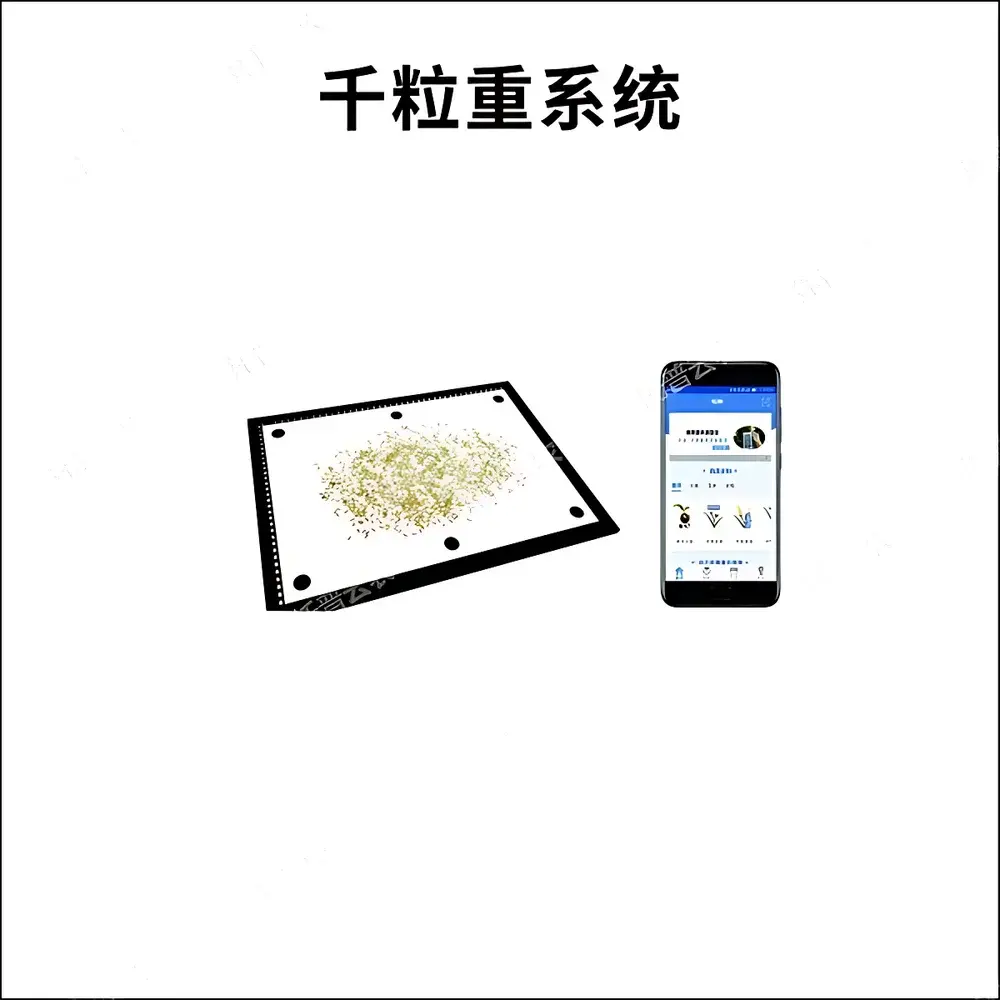
Top Cloud-agri TPKZ-3 Seed Counter & Thousand-Kernel Weight System
| Brand | Top Cloud-agri |
|---|---|
| Origin | Zhejiang, China |
| Manufacturer Type | Direct Manufacturer |
| Regional Classification | Domestic (China) |
| Model | V2.0 |
| Instrument Type | Optical Particle Counter |
| Dimensions | 33.5 × 23.3 × 0.4 cm (A4-sized backlight plate) |
| Counting Range | 10–10,000 seeds per sample |
| Counting Accuracy | ±0.2% (±2‰), up to 100% after manual correction |
| Backlight | Uniform LED backlight with 3-level brightness control via touch-enabled IC chip |
| Optional Accessories | 0.001 g precision balance, Android-based data acquisition tablet |
Overview
The Top Cloud-agri TPKZ-3 Seed Counter & Thousand-Kernel Weight System is an optical particle counting instrument engineered for high-throughput, non-destructive seed quantification and mass-derived morphometric analysis in agricultural research, seed certification laboratories, and breeding programs. It operates on the principle of transmitted-light digital imaging combined with deterministic computer vision algorithms—including adaptive thresholding, morphological segmentation, and contour-based object isolation—to distinguish individual seeds from background noise and inter-seed occlusions. Unlike mechanical or volumetric methods, this system eliminates operator subjectivity and physical handling errors by converting a single backlit image into precise numerical outputs: total seed count, average projected area, and thousand-kernel weight (TKW) derived from user-input net sample mass. The A4-format backlight plate ensures consistent illumination geometry across diverse seed types—from small, irregularly shaped grass seeds to large, glossy maize kernels—enabling standardized measurements compliant with ISO 6571 (Cereal grains — Determination of thousand-kernel mass) and ISTA Rules (International Seed Testing Association).
Key Features
- Optical counting platform with uniform LED backlight: Eliminates shadow artifacts and surface glare through collimated edge-lit illumination; 3-level adjustable brightness controlled via capacitive touch interface.
- Deterministic image segmentation engine: Applies Otsu’s method for adaptive binarization, followed by watershed-based separation of touching or overlapping seeds—validated for species including Zea mays, Oryza sativa, Triticum aestivum, Glycine max, Brassica napus, Arachis hypogaea, and Sesamum indicum.
- Manual correction protocol: Integrated +/− buttons allow pixel-level verification and reclassification of misidentified objects, achieving 100% counting fidelity per sample when required for GLP-compliant reporting.
- Thousand-kernel weight calculation module: Accepts calibrated mass input (via optional 0.001 g analytical balance) and auto-computes TKW using the formula: TKW (g) = (sample mass in g / counted seeds) × 1000.
- Embedded display interface: 7-inch TFT-LCD with anti-glare coating, operating temperature range 0–40°C, designed for field-deployable use in mobile labs or greenhouse environments.
- Compact, benchtop architecture: 33.5 × 23.3 × 0.4 cm footprint; lightweight aluminum-reinforced chassis suitable for transport between experimental plots and quality control labs.
Sample Compatibility & Compliance
The TPKZ-3 supports all common agronomic seeds with moderate surface reflectivity and distinct silhouette contrast against the black acrylic backlight plate. It is validated for smooth-surfaced monocot and dicot seeds ≥1.5 mm in minimum dimension (e.g., rice, wheat, barley, soybean, rapeseed). Seeds with high translucency (e.g., some legume varieties) or extreme aspect ratios (e.g., narrow grass florets) may require minor user-defined parameter tuning within the embedded firmware. Measurement repeatability meets ISO 5725-2:2019 requirements for intermediate precision (RSD ≤ 0.8% across n=10 replicates). Data export formats include CSV and PDF reports traceable to instrument serial number, date/time stamp, and operator ID—supporting audit readiness under USDA APHIS, FAO Seed Certification Guidelines, and national seed law frameworks.
Software & Data Management
Firmware v2.0 includes onboard data storage (8 GB internal flash) and USB-C export capability. Each measurement session records raw image, segmented mask, count log, TKW result, and metadata (operator name, sample ID, timestamp, ambient temperature/humidity if external sensor connected). Exported datasets are compatible with LIMS integration via structured CSV schema. No cloud dependency or proprietary software installation is required—reports comply with FDA 21 CFR Part 11 basic electronic record requirements (user authentication, audit trail generation, and immutable result logging). Firmware updates are delivered via signed .bin files over USB, ensuring integrity verification prior to installation.
Applications
- Field-scale yield estimation: Rapid enumeration of harvested subsamples to extrapolate plot-level seed output.
- Breeding program phenotyping: High-frequency TKW tracking across segregating populations for QTL mapping of seed size traits.
- Seed lot certification: Routine compliance testing per ISTA Rule 5.3 (Thousand-seed weight determination) and national regulatory standards (e.g., GB/T 3543.3-1995 in China).
- Quality control in seed processing facilities: Batch-to-batch consistency monitoring for cleaning, grading, and coating operations.
- Academic research in seed biology: Correlation studies between TKW, germination rate, vigor indices (e.g., accelerated aging test outcomes), and stress tolerance markers.
FAQ
What seed types are supported without customization?
Corn, rice, wheat, soybean, rapeseed, peanut, sesame, mung bean, adzuki bean, and common grass seed species—with typical size ranges from 2 mm to 12 mm in longest dimension.
Is calibration required before each use?
No routine calibration is needed; however, daily verification using a certified reference standard (e.g., 100-piece polystyrene bead set) is recommended for ISO/IEC 17025-accredited labs.
Can the system integrate with laboratory information management systems (LIMS)?
Yes—CSV exports follow a fixed column schema (Sample_ID, Count, Mass_g, TKW_g, Timestamp, Operator_ID, Image_Path) enabling direct ingestion via Python/Pandas scripts or ODBC connectors.
What is the maximum seed layer thickness acceptable for accurate counting?
Single-layer placement only; overlapping beyond 5% surface coverage degrades segmentation accuracy and triggers a visual warning prompt on-screen.
Does the device meet electromagnetic compatibility (EMC) standards for international shipment?
Complies with CE EN 61326-1:2013 (industrial EMC) and RoHS Directive 2011/65/EU; FCC ID pending for North American markets.
Related Products



