
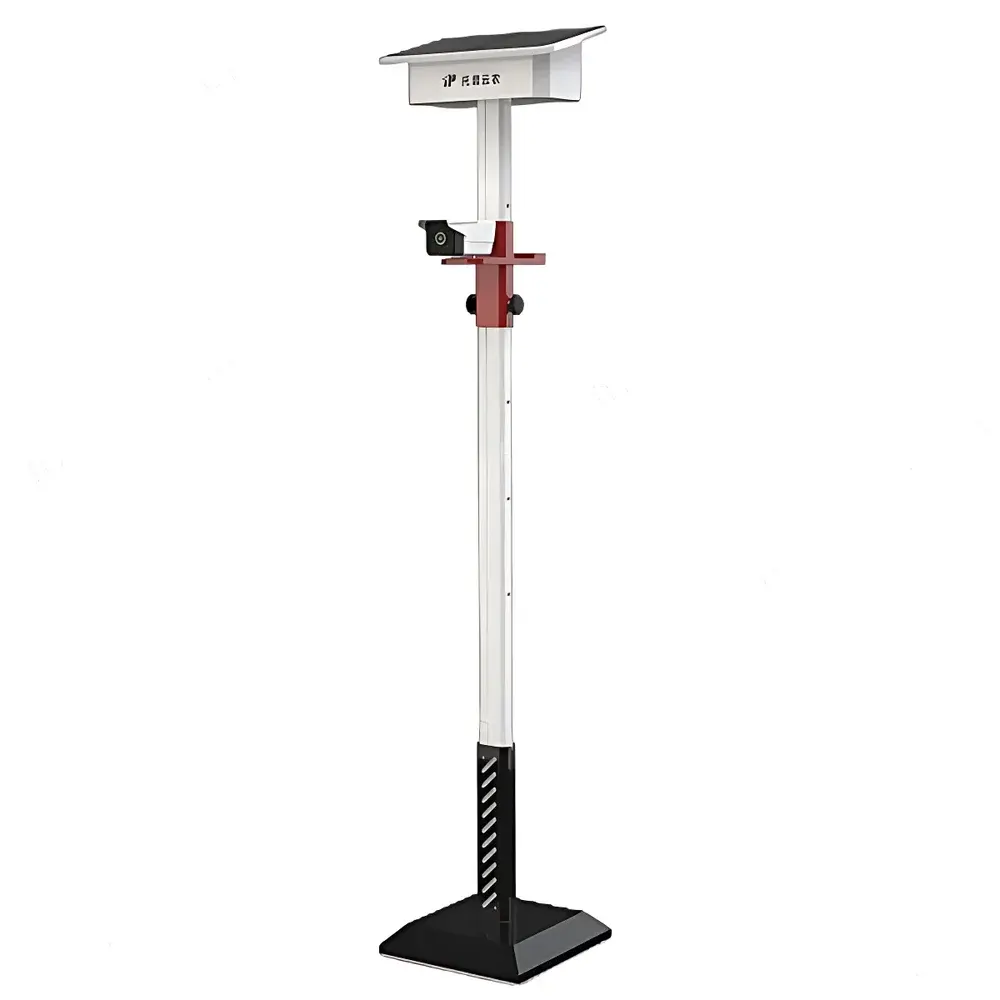
Top Cloud-agri TPN-WLW-BX1 IoT Distributed Crop Growth Time-Series Dynamic Phenotyping Monitoring System
| Brand | Top Cloud-agri |
|---|---|
| Origin | Zhejiang, China |
| Manufacturer Type | Manufacturer |
| Origin Category | Domestic |
| Model | TPN-WLW-BX1 |
| Pricing | Upon Request |
| Imaging Sensor | 24 MP CMOS, 6400 × 4000 resolution, 14.8 µm pixel size, auto-focus, 60°–120° FOV, programmable capture frequency (up to 1 fps) |
| Environmental Sensors | Soil moisture 0–100% (±2% accuracy), soil temperature −15–65°C (±1°C), air temperature −40–100°C (±1°C), relative humidity 0–100% (±2%) |
| Power System | Dual-layer 50 W solar panel + 50 Ah Li-ion battery, supports 3–5 days continuous operation under overcast conditions |
| GPS Accuracy | Sub-meter level |
| Data Storage | Cloud-native architecture with scalable storage |
| Weight | < 2.5 kg (core unit) |
| Deployment Mode | Unattended, scheduled time-series acquisition |
| Network Capability | Standalone or multi-node synchronized deployment |
Overview
The Top Cloud-agri TPN-WLW-BX1 IoT Distributed Crop Growth Time-Series Dynamic Phenotyping Monitoring System is a field-deployable, fixed-station phenotyping platform engineered for long-term, non-invasive, high-temporal-resolution monitoring of plant morphological and physiological dynamics under natural field conditions. It operates on the principle of spatiotemporal image-based phenotyping—leveraging repeated high-resolution visible-light imaging combined with co-located environmental sensing to resolve genotype-by-environment (G×E) interactions across developmental time. Unlike manual or mobile phenotyping systems, the TPN-WLW-BX1 enables autonomous, year-round data acquisition at plot- and organ-level scales—including canopy structure, leaf color progression, flowering onset, senescence kinetics, and inflorescence emergence—without requiring human intervention or infrastructure wiring. Its design prioritizes ecological validity: measurements are made in situ, under ambient light, wind, precipitation, and diurnal cycles, ensuring trait expressions reflect real-world agronomic contexts.
Key Features
- 360° Rotational Field-of-View Acquisition: Equipped with a precision stepper-driven pan-tilt-zoom (PTZ) mount, the system autonomously rotates to capture synchronized imagery from ≥4 adjacent experimental plots within a 3 m radius—enabling comparative phenotyping across genetic lines or treatment zones without physical repositioning.
- Energy-Autonomous Operation: Integrated dual-layer 50 W monocrystalline solar panels and a 50 Ah lithium iron phosphate (LiFePO₄) battery provide uninterrupted power. The system maintains full imaging and sensor functionality for 72–120 hours during consecutive low-irradiance periods, validated per IEC 61215 standards for outdoor photovoltaic reliability.
- Multi-Node Synchronization Capability: Supports LoRaWAN- or cellular-based mesh networking, allowing coordinated time-synchronized capture across distributed nodes—critical for landscape-scale trials, breeding nurseries, or regional phenomics networks requiring spatially referenced temporal alignment.
- Co-Located Environmental Sensing: Onboard calibrated sensors measure microclimate (air T/RH) and rhizosphere conditions (soil T/moisture) at plot-level resolution. All environmental timestamps are hardware-synchronized with image capture events, enabling direct statistical coupling of phenotypic trajectories with environmental drivers.
- Pre-Validated Crop-Specific Algorithms: Includes production-grade computer vision pipelines for rice, wheat, maize, soybean, cotton, and rapeseed—trained on >10⁵ manually annotated field images. Outputs include LAI, green/yellow leaf area, leaf senescence index, panicle/ear count, flag leaf angle, and phenological stage classification (e.g., BBCH scale).
- Cloud-Native Data Architecture: Raw images and derived traits are transmitted via TLS 1.3-encrypted MQTT streams to a secure AWS-hosted platform. All metadata (GPS, sensor logs, capture parameters) is stored in FAIR-compliant JSON-LD format, supporting MIAPPE v1.1 metadata schema adherence.
Sample Compatibility & Compliance
The TPN-WLW-BX1 is optimized for herbaceous annual crops grown in standard agronomic field trials (0.5–5 m² plots). It accommodates variable canopy architectures—from erect rice tillers to sprawling soybean canopies—through adaptive focal plane calibration and dynamic exposure control. All environmental sensors comply with ISO 11274 (soil water content) and ISO 7726 (thermal environment) measurement protocols. The system’s firmware and cloud API adhere to GLP-relevant audit trail requirements: every image ingestion, algorithm execution, and parameter modification is logged with immutable timestamps, user context, and cryptographic hash verification. Data export supports CSV, NetCDF4, and MIAPPE-compliant ISA-Tab formats for integration into BreedBase, BrAPI, or local LIMS environments.
Software & Data Management
The配套 software suite comprises two tightly coupled components: the Edge Firmware (v4.x, OTA-upgradable) and the Phenotype Intelligence Platform (PIP). The firmware implements on-device JPEG2000 compression, EXIF-embedded geotagging (WGS84), and failover buffering to onboard microSD. PIP provides role-based access control (RBAC), versioned analysis pipelines, and RESTful BrAPI v2.1 endpoints. All processing workflows—whether LAI estimation via deep U-Net segmentation or phenophase detection using temporal convolutional networks—are containerized (Docker) and reproducible via Singularity images. Audit logs meet FDA 21 CFR Part 11 requirements for electronic records and signatures, including operator authentication, change history, and electronic signature capture for report finalization.
Applications
- High-throughput germplasm screening across multi-environment trials (METs) for drought tolerance, heat resilience, or nitrogen-use efficiency traits.
- Longitudinal validation of QTLs and GWAS candidates under field-realistic G×E variance—supporting marker-assisted selection and genomic prediction model training.
- Phenological modeling for climate adaptation studies, including thermal time accumulation, vernalization response, and photoperiod sensitivity quantification.
- Calibration and ground-truthing of satellite- and UAV-based remote sensing indices (e.g., NDVI, PRI, CIrededge) at sub-meter spatial resolution.
- Regulatory phenotyping for OECD/CPVO variety testing, where objective, timestamped, auditable trait records are required for distinctness, uniformity, and stability (DUS) assessments.
FAQ
What is the minimum recommended plot spacing for reliable 360° coverage?
For optimal image resolution and geometric consistency, plots should be spaced ≥1.2 m apart center-to-center within the 3 m operational radius.
Can the system operate in extreme cold or high-humidity environments?
Yes—the camera housing and sensor enclosures meet IP66 ingress protection, and the battery management system includes low-temperature charge regulation down to −20°C.
Is raw image data accessible for custom algorithm development?
Absolutely. Full-resolution TIFF and RAW (DNG) files are available via S3-compatible object storage with programmatic API access.
How frequently are software updates released, and are they backward-compatible?
Firmware and PIP updates are issued quarterly, with LTS (Long-Term Support) versions maintained for 24 months. All updates preserve data schema integrity and API contract stability.
Does the system support integration with existing farm management software (e.g., Climate FieldView, Granular)?
Yes—via standardized ADAPT and AgGateway ADAPT-XML connectors, as well as custom webhook integrations for field boundary synchronization and treatment assignment mapping.





