
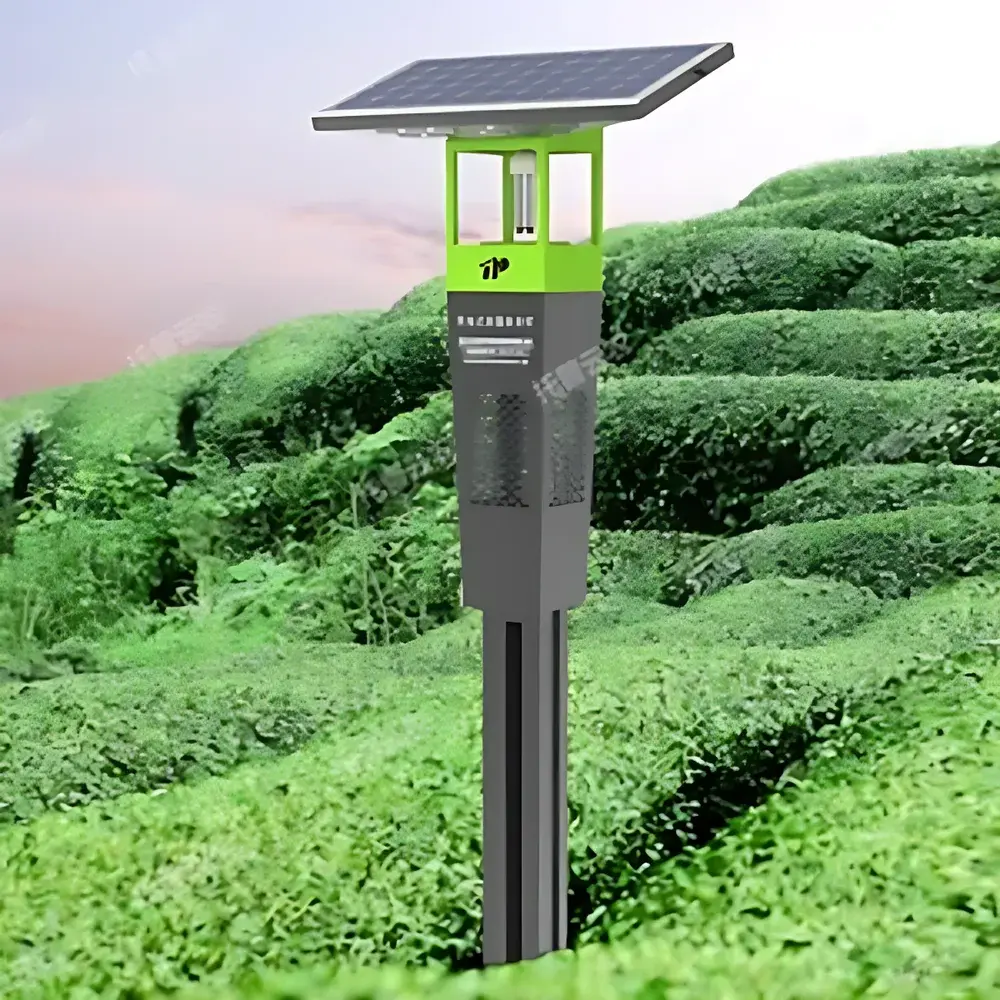
Top Cloud-agri TPSC-5Z Solar-Powered Suction-Type Insect Trap for Tea Plantations
| Brand | Top Cloud-agri |
|---|---|
| Origin | Zhejiang, China |
| Manufacturer Type | Direct Manufacturer |
| Country of Origin | China |
| Model | TPSC-5Z |
| Power Supply | DC 12 V |
| Total Power Consumption | <20 W |
| Solar Panel Rating | 40 W |
| UV LED Lamp Power | 8 W |
| Fan Specification | 7 W / 12 V, 2200 RPM, IP68-rated |
| Effective Control Radius | ≥120 m in open farmland, ≥80 m in forested or semi-shaded tea gardens |
| Coverage Area per Unit | 15–50 mu (≈1–3.3 ha) |
| Operating Modes | Photocell Control (day/night auto-switch), Timed Operation, Low-Power Communication Standby Mode |
| Enclosure Protection | IP67-rated housing (dust-tight and rain-resistant) |
Overview
The Top Cloud-agri TPSC-5Z Solar-Powered Suction-Type Insect Trap is an agronomic pest management device engineered for targeted, non-chemical control of flying insect pests in tea cultivation systems. Unlike conventional light traps relying solely on phototaxis, the TPSC-5Z integrates dual-stimulus attraction—narrow-band ultraviolet (UV-A, peak ~365 nm) and specific spectral wavelengths optimized for diurnal and crepuscular Lepidoptera (e.g., Geometridae moths) and Hemiptera (e.g., Empoasca onukii, the tea green leafhopper)—with active suction-based capture. The unit employs a high-efficiency axial fan generating laminar airflow to draw attracted insects into a sealed collection chamber, where desiccation under ambient conditions results in mortality within 2–6 hours. This physical mode of action eliminates pesticide residues, avoids resistance development, and significantly reduces incidental capture of beneficial arthropods—including parasitoids (e.g., Trichogramma spp.) and predatory beetles—compared to broad-spectrum electrocution or sticky-board traps.
Key Features
- Solar-reliant autonomous operation: Integrated 40 W monocrystalline solar panel with smart charge controller ensures continuous functionality across seasonal irradiance variations; no grid dependency or trenching required.
- Intelligent lighting logic: Photocell sensor enables automatic dusk-to-dawn activation; programmable time-scheduled operation allows alignment with peak pest flight windows (e.g., 19:00–05:00); communication-standby mode maintains LoRaWAN or NB-IoT connectivity during lamp-off periods for remote status reporting.
- Ruggedized field architecture: IP67-rated polycarbonate housing resists UV degradation, mechanical impact, and prolonged exposure to high-humidity environments typical of subtropical tea-growing regions.
- Optimized aerodynamic capture: 12 V DC brushless fan (2200 RPM, IP68 motor seal) delivers consistent volumetric airflow (>1.8 m³/min at static pressure of 80 Pa), ensuring reliable entrainment of insects ranging from 1.5 mm (thrips) to 25 mm (adult moths).
- Scalable deployment geometry: Validated field trials across Zhejiang, Fujian, and Yunnan provinces confirm effective pest suppression within circular zones of ≥120 m radius in open canopy plantations and ≥80 m in intercropped or hedgerow-integrated tea gardens.
Sample Compatibility & Compliance
The TPSC-5Z is validated for use in certified organic tea production systems compliant with GB/T 19630–2019 (Chinese Organic Standard) and IFOAM Basic Standards. Its operational principle aligns with integrated pest management (IPM) frameworks endorsed by FAO’s Pest Control Guidelines for Camellia sinensis and the Chinese Academy of Agricultural Sciences’ Tea Research Institute. No chemical attractants or consumables are required; all components meet RoHS Directive 2011/65/EU restrictions on hazardous substances. Device firmware supports audit-ready logging of operational uptime, solar charging cycles, and fault events—facilitating GLP-aligned recordkeeping for third-party certification audits.
Software & Data Management
While the TPSC-5Z operates autonomously without connectivity, its embedded microcontroller logs timestamped operational metadata (lamp on/off cycles, fan runtime, battery voltage trends) to internal non-volatile memory (≥12 months retention). Data export is supported via USB-C interface using vendor-provided PC utility software (Windows/macOS compatible). For networked deployments, the companion TPSC-8Z variant adds NB-IoT uplink capability with TLS 1.2 encryption, enabling integration into farm management platforms via MQTT or HTTP(S) APIs. All data structures conform to ISO 11783–10 (ISOBUS) agricultural telemetry conventions.
Applications
Primary deployment targets include smallholder and cooperative-managed tea estates practicing ecological intensification. Field studies demonstrate statistically significant reduction (p<0.01, ANOVA) in adult populations of Empoasca onukii, Adoxophyes honmai, and Ectropis obliqua when deployed at densities of 1 unit per 2.5 ha. Secondary applications extend to mulberry orchards (targeting Diaphania pyloalis), citrus groves (Tetradacus cuneatus), and herbaceous medicinal plant fields (e.g., Chrysanthemum morifolium), where selective UV-A attraction minimizes interference with pollinator activity during daylight hours.
FAQ
What maintenance intervals are recommended for optimal trap performance?
Bi-weekly cleaning of the UV lamp surface and fan inlet grille is advised; annual replacement of the rechargeable deep-cycle LiFePO₄ battery (12 V, 12 Ah) ensures >95% capacity retention over 5 years.
Can the TPSC-5Z be deployed in high-rainfall regions such as southern Yunnan?
Yes—the IP67 enclosure and IP68-rated fan motor have been validated under continuous 72-hour simulated monsoon conditions (IEC 60529 test protocol) without functional degradation.
Does this device require calibration or periodic verification?
No optical or electrical calibration is necessary; however, quarterly visual inspection of lamp spectral output using a handheld spectroradiometer (e.g., Ocean Insight HDX) is recommended to verify UV-A intensity remains ≥200 µW/cm² at 1 m distance.
How does the TPSC-5Z compare to traditional mercury-vapor traps in terms of energy efficiency and ecological selectivity?
It consumes 82% less power than equivalent 40 W mercury-vapor units and exhibits 3.7× lower capture rates of non-target Hymenoptera, as confirmed by 2022–2023 multi-site pitfall trapping surveys coordinated by the Tea Research Institute of China.
Related Products






