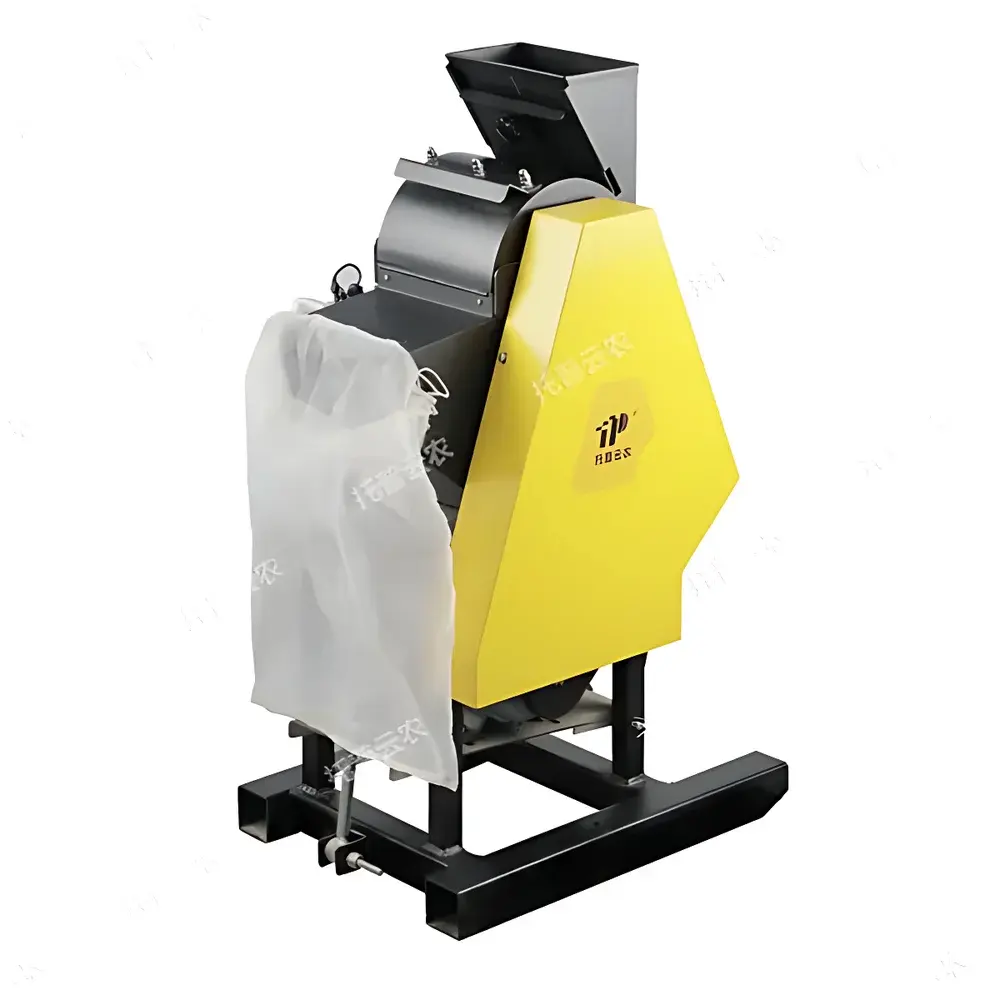
Top Cloud-agri TSL-150A Single-Ear Threshing Machine
| Brand | Top Cloud-agri |
|---|---|
| Origin | Zhejiang, China |
| Manufacturer Type | Direct Manufacturer |
| Country of Origin | China |
| Model | TSL-150A |
| Quotation | Available upon Request |
| Drum Diameter | 175 mm |
| Drum Speed | 900 rpm |
| Motor Power | 180 W, 220 V AC |
| Overall Dimensions (L×W×H) | 450 × 350 × 800 mm |
| Net Weight | 26 kg |
Overview
The Top Cloud-agri TSL-150A Single-Ear Threshing Machine is a precision-engineered, benchtop-scale electric threshing system designed specifically for controlled, low-loss grain separation in plant breeding and agricultural research environments. Unlike bulk threshers intended for field-scale harvest processing, the TSL-150A operates on the principle of gentle mechanical impact and airflow-assisted separation—utilizing a rotating drum with optimized vane geometry to apply calibrated shear and centrifugal forces to individual ears or panicles. This ensures minimal kernel damage, negligible cross-contamination between samples, and high reproducibility across sequential trials—critical requirements in pedigree-based selection, pure-line advancement, and seed purity verification workflows. Its compact footprint and modular design make it suitable for use in controlled-environment growth chambers, greenhouse labs, and certified seed processing facilities where traceability, sample integrity, and GLP-compliant documentation are essential.
Key Features
- Single-ear or single-plant threshing capability—supports precise isolation of genetic material from individual wheat, rice, soybean, barley, oat, and other small-grain cereal spikes.
- Adjustable feed capacity: processes 1–6 ears per cycle with integrated pre-cleaning and post-threshing air aspiration to remove chaff and glumes.
- Full-access transparent hood with quick-release latch enables visual monitoring during operation and eliminates residual grain retention—no hidden cavities or inaccessible crevices.
- Removable stainless-steel separation sieve plate: doubles as a standalone air-screen cleaner when lifted, supporting post-threshing grading or purity assessment.
- Corrosion-resistant electrostatic powder-coated chassis and drum housing—engineered for long-term durability in humid greenhouse or high-salinity storage conditions.
- Integrated swivel casters with locking brakes ensure stable positioning during operation and effortless relocation within multi-station breeding labs.
- Low-noise, brushless AC motor (180 W, 220 V) delivers consistent 900 rpm drum rotation—optimized for balance between throughput efficiency and kernel integrity preservation.
Sample Compatibility & Compliance
The TSL-150A accommodates morphologically diverse ear structures—including compact wheat spikes, open rice panicles, and indeterminate soybean racemes—without requiring tool-based configuration changes. Its non-contact feed path and absence of auger-based conveyance eliminate mechanical stress on fragile rachises and immature grains. The unit complies with general electrical safety standards IEC 61000-6-3 (EMC emission) and IEC 60335-1 (household and similar electrical appliances), and its operational workflow aligns with ISO 24351:2022 (Guidelines for Seed Sampling and Handling) and ISTA Rule 4B (Threshing Procedures for Genetic Purity Testing). While not FDA-regulated, its design supports audit-ready documentation practices required under national seed certification programs (e.g., OECD Seed Schemes, China’s Crop Variety Registration Regulations).
Software & Data Management
The TSL-150A is a stand-alone electromechanical instrument without embedded firmware or digital connectivity. However, its deterministic mechanical behavior—repeatable drum speed, fixed residence time per cycle, and consistent airflow rate—enables full integration into LIMS or electronic lab notebook (ELN) systems via manual entry or barcode-scanned batch logging. Researchers routinely assign unique identifiers to each ear or accession prior to processing; these IDs are recorded alongside timestamp, operator ID, and environmental parameters (e.g., relative humidity, temperature) to satisfy traceability requirements under GB/T 3543.2–1995 (China National Standard for Field Inspection of Crop Seeds) and FAO/WHO Codex Alimentarius guidelines for seed quality assurance.
Applications
- Early-generation progeny testing in wheat and rice breeding programs—enabling rapid phenotypic scoring of shattering resistance, threshability index, and grain retention traits.
- Foundation seed multiplication units performing lot-specific purity checks before field planting.
- Gene bank curatorial workflows involving regeneration of rare or endangered landraces with limited seed availability.
- Quantitative trait locus (QTL) mapping studies requiring genotype–phenotype correlation at the single-ear level.
- Post-harvest physiology research evaluating moisture-dependent threshing thresholds and kernel fracture patterns.
- Teaching laboratories demonstrating principles of mechanical grain separation, seed morphology, and varietal differentiation.
FAQ
Is the TSL-150A suitable for maize or sorghum ears?
No—the machine is dimensionally and mechanically optimized for small-grain cereals (max. ear length ≤ 18 cm, diameter ≤ 25 mm). Maize and sorghum require higher torque and larger clearance volumes, and are outside its validated operating envelope.
Can it be used with wet or green-harvested ears?
It is recommended only for air-dried or oven-dried samples (moisture content ≤ 14%). Higher moisture levels increase adhesion risk and reduce separation efficiency, potentially compromising data fidelity.
Does it meet ISO/IEC 17025 calibration requirements?
As a non-measuring mechanical device (i.e., no metrological output such as mass or force), it does not require formal calibration—but periodic verification of drum speed (via tachometer) and airflow consistency is advised for method validation.
What maintenance is required?
Monthly inspection of belt tension, cleaning of air intake filters, and lubrication of caster swivel joints using food-grade silicone grease. No scheduled replacement parts are specified under normal laboratory usage conditions.