
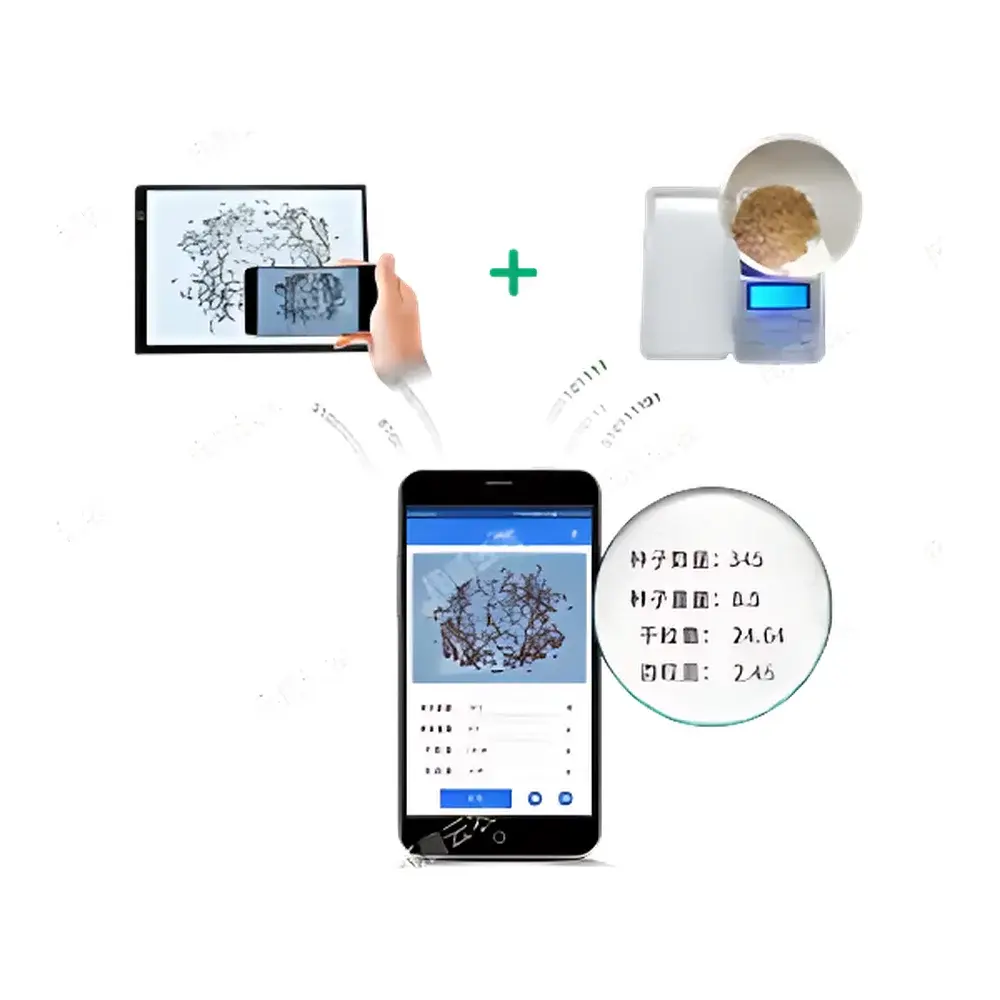
Top Cloud-agri V2.0 Seed Counting and Thousand-Seed Weight Analyzer
| Brand | Top Cloud-agri |
|---|---|
| Origin | Zhejiang, China |
| Manufacturer Type | Direct Manufacturer |
| Product Category | Domestic |
| Model | V2.0 |
| Instrument Type | Seed Sample Divider & Digital Counting System |
| Minimum Weighing Resolution | 0.001 g (optional integrated precision balance) |
| Seed Counting Range | 10–10,000 seeds per batch |
| Counting Accuracy | ±0.2% (±2‰), adjustable to 100% via manual correction |
| Backlight Panel Dimensions | 33.5 × 23.3 × 0.4 cm (A4 format) |
| Compliance | Designed for ISO 5657:2022 (Seed Testing — Determination of Thousand-Seed Mass), GB/T 3543.3–1995 (China National Standard for Seed Testing), and aligned with ISTA Handbook Chapter 5 (Weight Determination) |
Overview
The Top Cloud-agri V2.0 Seed Counting and Thousand-Seed Weight Analyzer is an automated, vision-based instrumentation system engineered for high-throughput, non-destructive seed quantification and standardized thousand-seed mass (TSM) calculation in agricultural research and quality control laboratories. It operates on the principle of high-contrast backlight imaging combined with real-time digital image segmentation and morphological analysis—enabling precise pixel-level differentiation between intact seeds, broken fragments, and extraneous debris. Unlike mechanical counters or manual tallying methods, this system eliminates operator bias and fatigue-related errors while maintaining full traceability of each counting session. The device is purpose-built for compliance with internationally recognized seed testing protocols, including ISO 5657:2022 and ISTA Chapter 5, where TSM serves as a critical biometric indicator of seed vigor, uniformity, genetic consistency, and sowing density calibration.
Key Features
- AI-enhanced image recognition engine optimized for 12+ major crop species—including maize, rice, wheat, soybean, rapeseed, peanut, sesame, mung bean, adzuki bean, and turfgrass seeds—without requiring pre-trained model reconfiguration.
- Uniform LED backlit A4-sized illumination panel (33.5 × 23.3 cm) with adjustable three-level brightness control, minimizing shadow artifacts and enabling reliable detection of low-contrast or irregularly shaped seeds.
- Integrated manual correction interface: users may incrementally adjust counts using intuitive +/− controls to achieve 100% verification accuracy—essential for GLP-compliant reporting and audit readiness.
- Embedded color TFT display with capacitive touch interface and smart IC driver; supports both standalone operation and optional tethering to external data acquisition devices (e.g., calibrated 0.001 g analytical balance and Android-based tablet).
- Rugged industrial-grade housing designed for field-deployable use in seed stations, breeding facilities, and university agronomy labs—meeting IP54 environmental protection standards.
- No consumables required; optical path remains stable over time without recalibration under normal ambient lighting conditions.
Sample Compatibility & Compliance
The V2.0 analyzer accommodates all smooth-surfaced, opaque or semi-translucent dicot and monocot seeds within the specified size range (approx. 1.5 mm to 12 mm in longest dimension). Its algorithmic pipeline has been validated against reference samples certified by provincial seed quality supervision stations across China. The system fully supports documentation requirements under ISO/IEC 17025:2017 for testing laboratories, including metadata logging (operator ID, timestamp, sample ID, ambient temperature/humidity), raw image archiving, and revision-controlled correction history. When paired with an optional 0.001 g precision balance, it satisfies USP and OECD TG 122 guidelines for weight-based seed quality assessment in regulatory submissions.
Software & Data Management
The embedded firmware includes a local database capable of storing ≥5,000 test records with searchable fields (species, lot number, date, operator, TSM result, raw count, correction delta). Export formats include CSV, PDF summary reports, and XML for LIMS integration. Audit trail functionality logs every user action—including image capture, auto-count initiation, manual edits, and report generation—with immutable timestamps. Software architecture complies with FDA 21 CFR Part 11 principles for electronic records and signatures when deployed in GxP environments, supporting role-based access control and password-protected administrative functions.
Applications
- Thousand-seed mass determination for routine seed certification and varietal purity verification.
- High-volume seed lot sampling prior to packaging, storage, or export—reducing labor time by >85% versus manual counting.
- Phenotypic screening in plant breeding programs evaluating seed size distribution across F₂ or RIL populations.
- Quality assurance in seed coating and pelleting operations where post-treatment mass consistency must be verified.
- Educational use in undergraduate agronomy and plant science curricula for teaching statistical sampling theory and measurement uncertainty analysis.
FAQ
Does the V2.0 require periodic calibration with physical seed standards?
No—its counting accuracy relies on geometric image analysis rather than mechanical actuation or weight interpolation; however, annual verification using NIST-traceable reference seed lots is recommended for ISO 17025 accreditation.
Can the system distinguish between viable and non-viable seeds?
Not inherently; viability assessment requires complementary assays (e.g., tetrazolium staining or X-ray imaging). The V2.0 identifies morphological integrity only.
Is raw image data export supported for third-party algorithm development?
Yes—JPEG and TIFF exports are available via USB 2.0 port, preserving original 12-bit grayscale sensor output for custom CV pipeline training.
What is the maximum throughput per hour under standard operating conditions?
Approximately 40–60 samples/hour depending on seed type and average count per batch (e.g., ~500 rice seeds vs. ~20 maize kernels); batch processing mode allows queue-based unattended operation.
Does the device support multi-language UI beyond English and Chinese?
Currently English and Simplified Chinese only; firmware updates may extend language support based on regional demand from ISTA-accredited labs.





