
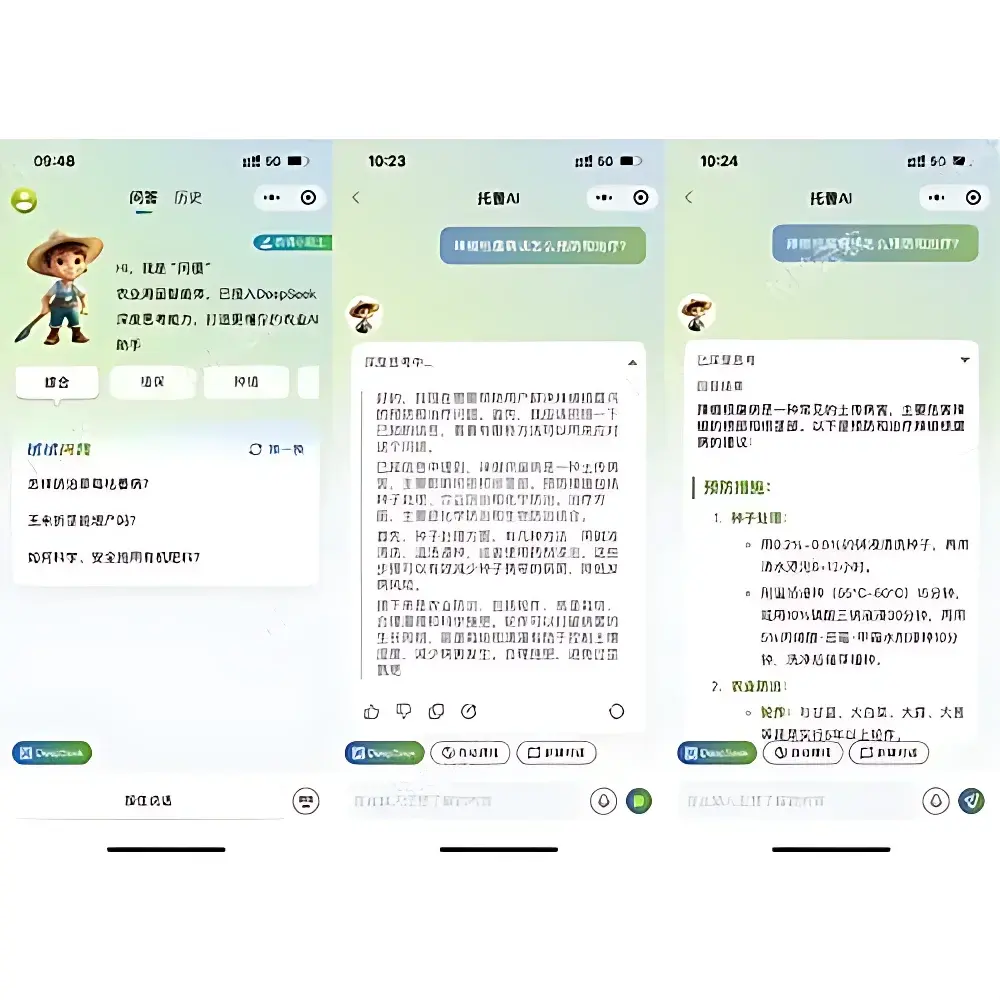
Top Cloud-agri “Wenji” Agricultural AI Assistant
| Brand | Top Cloud-agri |
|---|---|
| Origin | Zhejiang, China |
| Manufacturer Type | Direct Manufacturer |
| Regional Classification | Domestic (China) |
| Model | Intelligent Service Platform |
| Pricing | Upon Request |
Overview
The Top Cloud-agri “Wenji” Agricultural AI Assistant is a domain-specific artificial intelligence platform engineered for precision agricultural decision support. Unlike conventional environmental monitoring instruments that acquire physical soil or atmospheric measurements, Wenji operates as a knowledge-integrated AI service layer—designed to interpret, reason over, and deliver evidence-based agricultural guidance grounded in structured scientific literature, technical reports, and regulatory-compliant agronomic protocols. Built upon Retrieval-Augmented Generation (RAG) architecture, Wenji bridges the gap between unstructured agricultural knowledge assets (peer-reviewed journals, FAO guidelines, national soil fertility standards, crop protection bulletins, and regional extension manuals) and real-world operational queries from farmers, agronomists, extension officers, and research institutions. Its inference engine is powered by DeepSeek’s large language model, fine-tuned and constrained through agricultural ontology mapping, citation-aware grounding, and source-traceable response generation—ensuring outputs are not hallucinated but anchored to verifiable references within its continuously updated knowledge corpus.
Key Features
- Multi-Modal Interaction Interface: Supports both text-based and voice-enabled input via WeChat Mini Program—optimized for low-bandwidth rural networks and mobile-first use cases across Android and iOS platforms.
- RAG-Driven Knowledge Grounding: Every response is dynamically retrieved from a vetted, version-controlled repository of agricultural literature—including Chinese national standards (e.g., NY/T 1121 series for soil testing), ISO 11277 for soil particle size analysis, and FAO Soil Taxonomy frameworks—ensuring traceability and audit readiness.
- Context-Aware Reasoning Engine: Capable of decomposing multi-step agronomic questions (e.g., “How to diagnose and manage Fusarium wilt in greenhouse tomatoes under high-humidity conditions in Shandong?”) into sub-queries spanning pathology, irrigation scheduling, soil pH management, and biocontrol agent selection—with logical flow explicitly surfaced in output.
- Dynamic Knowledge Refresh Protocol: Integrates automated ingestion pipelines for new publications from CNKI, Wanfang, and international sources (e.g., Crop Protection, Soil Science Society of America Journal), with human-in-the-loop validation prior to indexing—maintaining temporal relevance and methodological consistency.
- Domain-Specific Safety Layer: Implements agricultural constraint logic to suppress non-compliant recommendations (e.g., pesticide application rates exceeding GB 2763–2021 MRL limits or fertilizer dosages violating local ecological carrying capacity thresholds).
Sample Compatibility & Compliance
While Wenji does not perform physical sampling or instrumental measurement, it is functionally interoperable with Top Cloud-agri’s hardware ecosystem—including IoT soil sensors (e.g., TuoPu TP-SC series), portable soil nutrient analyzers, and automated soil samplers compliant with ISO 22035:2021 (soil sampling for chemical analysis). All agronomic recommendations generated by Wenji align with China’s Ministry of Agriculture and Rural Affairs (MARA) technical guidelines, Good Agricultural Practice (GAP) frameworks, and provincial-level soil fertility monitoring protocols. The system supports GLP-aligned documentation export for advisory logs, enabling traceability in cooperative extension programs and government-subsidized digital agriculture initiatives.
Software & Data Management
Wenji operates as a cloud-native SaaS platform hosted on secure, ISO/IEC 27001-certified infrastructure. User interaction logs—including query timestamps, geolocation metadata (opt-in), and response provenance identifiers—are stored with end-to-end encryption and retained per MARA data governance requirements (no cross-border transfer of agricultural operational data). Audit trails comply with China’s Personal Information Protection Law (PIPL) and support internal QA reviews. API endpoints allow integration with farm management software (FMS), county-level agricultural big data platforms, and university research databases—facilitating federated learning scenarios while preserving data sovereignty.
Applications
- Real-time diagnosis and mitigation planning for abiotic stress (e.g., salinity-induced growth inhibition in Yellow River irrigation zones)
- Customized crop rotation design aligned with regional soil organic carbon targets (e.g., Heilongjiang black soil conservation plans)
- Evidence-based pesticide resistance management strategies referencing IRAC MoA classifications and local surveillance data
- Interpretation of soil test reports (pH, CEC, Olsen-P, available K) with actionable amendment prescriptions per crop-specific nutrient uptake curves
- Support for breeding program design—including GCA/SCA estimation workflows, marker-assisted selection logic, and trial site suitability scoring based on historical agroclimatic datasets
FAQ
Is Wenji suitable for regulatory compliance reporting in certified organic operations?
Yes—responses referencing OMRI-listed inputs, NOP-compliant soil amendments, and IFOAM-aligned pest management tactics are explicitly tagged with source citations and regulatory version numbers.
Does Wenji integrate with third-party soil sensor data?
It accepts CSV/JSON-formatted outputs from ISO 11464-compliant sensors; users may upload field measurement logs to trigger contextual interpretation and management alerts.
How frequently is the underlying knowledge base updated?
Core agronomic ontologies are refreshed quarterly; time-sensitive content (e.g., pest outbreak advisories, fertilizer price policy changes) is updated biweekly via automated feeds from official provincial agricultural bureaus.
Can Wenji operate offline or in low-connectivity environments?
The WeChat Mini Program caches frequently accessed reference modules (e.g., common disease symptom checklists, NPK deficiency visual guides); full RAG functionality requires internet connectivity.
Is user data used to retrain the underlying LLM?
No—Wenji employs strict inference-only architecture; no query data is retained for model retraining, consistent with MARA’s 2023 AI Ethics Guidelines for Smart Agriculture.







