
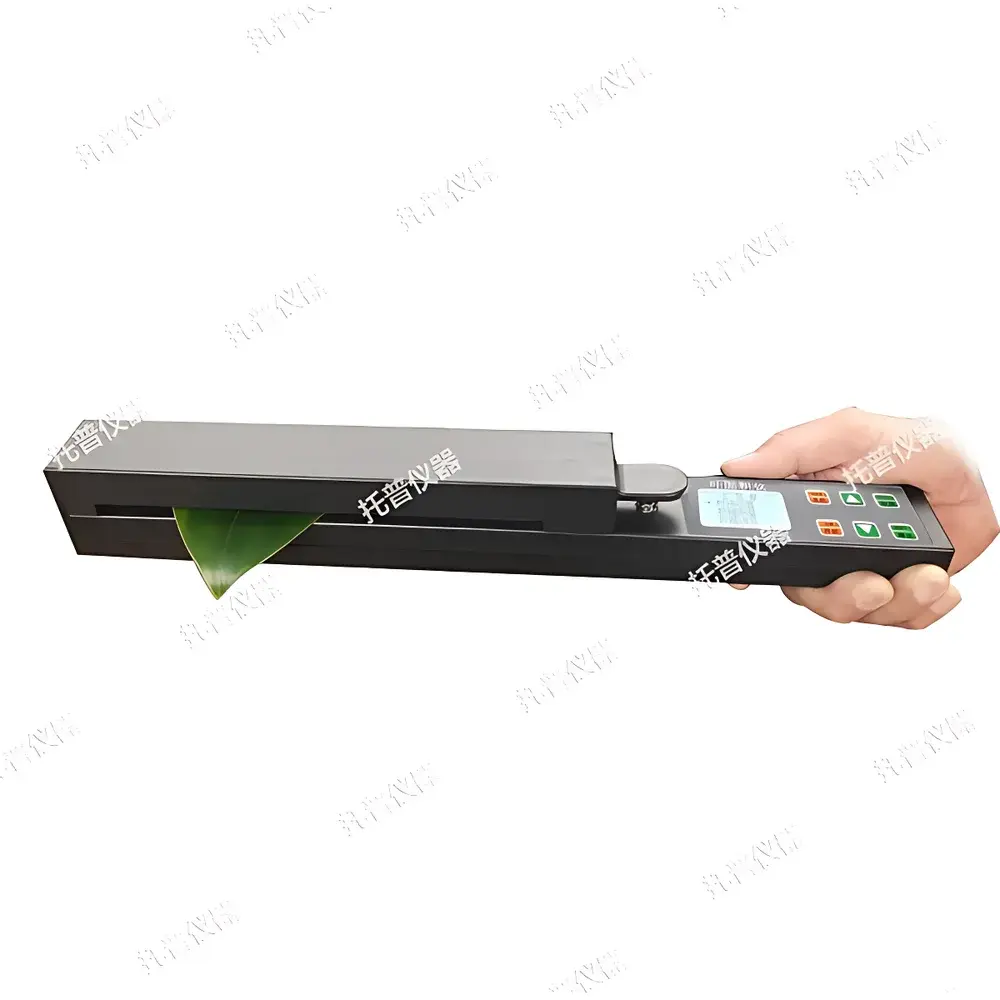
Top Cloud-agri YMJ Series Handheld Leaf Area Meter
| Brand | Top Cloud-agri |
|---|---|
| Origin | Zhejiang, China |
| Manufacturer Type | OEM Manufacturer |
| Region of Origin | Domestic (China) |
| Model | YMJ Series |
| Pricing | Upon Request |
| Measurement Parameters | Leaf Area, Average Leaf Area, Leaf Length, Leaf Width, Length-to-Width Ratio |
| Units | mm, cm² |
| Accuracy | ±2% |
| Resolution | 0.1 mm |
| Max. Measurable Length | 1000 mm |
| Max. Measurable Width | 160 mm |
| Max. Sample Thickness | 8 mm |
| Data Storage Capacity | 250 measurement sets |
| Display | LCD with integrated real-time clock (RTC) |
| Power | Rechargeable Li-ion battery |
| Portability | Integrated handheld design, field-deployable |
Overview
The Top Cloud-agri YMJ Series Handheld Leaf Area Meter is a portable, non-destructive optical measurement instrument engineered for rapid, in-situ quantification of leaf morphometric parameters in plant physiology and ecological field studies. It operates on the principle of high-contrast edge detection via linear CCD scanning combined with calibrated pixel-to-length conversion algorithms. Unlike destructive gravimetric or planimetric methods, this device captures digital silhouette profiles of intact leaves—whether still attached to the plant or freshly excised—without requiring physical contact beyond gentle placement on the scanning surface. Its compact, all-in-one architecture eliminates the need for external computers or power sources during operation, making it suitable for deployment across diverse environmental conditions: from greenhouse trials and agro-meteorological stations to forest canopy surveys and remote ecological monitoring sites. The instrument complies with foundational metrological requirements for botanical biometrics as referenced in ISO 5725 (accuracy and precision of measurement methods) and supports traceable data acquisition workflows aligned with GLP-compliant experimental protocols.
Key Features
- Integrated handheld design with embedded microcontroller and monochrome LCD interface—no external hardware required for basic operation.
- Linear CCD-based scanning sensor with 0.1 mm spatial resolution, enabling precise delineation of leaf margins and internal discontinuities (e.g., lobes, serrations).
- Onboard real-time clock (RTC) automatically timestamps each measurement, ensuring temporal context for longitudinal growth analysis or diurnal response studies.
- Internal rechargeable lithium-ion battery provides ≥8 hours of continuous field use; low-voltage indicator alerts users prior to operational cutoff.
- Maximum scan envelope of 1000 mm × 160 mm accommodates broadleaf species including maize, sunflower, banana, and mature woody dicot leaves—within mechanical thickness tolerance of ≤8 mm.
- Local storage capacity for 250 complete datasets, each comprising leaf area (cm²), length (mm), width (mm), and derived length-to-width ratio.
Sample Compatibility & Compliance
The YMJ Series accepts fresh, dried, or pressed leaf samples—including compound leaves with petioles—as long as they lie flat within the scanning aperture and exhibit sufficient contrast against the background plate. It is validated for use with angiosperm and gymnosperm foliage across major agricultural, horticultural, and forestry taxa. While not certified to IEC 61000-4 electromagnetic immunity standards, its analog signal conditioning circuitry incorporates noise-suppression filters suitable for typical outdoor electromagnetic environments (e.g., near irrigation controllers or weather stations). Data output conforms to ASCII-delimited text format, facilitating import into common statistical platforms (R, Python pandas, SAS) and supporting interoperability with LIMS systems under basic CSV ingestion protocols.
Software & Data Management
Measurement records are retained in non-volatile flash memory and can be exported wirelessly via Bluetooth 4.2 to Android/iOS mobile applications provided by Top Cloud-agri. The companion app enables chronological filtering, scatterplot generation (e.g., area vs. time), batch export to CSV/Excel, and annotation tagging (e.g., treatment ID, plot number, observer initials). Audit trails—including timestamped edits and session logs—are maintained locally on the mobile device. Though the device itself does not implement FDA 21 CFR Part 11 electronic signature controls, its data structure supports manual linkage to laboratory notebooks and metadata templates compliant with MIAME/MINQE reporting guidelines for plant phenotyping experiments.
Applications
- Quantitative assessment of drought-induced leaf abscission or heat-stress-related area reduction in crop breeding programs.
- Monitoring canopy development indices (e.g., LAI estimation via representative subsampling) in precision agriculture field trials.
- Validating growth models in controlled-environment phenotyping platforms where repeated non-invasive measurements are essential.
- Supporting ecological studies on leaf trait variation across altitudinal or latitudinal gradients—particularly when paired with spectroradiometric or gas exchange measurements.
- Teaching laboratories in botany and agronomy curricula, where student-operated, low-barrier instrumentation reinforces core concepts in plant allometry and functional morphology.
FAQ
Can the YMJ Series measure leaves while still attached to the plant?
Yes—when used with optional flexible support frames or field-mountable adapters, the scanner allows partial or full in-situ measurement of unharvested leaves, provided the leaf surface remains stable and fully illuminated during scanning.
Is calibration required before each use?
No routine recalibration is needed; the device undergoes factory calibration using NIST-traceable dimensional standards. Users may perform verification checks using supplied reference templates (10 cm² and 100 cm²).
Does the instrument support batch processing of multiple leaves?
It records individual leaves sequentially. For high-throughput workflows, users typically pair it with sample barcoding and external spreadsheet automation to aggregate metrics across genotypes or treatments.
What file formats are supported for data export?
CSV (comma-separated values) is the native export format; no proprietary binary files are generated. Time stamps follow ISO 8601 (YYYY-MM-DD HH:MM:SS) convention.
Is firmware upgradable in the field?
Firmware updates are delivered via USB-C connection and Top Cloud-agri’s desktop utility software, which runs on Windows 10/11 and macOS 12+. Updates include algorithm refinements, UI enhancements, and expanded language support.





