
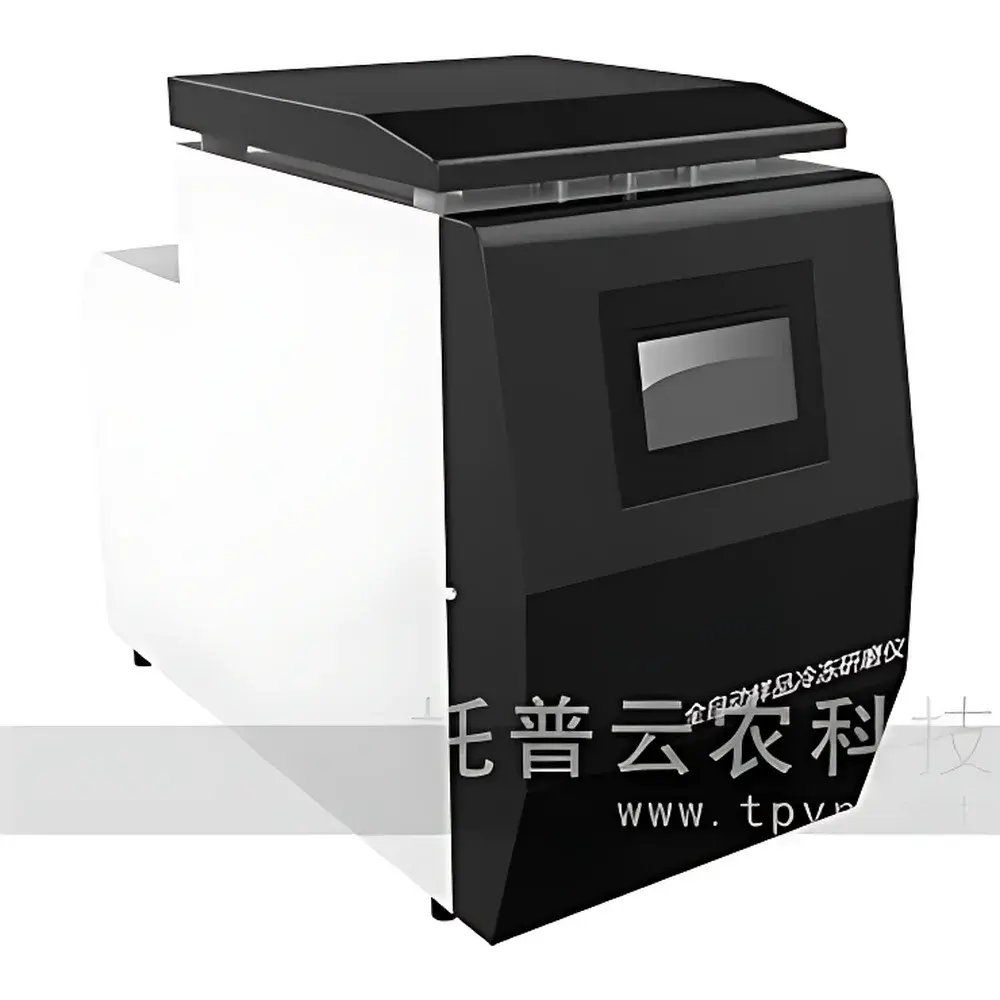
Top Cloud-agri YMY-240CL Automated Cryogenic Ball Mill
| Brand | Top Cloud-agri |
|---|---|
| Origin | Zhejiang, China |
| Manufacturer Type | Direct Manufacturer |
| Country of Origin | China |
| Model | YMY-240CL |
| Instrument Type | Cryogenic Ball Mill |
| Sample Compatibility | Soft biological tissues |
| Final Particle Size | ~5 µm |
| Batch Grinding Volume | 48 mL |
| Maximum Simultaneous Samples | 24 |
| Frequency Range | 0–70 Hz |
| Speed Range | 1,000–7,000 rpm |
| Temperature Control Range | –50 °C to +37 °C |
| Adapter Materials | PTFE or Alloy Steel |
| Grinding Media Diameter | 0.1–30 mm |
| Grinding Media Materials | Stainless steel, chromium steel, zirconia, tungsten carbide, quartz sand |
| Noise Level | <55 dB(A) |
| Programmable Protocols | 10 stored methods |
| Acceleration/Deceleration Time | ≤2 s |
| Sealing Mechanism | Electromagnetic lid lock |
| Centrifugal Centering | Automatic |
| Grinding Modes | Dry, wet, and cryogenic milling |
| Customizable Vial Configurations | Yes |
Overview
The Top Cloud-agri YMY-240CL Automated Cryogenic Ball Mill is an engineered solution for high-throughput, low-temperature mechanical disruption of thermolabile biological samples. It operates on the principle of high-frequency oscillatory ball milling under precisely controlled cryogenic conditions—leveraging inertial impact, shear, and compression forces generated by grinding media (e.g., stainless steel or zirconia beads) within sealed vials. Unlike ambient-temperature mills, its integrated refrigeration system maintains sample integrity by suppressing enzymatic degradation, RNA hydrolysis, protein denaturation, and thermal oxidation during homogenization. Designed for reproducible cell lysis, tissue pulverization, and subcellular fractionation, the instrument delivers consistent particle size reduction to approximately 5 µm while preserving nucleic acid yield, metabolite stability, and antigen conformation—critical for downstream applications including qPCR, LC-MS, Western blotting, and single-cell sequencing library preparation.
Key Features
- Automated cryogenic operation with adjustable temperature range from –50 °C to +37 °C, enabling stabilization of labile biomolecules across diverse sample classes;
- High-precision programmable control via capacitive touchscreen interface supporting up to 10 user-defined protocols with cycle repetition capability;
- Electromagnetically interlocked lid mechanism ensuring operational safety and preventing accidental opening during high-speed runs;
- Self-centering clamping system guaranteeing uniform force distribution and eliminating vial misalignment-induced vibration or imbalance;
- Dual-platform configuration supporting simultaneous processing of up to 24 samples without cross-contamination, compatible with 2 mL PTFE or alloy steel cryo-adapters and 10 mL stainless steel grinding jars;
- Rapid dynamic response: achieves target frequency (0–70 Hz, equivalent to 1,000–7,000 rpm) or decelerates to standstill within ≤2 seconds;
- Modular grinding architecture accommodating dry, wet, and cryo-milling modes with interchangeable media (0.1–30 mm diameter) in stainless steel, chromium steel, zirconia, tungsten carbide, or quartz;
- Low-noise design (<55 dB[A]) suitable for shared laboratory environments and continuous operation in ISO-certified cleanrooms or GLP-compliant facilities.
Sample Compatibility & Compliance
The YMY-240CL is validated for soft and semi-solid biological matrices including mammalian cardiac, pulmonary, hepatic, renal, and splenic tissues; bone marrow aspirates; skin biopsies; hair follicles; plant meristems; fungal mycelia; and microbial pellets. Its cryogenic workflow aligns with ASTM E2936-19 (Standard Guide for Cryogenic Milling of Biological Samples) and supports compliance with ISO/IEC 17025:2017 requirements for method validation in accredited testing laboratories. When operated with audit-trail-enabled software extensions (optional), it meets data integrity expectations under FDA 21 CFR Part 11 for electronic records and signatures in regulated life science R&D and QC environments.
Software & Data Management
The embedded firmware logs all critical process parameters—including setpoint temperature, actual chamber temperature, frequency profile, run duration, cycle count, and lid status—with timestamped entries stored locally on non-volatile memory. Exportable CSV reports facilitate integration into LIMS platforms or statistical analysis tools (e.g., JMP, Python pandas). While the base unit does not include network connectivity, optional RS-232 or USB-to-PC interfaces allow remote parameter upload/download and batch report generation. Protocol encryption and password-protected method editing support multi-user lab governance models aligned with GxP documentation standards.
Applications
- RNA/DNA extraction from fibrous or lipid-rich tissues where conventional bead-beating induces shearing or heat artifacts;
- Preparation of homogeneous powder for X-ray diffraction (XRD) or scanning electron microscopy (SEM) analysis of hydrated biological structures;
- Homogenization of environmental soil or sediment samples prior to heavy metal speciation or pesticide residue quantification (EPA Method 3540C);
- Cryopulverization of pharmaceutical excipients or active ingredients for dissolution rate profiling per USP <711>;
- Cell wall disruption in yeast or Gram-positive bacteria for proteomic profiling and phosphoproteome enrichment;
- Generation of ultrafine reference materials for inter-laboratory proficiency testing programs governed by ILAC G13.
FAQ
What types of grinding vessels are supported?
The system accommodates standard 2 mL cryotubes (with PTFE or alloy steel adapters), 10 mL stainless steel grinding jars, and custom-configured vials upon request—subject to mechanical compatibility verification.
Is the instrument suitable for hazardous or pathogenic samples?
Yes—when used with sealed, biocontainment-rated vials and appropriate PPE, it complies with BSL-2 containment practices for inactivation and homogenization of Category B infectious agents per WHO Laboratory Biosafety Manual (4th ed.).
Can I integrate this mill into an automated sample prep line?
While the base model lacks robotic arm interfaces, its programmable trigger signals (TTL-compatible) and serial command protocol enable third-party integration with liquid handlers or carousel-based automation systems.
How is temperature uniformity verified across all sample positions?
Each adapter block undergoes factory calibration using NIST-traceable thermocouples at multiple spatial points; users may perform periodic verification using calibrated infrared thermography or embedded PT100 probes.
Does the system support Good Manufacturing Practice (GMP) documentation?
With optional software upgrade and external audit trail module, full electronic records—including operator ID, parameter changes, and failure event logs—are generated in accordance with Annex 11 and ALCOA+ principles for regulated manufacturing environments.



