
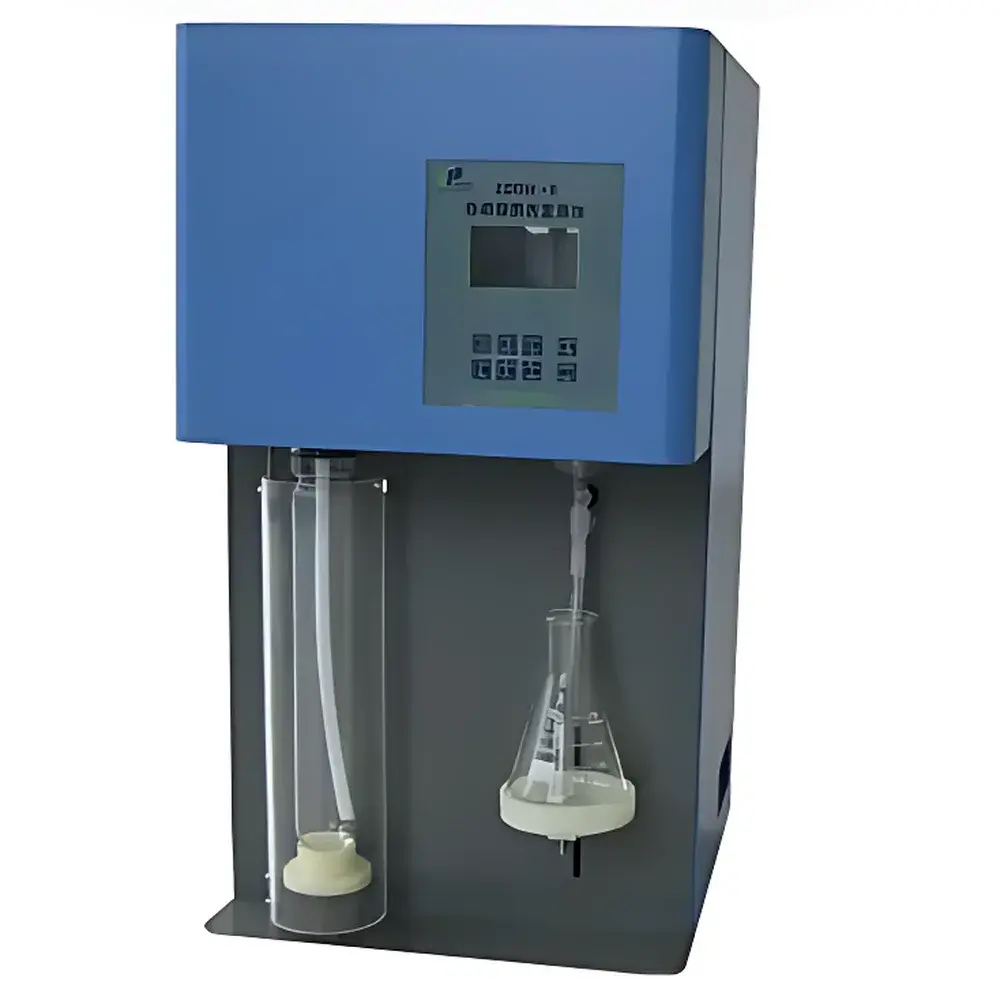
Top Cloud-agri ZDDN-II Automated Kjeldahl Nitrogen Determinator
| Brand | Top Cloud-agri |
|---|---|
| Origin | Zhejiang, China |
| Manufacturer Type | Direct Manufacturer |
| Country of Origin | China |
| Model | ZDDN-II |
| Price | USD 1,800 (approx.) |
| Measurement Principle | Kjeldahl Digestion & Steam Distillation |
| Sample Throughput | 1–4 samples per run |
| Nitrogen Range | 0.1–200 mg N |
| Recovery Rate | ≥99% |
| Repeatability | RSD < ±1% |
| Distillation Time | 5–15 min/sample |
| Cooling Water Consumption | 3 L/min |
| Power Supply | AC 220 V / 50 Hz, 1000 W |
| Dimensions | 430 × 360 × 670 mm |
| Weight | 25 kg |
| Sample Capacity | Solids (0.20–2.00 g), Semi-solids (2.00–5.00 g), Liquids (10.00–25.00 mL) |
| Water Supply Options | Tap water or distilled water |
| Max. Operating Ambient Temperature | ≤30 °C |
| Cooling Water Inlet Temp. | <20 °C |
Overview
The Top Cloud-agri ZDDN-II Automated Kjeldahl Nitrogen Determinator is an engineered solution for quantitative total nitrogen analysis based on the internationally standardized Kjeldahl method (ISO 8585, AOAC 984.13, ASTM D1142, and GB/T 10511–2022). It integrates automated reagent dosing, controlled steam distillation, and programmable endpoint detection to deliver reproducible nitrogen quantification in complex organic matrices. Unlike optical or enzymatic nitrogen assays, the ZDDN-II relies on acid digestion (typically with concentrated H2SO4 and catalysts), alkaline liberation of ammonium ions, and subsequent steam distillation into a boric acid trapping solution — a gravimetrically and titrimetrically validated process recognized by regulatory bodies including ISO/IEC 17025-accredited laboratories, national food safety authorities, and agricultural testing networks. The instrument is designed for routine use in high-volume analytical environments where traceability, operator safety, and method compliance are non-negotiable.
Key Features
- Fully automated workflow: Sequential addition of NaOH, steam generation, distillation, and automatic termination based on preset time or conductivity-based endpoint detection
- Dual water supply compatibility: Accepts both municipal tap water and pre-purified distilled water — enabling deployment across diverse laboratory infrastructures without requiring dedicated deionized water systems
- Modular digestion interface: Designed for seamless integration with external block digesters (e.g., Top Cloud-agri TD-40 series) to support parallel sample preparation and minimize lab footprint
- Corrosion-resistant internal architecture: Steam pathways and condenser surfaces constructed from high-purity borosilicate glass and PTFE-lined stainless steel to withstand prolonged exposure to caustic vapors and acidic condensates
- Thermal and pressure-stabilized distillation chamber: Maintains consistent steam flux and temperature profile across variable sample loads (0.2–5.0 g solids or 10–25 mL liquids), ensuring uniform recovery kinetics
- Integrated safety interlocks: Real-time monitoring of cooling water flow rate, condenser temperature, and chamber pressure; automatic shutdown upon anomaly detection per IEC 61010-1 safety standards
Sample Compatibility & Compliance
The ZDDN-II supports a broad spectrum of sample types per AOAC Official Method 984.13 and ISO 5983-1: cereal grains, compound feeds, dairy products, fruit juices, soil extracts, wastewater digests, pharmaceutical intermediates, and industrial chemical slurries. Its 0.1–200 mg N dynamic range accommodates low-protein botanical tissues (e.g., leaf litter, root exudates) as well as high-nitrogen fertilizers and protein concentrates. All operational parameters comply with GLP documentation requirements: audit trails record operator ID, method version, start/stop timestamps, reagent lot numbers, and environmental conditions (ambient temperature/humidity logged via optional external sensor). Data output conforms to FDA 21 CFR Part 11 readiness when paired with compliant LIMS or titration software (e.g., Metrohm OMNIS).
Software & Data Management
The ZDDN-II operates via an embedded 7-inch resistive touchscreen interface running firmware v3.2+, supporting user-defined method templates (up to 99 protocols), password-protected parameter locking, and CSV export of raw distillation logs (time-stamped temperature, steam pressure, condensate volume, endpoint signal). No proprietary cloud platform is required; exported files integrate natively with Excel, LabWare LIMS, or Thermo Fisher SampleManager. For full 21 CFR Part 11 compliance, optional USB-locked electronic signature modules enable role-based access control and immutable electronic records. All firmware updates are delivered via signed .bin files with SHA-256 checksum verification.
Applications
- Food & Feed Quality Control: Crude protein calculation (N × 6.25) in wheat flour, soybean meal, pet food, and infant formula per Codex Alimentarius standards
- Agricultural Soil Testing: Total Kjeldahl nitrogen (TKN) determination in acidic, calcareous, and organic-rich soils per USDA-NRCS Method 420
- Environmental Monitoring: TKN and ammonia-nitrogen speciation in wastewater influent/effluent, sediment pore water, and leachate — aligned with EPA Method 351.2 and ISO 14253-1
- Pharmaceutical Excipient Analysis: Nitrogen content verification in gelatin, casein, and synthetic polymers used in capsule shells and sustained-release matrices
- Research & Method Development: Validation of alternative digestion catalysts (e.g., Se-free Cu–TiO2 nanocomposites) and low-volume micro-Kjeldahl adaptations
FAQ
Does the ZDDN-II include an integrated titrator?
No — the ZDDN-II performs only the distillation step. Titration must be conducted separately using an autotitrator (e.g., Metrohm 809 or Hanna HI84532) or manual burette calibrated per ISO 3696 Grade 3 water specifications.
Can it analyze ammonium nitrogen (NH₄⁺) directly in aqueous samples without digestion?
Yes — when operated in “direct distillation mode” (bypassing digestion), it quantifies free NH₄⁺ in clarified water, digested sludge filtrates, or culture media, provided chloride and volatile amine interferences are removed via pretreatment (e.g., salicylate masking or ion exchange).
What maintenance intervals are recommended for long-term reliability?
Daily: Rinse condenser and steam trap with deionized water; weekly: inspect gasket integrity and clean alkali reservoir filter; annually: calibrate steam pressure transducer and validate distillation efficiency using certified urea reference material (NIST SRM 84g).
Is third-party calibration certification available?
Yes — accredited calibration services (ISO/IEC 17025) are offered through Top Cloud-agri’s authorized service centers in Shanghai, Guangzhou, and Berlin, covering volumetric delivery accuracy, temperature uniformity, and endpoint repeatability.
How does it handle high-fat or high-fiber samples that may foam during distillation?
The system includes anti-foam agent injection capability (via auxiliary peristaltic pump port) and adjustable steam ramp profiles to suppress frothing — validated for corn silage, fishmeal, and lignocellulosic biomass per AOAC 992.15 guidelines.







