
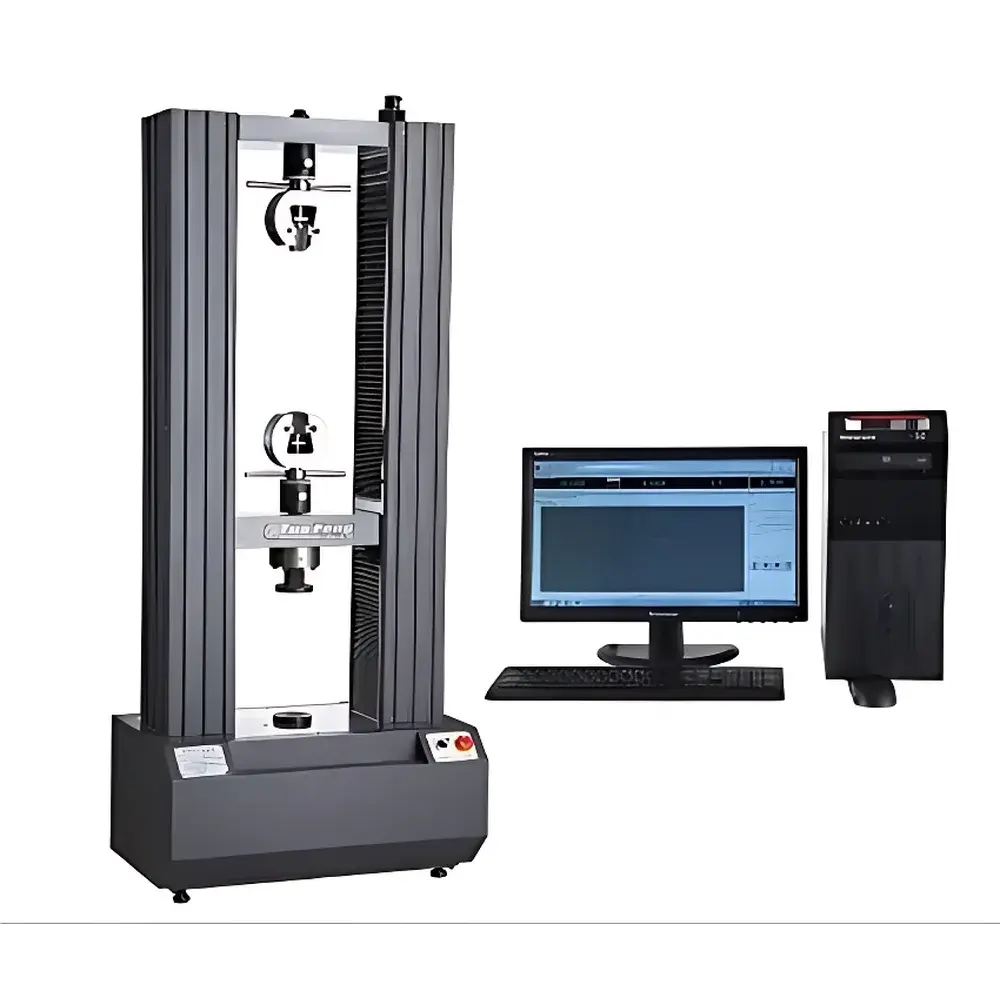
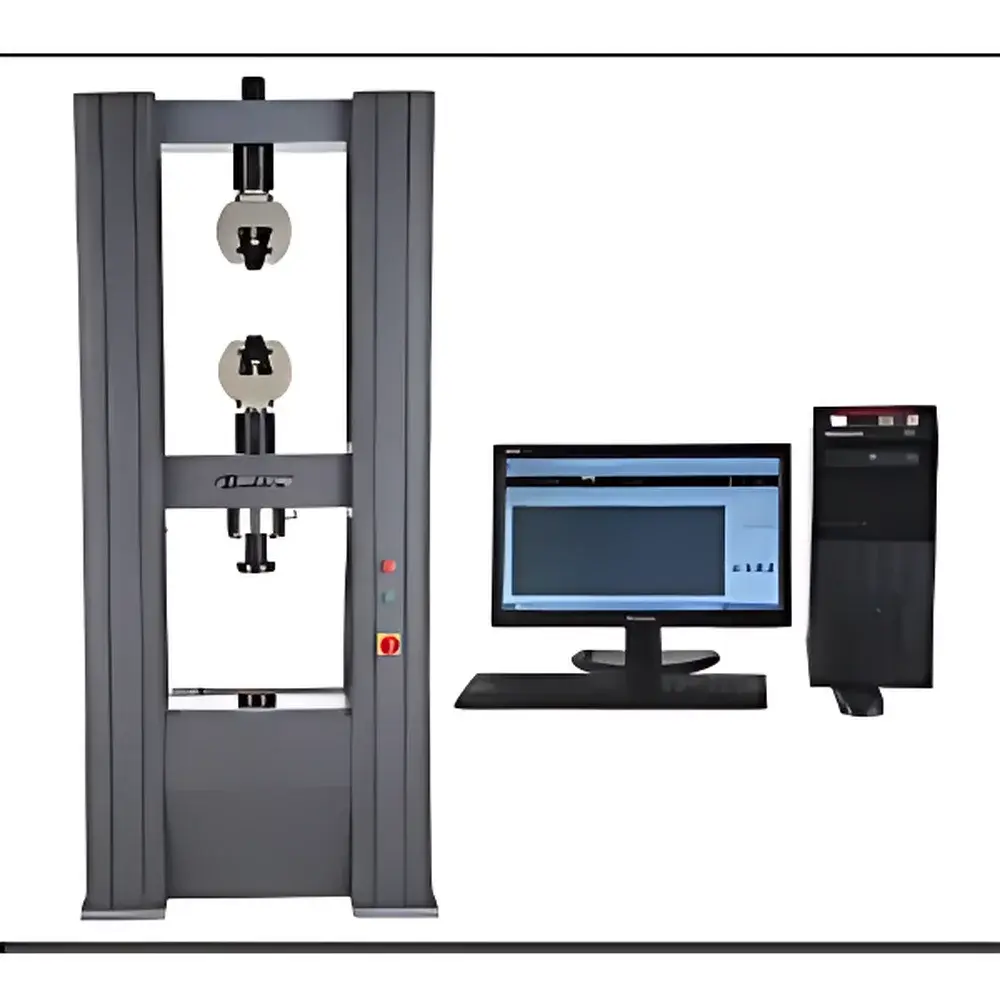
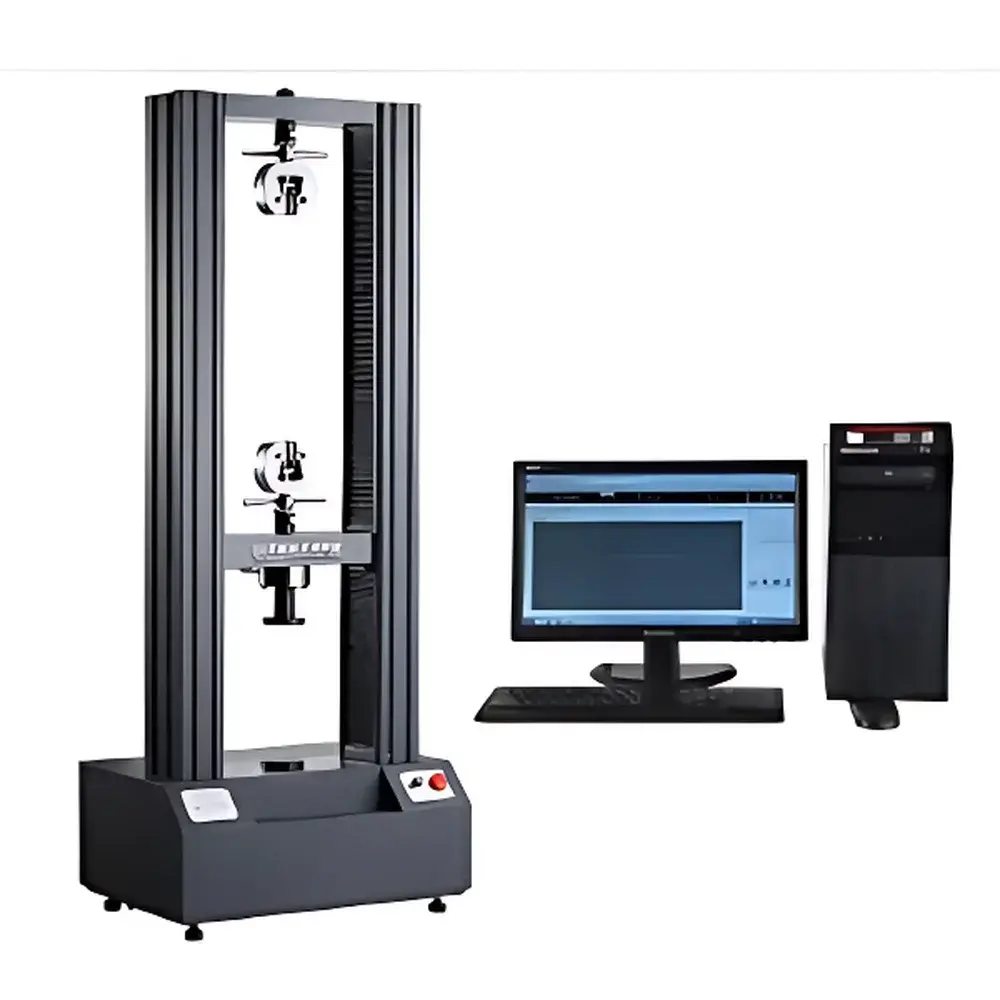
TopFeng TFW-100S Microcomputer-Controlled Electromechanical Universal Testing Machine
| Brand | TopFeng |
|---|---|
| Origin | Shanghai, China |
| Manufacturer Type | Direct Manufacturer |
| Product Category | Domestic |
| Model | TFW-100S |
| Instrument Type | Electromechanical Universal Testing Machine |
| Maximum Test Load | 100 kN |
| Accuracy Class | 0.5 |
| Effective Force Range | 0.2–100% of Full Scale |
| Force Measurement Accuracy | ±0.005% of Reading |
| Force Resolution | 1 / ±300,000 counts (full-scale, no range switching) |
| Drive System | Servo Motor with Worm Gear Reducer |
| Lead Screw | High-Precision Ball Screw |
| Effective Test Width | 500 mm (customizable) |
| Tensile Stroke | 800 mm (customizable) |
| Test Speed Range | 0.01–500 mm/min (optional extended range) |
| Displacement Measurement | Optical Encoder |
| Displacement Accuracy | ±0.005% of Reading |
| Strain Measurement (Optional) | Extensometer with Gauge Lengths 25/50/100 mm |
| Safety Protection | Electronic Limit Switches, Emergency Stop Button |
| Crosshead Adjustment | Dual-Speed Motorized (Fast/Slow), Jog Control |
| Return Function | Automatic or Manual Return at Maximum Speed Post-Test |
| Overload Protection | Automatic Shutdown at >110% of Rated Load |
| Fixture Customization | Application-Specific Clamping Solutions |
| Dimensions (W×D×H) | 1000 × 600 × 2000 mm |
| Power Supply | 220 V AC, 3000 W |
| Approx. Weight | 800 kg |
Overview
The TopFeng TFW-100S Microcomputer-Controlled Electromechanical Universal Testing Machine is an ISO/IEC 17025-aligned static mechanical testing platform engineered for high-fidelity tensile, compressive, flexural, shear, peel, tear, and adhesion characterization of metallic, polymeric, ceramic, composite, and elastomeric materials. Based on the fundamental principles of controlled displacement and load feedback via closed-loop servo actuation, the system complies with GB/T 16491–2008 and supports full interoperability with ASTM E4, ASTM E8/E21, ISO 6892-1, ISO 7500-1, ISO 178, ISO 604, JIS Z2241, DIN 50125, and EN 10002-1 test standards. Its force transducer architecture, coupled with real-time digital signal processing and a 300,000-count A/D resolution, ensures traceable measurement integrity across the entire 0.2–100% FS operating range — eliminating range-switching artifacts common in legacy dual-range systems.
Key Features
- 0.5-class accuracy certified per ISO 7500-1 and GB/T 16491–2008, validated through third-party calibration protocols.
- High-stiffness frame with precision-ground ball screw transmission and backlash-free worm gear reducer, delivering stable crosshead positioning under dynamic loading conditions.
- Integrated dual-speed motorized crosshead control (fast/slow modes) with jog capability for precise specimen alignment and rapid repositioning.
- Electronic limit switches and hardware-based emergency stop circuitry provide redundant mechanical and electrical protection compliant with IEC 61800-5-2 functional safety requirements.
- Modular extensometer interface supporting clip-on and non-contact strain measurement options (gauge lengths: 25/50/100 mm; strain capacity up to 25 mm; resolution ≤0.1 µm).
- Thermally stabilized load cell with temperature-compensated bridge circuitry, minimizing drift during extended-duration creep or relaxation tests.
Sample Compatibility & Compliance
The TFW-100S accommodates flat, round, tubular, and irregular geometries — including ASTM-standard dog-bone specimens, ISO tensile bars, compression cylinders, three/four-point bend fixtures, peel mandrels, and lap-shear coupons. Fixture mounting follows ISO 26203-2 and ASTM E1012 alignment guidelines. All test methods executed on this platform are fully auditable for GLP, GMP, and ISO 9001 quality systems. Data acquisition meets FDA 21 CFR Part 11 requirements when paired with optional electronic signature and audit trail modules. Calibration certificates include uncertainty budgets traceable to NIM (National Institute of Metrology, China) and NIST-equivalent reference standards.
Software & Data Management
The embedded Windows-based testing software (compatible with Windows 10/11 LTS versions) supports multi-mode control — including constant rate of extension (CRE), constant rate of loading (CRL), stress/strain ramping, hold steps, and cyclic profiling. Real-time plotting includes synchronized force–time, force–displacement, displacement–time, stress–strain, and force–extension curves. Units are configurable per ISO 80000 (e.g., MPa, psi, N/mm², % elongation, kN, lbf). Raw data export adheres to ASTM E1434 and ISO/IEC 17025 Annex A.3 formats (CSV, XML, XLSX), enabling integration with LIMS and statistical process control (SPC) platforms. Software architecture supports user-defined test templates, multi-user role permissions, and encrypted local database storage with automatic backup scheduling.
Applications
Typical use cases include mechanical property validation for aerospace aluminum alloys (AMS 4027), automotive thermoplastics (SAE J2116), biomedical polymer sutures (ISO 10993-12), construction-grade rebar (ASTM A615), packaging film peel strength (ASTM F904), rubber vulcanizate tensile set (ISO 37), and adhesive bond durability (ASTM D1002/D3163). The system is routinely deployed in QC laboratories, R&D centers, and contract testing facilities requiring repeatable, standards-compliant mechanical data for regulatory submissions, material certification, and failure analysis.
FAQ
Does the TFW-100S support ASTM and ISO standard-compliant reporting?
Yes — all test reports include method identification, environmental conditions, calibration status, operator ID, and raw data timestamps, satisfying ASTM E1434 and ISO/IEC 17025 clause 7.8 documentation requirements.
Can the system be integrated into an existing laboratory network with centralized data management?
Yes — it supports OPC UA and TCP/IP communication protocols for seamless connection to enterprise MES, LIMS, or SCADA environments.
Is remote diagnostics and software update capability available?
Yes — secure remote access is supported via TLS-encrypted VNC sessions; firmware and application updates are delivered through authenticated package repositories.
What is the recommended recalibration interval for ISO 17025 compliance?
Annual calibration is advised; however, internal verification using certified reference load cells and displacement standards should be performed before each shift in regulated environments.
Are custom fixture designs supported by TopFeng engineering services?
Yes — TopFeng provides turnkey fixture design, FEA-based stress analysis, and validation testing per ASTM E2387 for non-standard specimen configurations.



