
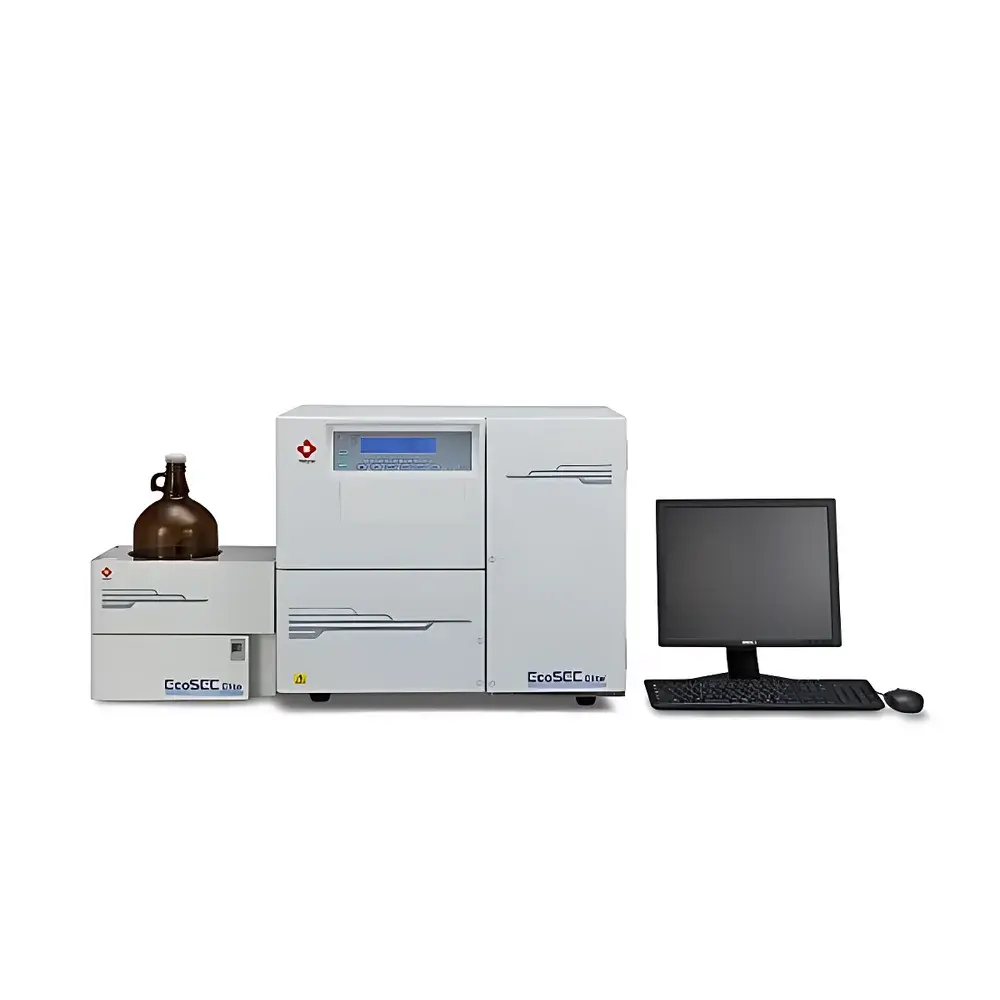
Toray HLC-8420GPC Gel Permeation Chromatograph
| Brand | Toray |
|---|---|
| Origin | Japan |
| Model | HLC-8420GPC |
| Instrument Type | Ambient-Temperature GPC System |
| Pump Flow Range | 0.10–2.00 mL/min |
| Pump Pressure Range | 0–25 MPa |
| RI Detector Drift | < 0.8 × 10⁻⁷ RIU/h |
| RI Detector Cell Volume | 2.5 µL |
| UV Detector Wavelength Range | 195–350 nm |
| UV Detector Noise | < 1.5 × 10⁻⁵ AU |
| Column Oven Temperature Range | 40–60 °C |
Overview
The Toray HLC-8420GPC is a dedicated, high-performance gel permeation chromatography (GPC) system — also known as size exclusion chromatography (SEC) — engineered for precise, reproducible determination of polymer molecular weight distribution (MWD), including number-average (Mn), weight-average (Mw), and polydispersity index (PDI). Developed by Toray Industries, Inc. — a pioneer in polymer characterization since its first commercial GPC instrument in 1972 — the HLC-8420GPC represents the eighth-generation evolution of its GPC platform. It employs a dual-channel, dual-flow-path refractive index (RI) detection architecture coupled with rigorously temperature-controlled fluidic pathways, column oven, pump compartment, and degasser cavity to minimize thermal-induced baseline drift and ensure long-term signal stability. Designed exclusively for ambient-temperature SEC analysis of synthetic polymers, copolymers, and oligomers in organic solvents (e.g., THF, chloroform, DMF), the system delivers high-resolution separation with minimized system dead volume and optimized solvent efficiency.
Key Features
- Thermally stabilized dual-flow-path RI detector with <2.5 µL cell volume, enabling high-sensitivity detection compatible with semi-micro SEC columns (e.g., 7.8 mm × 15 cm)
- Integrated pump temperature control chamber housing both high-pressure pump and vacuum degasser (800 µL cavity), reducing startup time and improving flow consistency
- Column oven with precise ±0.1 °C temperature regulation across 40–60 °C range, supporting method robustness and retention time reproducibility
- Low-noise UV detector (195–350 nm, <1.5 × 10⁻⁵ AU noise) for simultaneous UV-absorbing polymer detection and RI confirmation
- Optimized fluidic layout featuring low-dead-volume tubing and minimized inter-unit connections to enhance peak resolution and reduce band broadening
- Modular design allowing seamless integration of optional solvent bottle temperature control unit to suppress baseline fluctuations in volatile solvents such as chloroform
Sample Compatibility & Compliance
The HLC-8420GPC is validated for routine analysis of linear and branched synthetic polymers, including polystyrene, poly(methyl methacrylate), polyethylene oxide, and polyacrylates, dissolved in common SEC mobile phases (THF, chloroform, DMF, o-dichlorobenzene). Its hardware architecture and operational protocols align with widely adopted polymer characterization standards, including ASTM D5296 (standard test method for molecular weight averages of polystyrene by SEC), ISO 16014 (plastics — determination of average molecular parameters of polymers by SEC), and USP (chromatography). The system supports GLP-compliant operation when paired with EcoSEC Elite-WS software configured for audit trail logging, electronic signatures, user access levels, and automatic session timeout — fulfilling core requirements of FDA 21 CFR Part 11 for regulated environments.
Software & Data Management
Control, acquisition, calibration, and reporting are executed via EcoSEC Elite-WS — a dedicated GPC data system developed by Toray. The software features multi-panel GUI with synchronized real-time chromatogram display, calibration curve management, batch processing, and automated MWD calculation using universal calibration or narrow-standard methods. All raw data files are stored in vendor-neutral formats with embedded metadata (instrument configuration, method parameters, operator ID, timestamp). Audit trail functionality records all user actions (method edits, integration changes, report generation), ensuring traceability and data integrity. Export options include CSV, PDF, and XML formats compatible with LIMS integration and third-party statistical analysis platforms.
Applications
- Determination of absolute and relative molecular weight distributions in R&D and QC labs for polymer synthesis optimization
- Batch-to-batch consistency verification in pharmaceutical excipient manufacturing (e.g., PEG, PLGA)
- Stability assessment of polymer-based drug delivery systems under accelerated aging conditions
- Characterization of graft copolymers and block copolymers where branching ratio or composition distribution affects performance
- Supporting regulatory submissions requiring documented SEC methodology validation per ICH Q5E and Q2(R2)
- Quality control of industrial resins, adhesives, and coating materials where rheological behavior correlates with MWD
FAQ
Is the HLC-8420GPC compliant with FDA 21 CFR Part 11?
Yes — when operated with EcoSEC Elite-WS configured for electronic signature enforcement, audit trail logging, role-based access control, and automatic session termination.
Can it be used with aqueous SEC mobile phases?
No — the HLC-8420GPC is designed exclusively for organic-phase SEC; aqueous applications require a dedicated aqueous SEC system with corrosion-resistant components and compatible detectors.
What column dimensions are recommended for optimal performance?
Standard 30 cm columns (7.8 mm i.d.) are supported; however, semi-micro columns (15 cm, 4.6 mm i.d.) are strongly recommended to achieve faster analysis, lower solvent consumption, and improved resolution when paired with the 2.5 µL RI cell.
Does the system support multi-detector configurations (e.g., light scattering)?
No — the HLC-8420GPC is a fixed two-detector platform (RI + UV); advanced multi-angle light scattering (MALS) or viscometry requires integration with Toray’s modular HLC-8320 series or third-party coupling solutions.
What maintenance intervals are recommended for the RI detector?
Daily purging and weekly optical window cleaning are advised; annual recalibration of RI sensitivity and zero-point drift correction are recommended to maintain <0.8 × 10⁻⁷ RIU/h baseline stability specification.




