
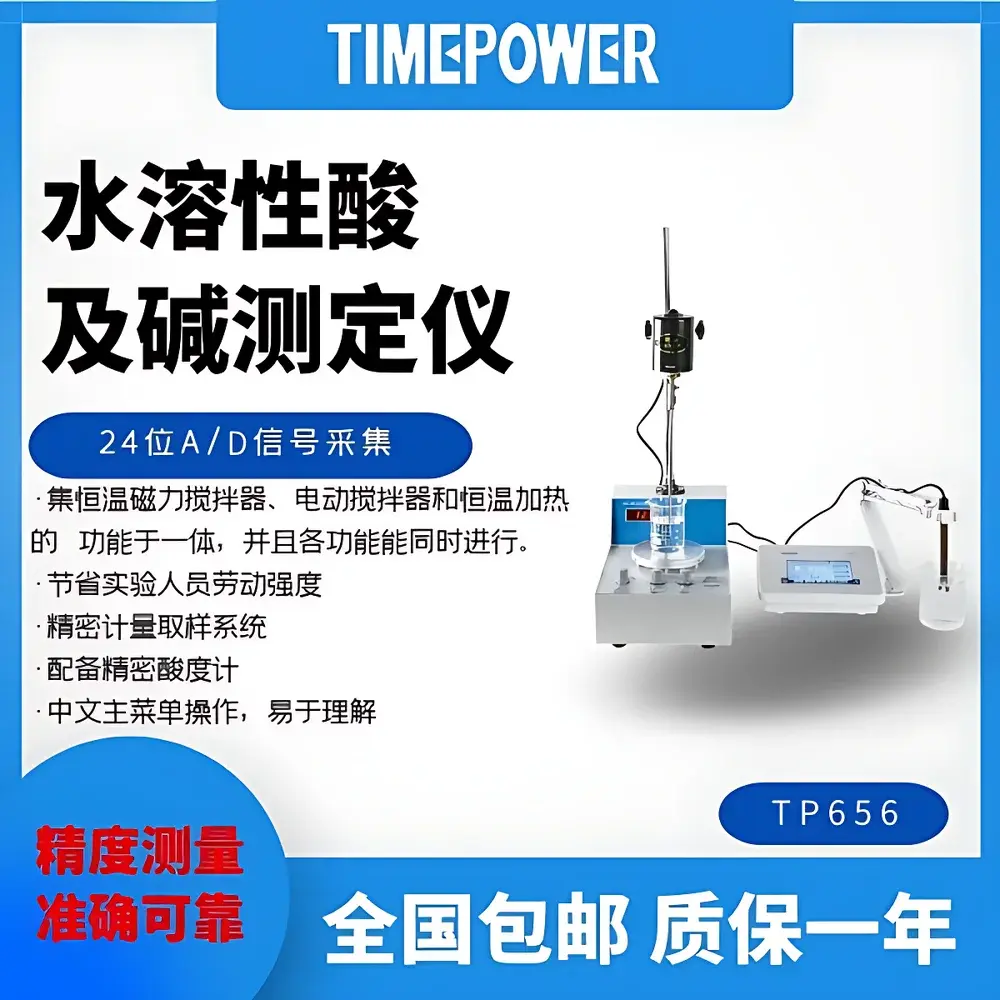
TP-656 TimePower Water-Soluble Acid and Alkali Analyzer
| Brand | TimePower |
|---|---|
| Model | TP-656 |
| Origin | Beijing, China |
| Manufacturer | TimePower Co., Ltd. |
| Type | Benchtop Electrochemical Analyzer for Water-Soluble Acidity/Alkalinity Determination |
| Compliance | Designed for ASTM D974, ASTM D664, IEC 62021-1, GB/T 259, DL/T 704 |
| Temperature Control Range | 20–80 °C (adjustable) |
| Stirring Mode | Integrated Magnetic & Mechanical Stirring |
| pH Measurement Resolution | 0.01 pH |
| A/D Conversion | 24-bit |
| Display | Chinese GUI with Menu Navigation |
| Power Supply | AC 220 V ±10%, 50 Hz |
Overview
The TP-656 TimePower Water-Soluble Acid and Alkali Analyzer is a dedicated benchtop electrochemical instrument engineered for the quantitative determination of water-soluble acidity and alkalinity in petroleum-based insulating oils, lubricants, transformer oils, and related hydrocarbon fluids. It operates on the principle of potentiometric titration using standardized alcoholic–water solvent extraction followed by pH endpoint detection or electrometric titration—fully aligned with ASTM D974 (indication method), ASTM D664 (potentiometric method), IEC 62021-1, and national standards including GB/T 259 and DL/T 704. Unlike general-purpose pH meters, the TP-656 integrates sample conditioning, extraction, temperature stabilization, and endpoint recognition into a single controlled workflow—ensuring repeatability across variable matrix compositions such as naphthenic, paraffinic, and synthetic base oils. Its design prioritizes analytical robustness in high-ionic-strength, low-conductivity oil extracts where conventional electrodes exhibit drift and sluggish response.
Key Features
- Integrated tri-functional module: simultaneous magnetic stirring, mechanical agitation, and precision thermostatic heating (20–80 °C, ±0.3 °C stability) eliminates manual intervention during extraction and titration phases.
- Dual-mode titration support: compatible with both visual indicator-based endpoint detection (per ASTM D974) and automated potentiometric endpoint recognition (per ASTM D664), configurable via menu-driven interface.
- 24-bit high-resolution analog-to-digital conversion ensures stable baseline acquisition and minimizes quantization error in low-signal electrochemical measurements.
- Chinese-language graphical user interface with hierarchical menu navigation reduces operator training time while maintaining full parameter traceability—including date/time stamp, operator ID, and method selection.
- Electrode compatibility with standard glass pH electrodes and reference Ag/AgCl double-junction electrodes; built-in electrode diagnostics monitor slope, offset, and response time.
- Rugged industrial-grade housing with chemical-resistant surface finish and internal vapor management to prevent condensation-induced measurement artifacts during prolonged heating cycles.
Sample Compatibility & Compliance
The TP-656 is validated for use with light distillates (e.g., kerosene, diesel), heavy fuel oils, unused and in-service transformer oils, turbine oils, hydraulic fluids, and additive-containing formulations. It accommodates sample volumes from 20 mL to 100 mL and supports both manual and semi-automated reagent dispensing. All operational parameters—including extraction temperature, stirring speed, titrant addition rate, and endpoint threshold—are programmable and recallable per test method. The system meets functional requirements for GLP-compliant laboratories: audit trail logging (operator, timestamp, method version, raw sensor data), electronic signature readiness, and alignment with FDA 21 CFR Part 11 principles when paired with validated LIMS integration protocols. Calibration verification follows ISO/IEC 17025 guidance for electrochemical analyzers used in power generation asset condition monitoring.
Software & Data Management
Data handling is performed through embedded firmware with non-volatile memory storage for ≥1,000 test records. Each record includes extracted aqueous phase pH curve, first derivative plot, equivalence point coordinates, calculated acid number (mg KOH/g) or alkali number (mg HCl/g), and pass/fail status against user-defined limits. Export options include CSV via USB port for downstream statistical process control (SPC) analysis. Optional PC software provides trend charting across multiple instruments, batch-level summary reports, and deviation alerts triggered by out-of-specification results relative to historical baselines. All stored data retain full metrological traceability, including calibration certificate references and electrode serial numbers.
Applications
- Condition monitoring of transformer oil in substations and generating stations per IEEE C57.106 and IEC 60296.
- Quality release testing of new lubricants prior to commissioning in turbine and compressor systems.
- Root cause analysis of corrosion-related failures in steam cycle chemistry programs.
- Research and development of antioxidant packages and metal deactivators in formulated oils.
- Third-party certification testing for commercial oil re-refiners and independent testing laboratories accredited to ISO/IEC 17025.
FAQ
What standards does the TP-656 comply with for acid number testing?
It supports ASTM D974, ASTM D664, IEC 62021-1, GB/T 259, and DL/T 704 methodologies with hardware and firmware configurations verified per each standard’s procedural requirements.
Can the instrument be used for alkaline reserve determination in inhibited oils?
Yes—the TP-656 enables titration with standardized hydrochloric acid solution to quantify total base number (TBN) equivalents in overbased detergent formulations, provided appropriate solvent selection and endpoint criteria are applied.
Is external computer connectivity required for routine operation?
No. All core functions—including method execution, result calculation, and local data storage—are fully autonomous. PC connectivity is optional and used exclusively for archival, reporting, or SPC integration.
How often must the pH electrode be calibrated?
Calibration is recommended before each test series using two-point buffer verification (pH 4.01 and 7.00 at operating temperature); slope acceptance criterion is 95–105% with offset ≤±15 mV.
Does the system support multi-user access control?
User roles (Operator, Supervisor, Administrator) can be assigned with password protection; supervisor-level access is required to modify calibration parameters or delete stored records.




