
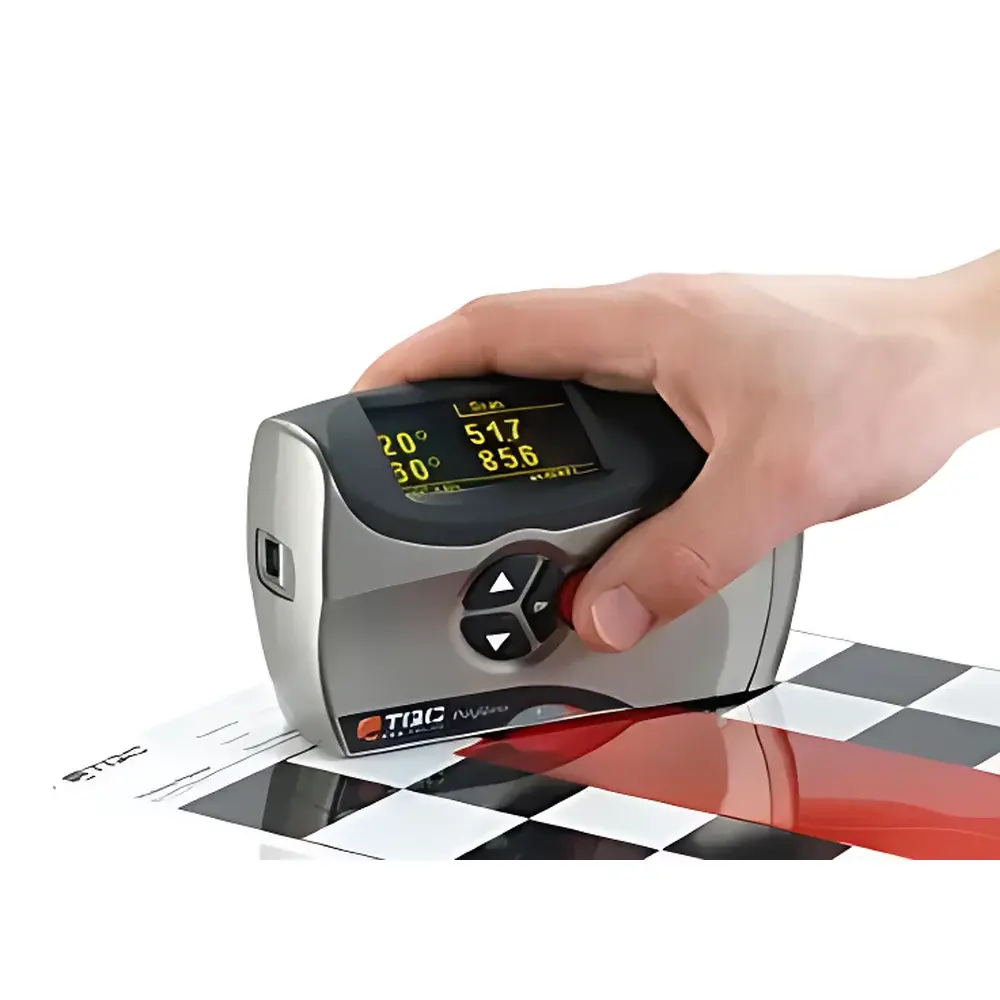
TQC GL0030 Tri-Angle Gloss Meter
| Brand | TQC |
|---|---|
| Origin | Netherlands |
| Model | GL0030 |
| Measurement Angles | 20°, 60°, 85° |
| Gloss Range | 0–2000 GU (all angles) |
| Repeatability | 0.4 GU (20°), 0.2 GU (60°), 0.2 GU (85°) |
| Reproducibility | 1.69 GU (20°), 1.58 GU (60°), 1.88 GU (85°) |
| Accuracy Deviation | 1.2 GU (20°), 0.6 GU (60°), 1.6 GU (85°) |
| Display | OLED with high contrast & wide viewing angle |
| Interface | USB port for calibration and data transfer |
| Operating Temperature | 10–40 °C |
| Storage Humidity | <80% RH non-condensing |
| Calibration Interval | Recommended annually |
| Compliance | ISO 2813, ASTM D523, DIN 67530, JIS Z8741 |
Overview
The TQC GL0030 Tri-Angle Gloss Meter is a precision optical instrument engineered for objective, traceable gloss assessment across industrial quality control and R&D environments. Based on the principle of specular reflectance measurement—defined as the ratio of reflected luminous flux at the specular angle to that of a reference black glass standard—the GL0030 complies with internationally recognized standards including ISO 2813, ASTM D523, DIN 67530, and JIS Z8741. Unlike visual evaluation, which introduces subjectivity due to observer variability (e.g., age-related contrast sensitivity, ambient lighting, or chromatic adaptation), this instrument delivers quantitative, operator-independent results. Its triple-angle configuration (20°, 60°, and 85°) enables comprehensive characterization of surface optical behavior: 20° for high-gloss finishes (e.g., automotive clear coats), 60° as the universal reference angle for mid-gloss materials (e.g., architectural paints and molded plastics), and 85° optimized for low-gloss or matte surfaces (e.g., paper, textured coatings, and matte-finish composites) where diffuse reflectance dominates.
Key Features
- Triple-angle measurement capability (20°, 60°, 85°) with independent calibration and repeatability verification per angle
- OLED display offering high contrast, wide viewing angles, and consistent legibility under variable lab or production-floor lighting
- Ergonomic housing designed for ambidextrous operation, minimizing operator fatigue during high-throughput testing
- Integrated USB interface supporting user-initiated calibration routines, firmware updates, and raw data export in CSV format
- Robust mechanical architecture with scratch-resistant optical window and IP54-rated enclosure for resistance to dust and incidental splashes
- On-device menu navigation with intuitive icon-based prompts—no specialized training required for routine operation
Sample Compatibility & Compliance
The GL0030 accommodates flat, curved, and slightly textured substrates up to 10 mm in thickness, provided the measurement area exceeds 12 mm × 12 mm. It is routinely deployed for QC of coated metals, laminated films, printed packaging, wood veneers, ceramic glazes, and polymer injection-molded parts. All measurements adhere to ISO/IEC 17025 traceability requirements when used with NIST-traceable calibration standards. The instrument supports GLP-compliant workflows through timestamped measurement logging and optional audit trail extension via TQC’s optional software suite. While not FDA 21 CFR Part 11 certified out-of-the-box, its data export functionality enables integration into validated LIMS or ELN platforms meeting pharmaceutical or medical device regulatory requirements.
Software & Data Management
The GL0030 operates autonomously but interfaces seamlessly with TQC’s free PC-based software (compatible with Windows 10/11). This application enables batch reporting, statistical process control (SPC) charting (X̄-R, Cpk), pass/fail threshold configuration per angle, and comparative analysis across material lots or production shifts. Measurement records include date/time stamp, operator ID (manually entered), angle selection, measured value (GU), and instrument serial number—supporting full data lineage for internal audits or customer-facing documentation. Export formats include CSV, PDF reports with embedded instrument metadata, and XML for ERP system ingestion.
Applications
- Automotive OEMs: Monitoring gloss consistency of basecoat/clearcoat systems across body panels
- Coatings manufacturers: Validating batch-to-batch reproducibility of solvent-borne and waterborne formulations
- Packaging converters: Verifying gloss uniformity on metallized PET films and UV-cured offset prints
- Printing industry: Quantifying varnish gloss retention after folding or creasing operations
- Academic research: Correlating surface topography (via AFM or profilometry) with macroscopic gloss response
- Building materials labs: Assessing weathering-induced gloss loss in exterior façade coatings per ISO 11341
FAQ
What calibration standards are required for daily verification?
Users must employ certified black glass standards traceable to NIST or PTB, with assigned gloss values at each operational angle (20°, 60°, 85°). A two-point verification (low- and high-range standards) is recommended before each shift.
Can the GL0030 measure curved surfaces?
Yes—within limits. The instrument’s aperture design accommodates convex surfaces with radii ≥50 mm. Concave surfaces require flat-sample adapters or alternative instrumentation.
Is temperature compensation built into the firmware?
No. The GL0030 specifies an operating range of 10–40 °C. Measurements outside this range may exhibit thermal drift; users must acclimate both instrument and sample for ≥30 minutes prior to testing.
How often should factory recalibration be performed?
TQC recommends annual recalibration by an accredited service center. In-house verification using reference standards should occur daily or per shift in regulated environments.
Does the USB interface support real-time data streaming to SCADA systems?
No—USB mode operates in command-response protocol only. For continuous integration, users must implement polling via the provided SDK (C/C++, .NET compatible) or use the software’s scheduled export function.





